Question
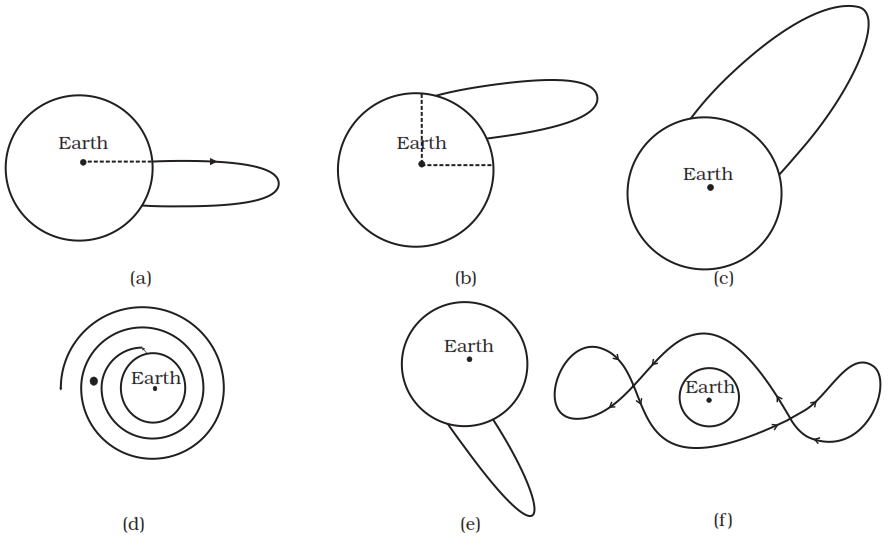
Shown are several curves. Explain with reason, which ones amongst them can be possible trajectories traced by a projectile (neglect air friction).
Answer

The trajectory of a projectile under gravitational force of earth is a conic section or parabolic or elliptical or its part whose focus must be the centre of the earth. Only (c) option amongst the given curves show the centre of the earth as the focus of trajectory.

Need a full question paper?

Generate a complete, print-ready paper with questions like this in minutes — across 16+ boards, with answer keys.
Start Generating Free

Similar questions

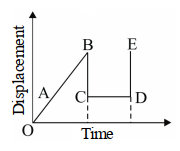
The figure show the displacement-time graph for an imaginary one-dimensional motion. Explain why this type of motion is not possible?
Image
How does tea in a thermo flask remain hot for a long time?
Prove that in projectile motion, when bodies are projected at angle $\left(45^{\circ}+\phi\right)$ and $\left(45^{\circ}-\phi\right)$ from the horizontal, their horizontal range will be same.
A conducting disc of radius r rotates with a small but constant angular velocity $\omega$ about its axis. A uniform magnetic field B exists parallel to the axis of rotation. Find the motional emf between the centre and the periphery of the disc.
The friction force of air on an object moving in air is directly proportional to the velocity of the object, what will be the dimension of constant of proportionality (b)?
If the resultant torque of all the forces acting on a body is zero about a point, is it necessary that it will be zero about any other point?
Check the correctness of the relation $\text{v}^2-\text{u}^2=2\text{as}$ by method of dimensions. The symbol have their usual meaning.
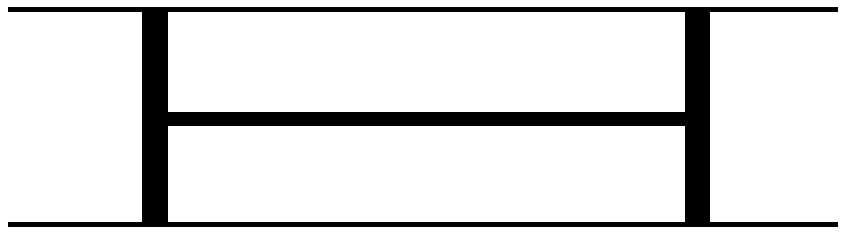
Figure. shows a cylindrical tube of cross-sectional area A fitted with two frictionless pistons. The pistons are connected to each other by a metallic wire. Initially, the temperature of the gas is $T_0$ and its pressure is P, which equals the atmospheric pressure. (a) What is the tension in the wire? (b) What will be the tension if the temperature is increased to $2T_0​​​​​​​$​​​​​​​?
A particle moves from a point $\vec{\text{r}}_1=(2\text{m})\vec{\text{i}}+(3\text{m})\vec{\text{j}}$ to another point $\vec{\text{r}}_2=(3\text{m})\vec{\text{i}}+(2\text{m})\vec{\text{j}}$ during which a certain force $\vec{\text{F}}=(5\text{N})\vec{\text{i}}+(5\text{N})\vec{\text{j}}$ acts on it. Find the work done by the force on the particle during the displacement.
Show that the slope of p-V diagram is greater for an adiabatic process as compared to an isothermal process.