Question
Simplify:$\frac{4+\sqrt{5}}{4-\sqrt{5}}+\frac{4-\sqrt{5}}{4+\sqrt{5}}$

Answer

For rationalising the denominator of a number, we multilply its numerator and denominator by its rationalising factor. If a and b are integers, then $\big(\text{a}+\sqrt{\text{b}}\big)$ and $\big(\text{a}-\sqrt{\text{b}}\big)$ are rationalising factor of each other, as $\big(\text{a}+\sqrt{\text{b}}\big)\big(\text{a}-\sqrt{\text{b}}\big)=\big(\text{a}^2-\text{b}\big),$ which is rational. Let us rationalise the denominator of the first term on the left hand side. We have,$\frac{4+\sqrt{5}}{4-\sqrt{5}}=\frac{4+\sqrt{5}}{4-\sqrt{5}}\times\frac{4+\sqrt{5}}{4+\sqrt{5}}$
$=\frac{\big(4+\sqrt{5}\big)^2}{(4)^2-\big(\sqrt{5}\big)^2}$
$=\frac{(4)^2+2(4)\big(\sqrt{5}\big)+\big(\sqrt{5}\big)^2}{16-5}$
$\frac{4+\sqrt{5}}{4-\sqrt{5}}=\frac{16+8\sqrt{5}+5}{11}=\frac{21+8\sqrt{5}}{11} \ ...(1)$
Now consider the denominator of the second term on the left hand side:$\frac{4-\sqrt{5}}{4+\sqrt{5}}=\frac{4-\sqrt{5}}{4+\sqrt{5}}\times\frac{4-\sqrt{5}}{4-\sqrt{5}}$
$=\frac{\big(4-\sqrt{5}\big)^2}{(4)^2-\big(\sqrt{5}\big)^2}$
$=\frac{(4)^2-2(4)\big(\sqrt{5}\big)+\big(\sqrt{5}\big)^2}{16-5}$
$\frac{4-\sqrt{5}}{4+\sqrt{5}}=\frac{16-8\sqrt{5}+5}{11}=\frac{21-8\sqrt{5}}{11} \ ...(2)$
Adding equations (1) and (2), we have,$\therefore \ \frac{4+\sqrt{5}}{4-\sqrt{5}}+\frac{4-\sqrt{5}}{4+\sqrt{5}}=\frac{21+8\sqrt{5}}{11}=\frac{21-8\sqrt{5}}{11}$
$=\frac{21+8\sqrt{5}+21-8\sqrt{5}}{11}=\frac{42}{11}$

Need a full question paper?

Generate a complete, print-ready paper with questions like this in minutes — across 16+ boards, with answer keys.
Start Generating Free

Similar questions

In a $\triangle\text{ABC},$ BM and CN are perpendiculars from B and C respectively on any line passing through A. If L is the mid-point of BC, prove that ML = NL.
Draw the graph of the following linear equations in two variables:
y = 2x
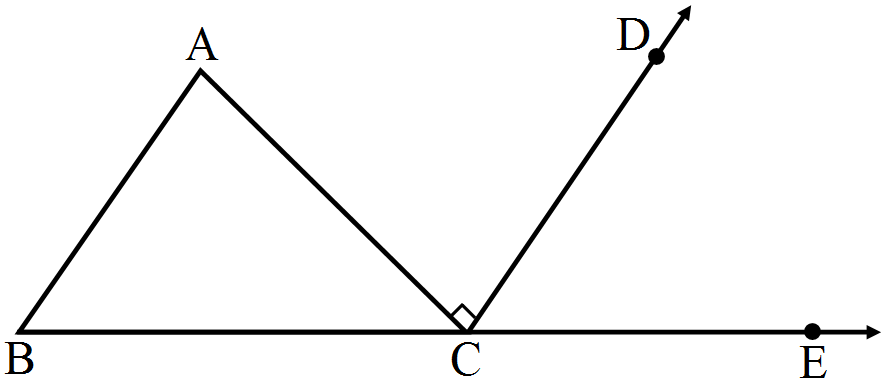
In a $\triangle\text{ABC},$ it is given that $\angle\text{A}:\angle\text{B}:\angle\text{C}=3:2:1$ and $\text{CD}\perp\text{AC}.$ Find $\angle\text{ECD}.$
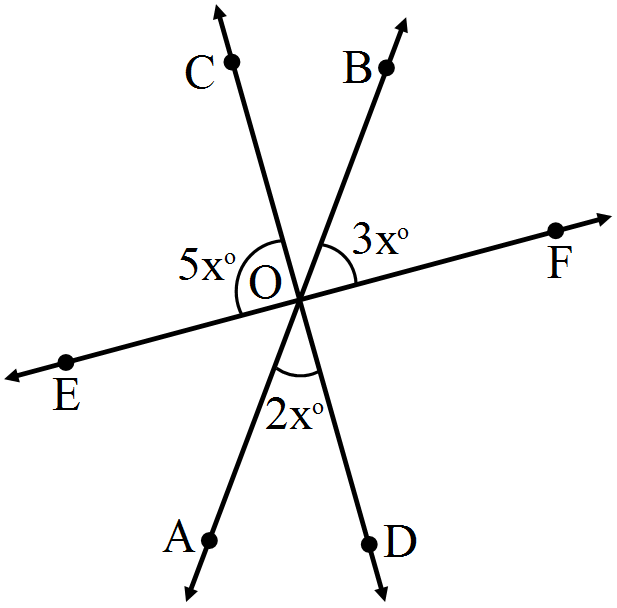
In the adjoining figure, three coplanar lines AB, CD and EF intersect at a point O. Find the value of x. Also, find $\angle\text{AOD},\angle\text{COE}$ and $\angle\text{AOE}.$
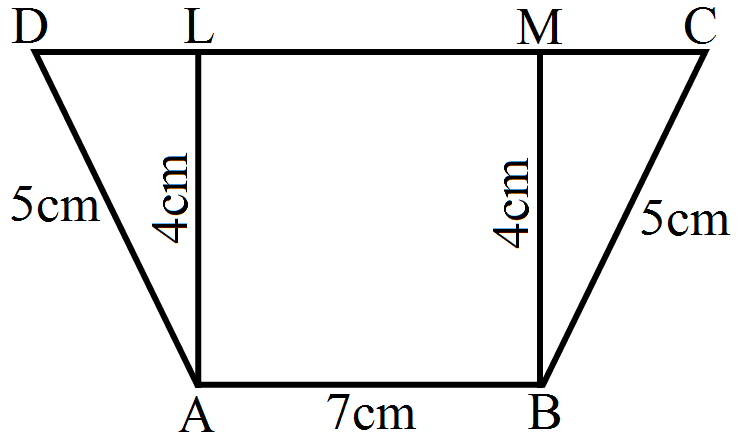
In the adjoining figure, ABCD is a trapezium in which AB || DC; AB = 7cm; AD = BC = 5cm and the distance between AB and DC is 4cm. Find the length of DC and hence, find the area of trap. ABCD.
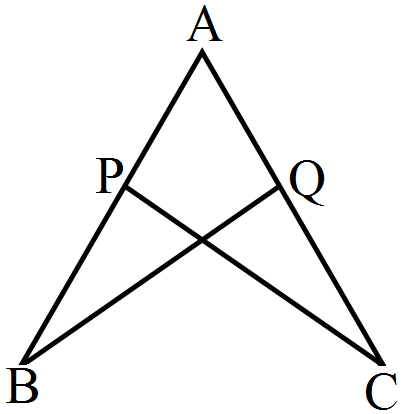
In the given figure, if $\text{AB}=\text{AC}$ and $\angle\text{B}=\angle\text{C}.$ Prove that $\text{PQ}=\text{CP}.$
In the following, using the remainder theorem, find the remainder when $f(x)$ is divided by $g(x)$ and verify the by actual division:
$f(x) = x^3 + 4x^2 - 3x + 10, g(x) = x + 4$
P is a point on the bisector of $\angle\text{ABC}.$ If the line through P, parallel to BA meets BC at Q, prove that $\triangle\text{BPQ}$ is an isosceles triangle.
Three coins are tossed simultaneously 200 times with the following frequencies of different outcomes:
Outcome
3 heads
2 heads
1 head
No head
Frequency
23
72
77
28
Find the probability of getting at most two heads.
Plot the following points on the graph paper:(7, 0)