Two capacitor having capacitances $8\ \mu F$ and $16\ \mu F$ have breaking voltages $20\ V$ and $80\ V$. They are combined in series. The maximum charge they can store individually in the combination is...... $\mu C$
Advanced
Download our app for free and get started
$C_{e q}=\left(\frac{1}{8}+\frac{1}{16}\right)^{-1}=\frac{16}{3} \mu C$
then let $v_{\max }=$ the $\max$
voltage across the capacitors
So charge $=\mathrm{Q}=\mathrm{Cv}_{\max }=\frac{16}{3} \times \mathrm{v}_{\max }$
Now ${v_{1}}=\frac{16}{3} \times v_{\max } \times \frac{1}{16}\left[\left(\frac{Q}{C}\right)\right]$
$=\frac{v_{\max }}{3}<80 \Rightarrow v_{\max }<240 \mathrm{V}$
and $v_{2}=\frac{16}{3} \times v_{\max } \times \frac{1}{8}$
$=\frac{2}{3} v_{\max }<20 \Rightarrow v_{\max }<30 v$
so $v_{\max }=30 \mathrm{V}$
Thus $Q=\frac{16 \times 30}{3}=160 \mu C$

Download our appand get started for free
Experience the future of education. Simply download our apps or reach out to us for more information. Let's shape the future of learning together!No signup needed.*
Similar Questions
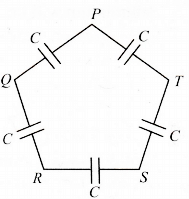
- 1Five capacitors, each of capacitance value $C$ are connected as shown in the figure. The ratio of capacitance between $P$ and $R$, and the capacitance between $P$ and $Q$, isView Solution
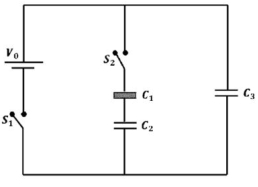
- 2. Three identical capacitors $C _1, C _2$ and $C _3$ have a capacitance of $1.0 \mu F$ each and they are uncharged initially. They are connected in a circuit as shown in the figure and $C _1$ is then filled completely with a dielectric material of relative permittivity $\varepsilon_{ r }$. The cell electromotive force (emf) $V_0=8 V$. First the switch $S_1$ is closed while the switch $S_2$ is kept open. When the capacitor $C_3$ is fully charged, $S_1$ is opened and $S_2$ is closed simultaneously. When all the capacitors reach equilibrium, the charge on $C _3$ is found to be $5 \mu C$. The value of $\varepsilon_{ r }=$. . . . .View Solution
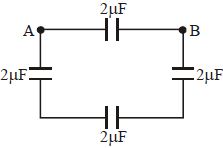
- 3The equivalent capacitance between the points $A$ and $B$ in the given diagram isView Solution
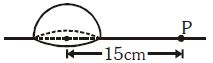
- 4Figure shows a solid hemisphere with a charge of $5\ nC$ distributed uniformly through its volume. The hemisphere lies on a plane and point $P$ is located on this plane, along a radial line from the centre of curvature at distance $15\ cm$. The electric potential at point $P$ due to the hemisphere, is .....$V$View Solution
- 5Two identical metal balls of radius $r$ are at a distance $a (a >> r)$ from each other and are charged, one with potential $V_1$ and other with potential $V_2$. The charges $q_1$ and $q_2$ on these balls in $CGS$ esu areView Solution
- 6On moving a charge of $20$ coulombs by $2 \;cm , 2 \;J$ of work is done, then the potential difference between the points is (in $volt$)View Solution
- 7Potential at a point $x$-distance from the centre inside the conducting sphere of radius $R$ and charged with charge $Q$ isView Solution
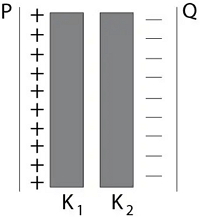
- 8Two thin dielectric slabs of dielectric constants $K_1$ and $K_2$ $(K_1 < K_2)$ are inserted between plates of a parallel plate capacitor, as shown in the figure. The variation of electric field $E$ between the plates with distance $d$ as measured from plate $P$ is correctly shown byView Solution
- 9Two thin wire rings each having a radius $R$ are placed at a distance $d$ apart with their axes coinciding. The charges on the two rings are $ + q$ and $ - q$. The potential difference between the centres of the two rings isView Solution
- 10View SolutionPutting a dielectric substance between two plates of condenser, capacity, potential and potential energy respectively