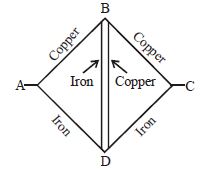
Six wire each of cross-sectional area $A$ and length $l$ are combined as shown in the figure. The thermal conductivities of copper and iron are $K_1$ and $K_2$ respectively. The equivalent thermal resistance between points $A$ and $C$ is :-
Medium
Download our app for free and get started
Let $R_{1}$ and $R_{2}$ be the thermal resistance of copper and iron wires. Then
$\mathrm{R}_{1}=\frac{l}{\mathrm{K}_{1} \mathrm{A}}$ and $\mathrm{R}_{2}=\frac{l}{\mathrm{K}_{2} \mathrm{A}}$
According to the principle of Wheat stone's bridge, the point $\mathrm{B}$ and $\mathrm{D}$ must be at same temperature when the bridge is balanced. Therefore, thermal resistance of arm $BD$ becomes ineffective. Now the equivalent circuit at balance is
The effective resistance between $A$ and $C$ is
$\mathrm{R}=\frac{\left(2 \mathrm{R}_{1}\right)\left(2 \mathrm{R}_{2}\right)}{2 \mathrm{R}_{1}+2 \mathrm{R}_{2}}$
$=\frac{2 \mathrm{R}_{1} \mathrm{R}_{2}}{\mathrm{R}_{1}+\mathrm{R}_{2}}$
$\mathrm{R}=\frac{2 \frac{l}{\mathrm{K}_{1} \mathrm{A}} \cdot \frac{l}{\mathrm{K}_{2} \mathrm{A}}}{\frac{l}{\mathrm{K}_{1} \mathrm{A}}+\frac{l}{\mathrm{K}_{2} \mathrm{A}}}=\frac{2 l}{\left(\mathrm{K}_{1}+\mathrm{K}_{2}\right) \mathrm{A}}$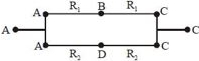

Download our appand get started for free
Experience the future of education. Simply download our apps or reach out to us for more information. Let's shape the future of learning together!No signup needed.*
Similar Questions
- 1A cylindrical metallic rod in thermal contact with two reservoirs of heat at its two ends conducts an amount of heat $Q$ in time $t$. The metallic rod is melted and the material is formed into a rod of half the radius of the original rod. What is the amount of heat conducted by the new rod, when placed in thermal contact with the two reservoirs in time $t$ ?View Solution
- 2A hot black body emits the energy at the rate of $16\ J\ m^{-2}\ s^{-1}$ and its most intense radiation corresponds to $20,000\ Å$ . When the temperature of this body is further increased and its most intense radiation corresponds to $10,000\ Å$ , then the energy radiated in $Jm^{-2}\ s^{-1}$ will beView Solution
- 3In a steady state of thermal conduction, temperature of the ends $A$ and $B$ of a $20\, cm$ long rod are ${100^o}C$ and ${0^o}C$ respectively. What will be the temperature of the rod at a point at a distance of $6$ cm from the end $A$ of the rod....... $^oC$View Solution
- 4The maximum wavelength of radiations emitted at $900\,K$ is $4\mu m$. What will be the maximum wavelength of radiations emitted at $1200 \,K$ ......... $\mu m$View Solution
- 5A cylindrical rod having temperature ${T_1}$ and ${T_2}$ at its ends. The rate of flow of heat is ${Q_1}$ $cal/sec$. If all the linear dimensions are doubled keeping temperature constant then rate of flow of heat ${Q_2}$ will beView Solution
- 6A hot body, obeying Newton's law of cooling is cooling down from its peak value $80\,^oC$ to an ambient temperature of $30\,^oC$ . It takes $5\, minutes$ in cooling down from $80\,^oC$ to $40\,^oC$. ........ $\min.$ will it take to cool down from $62\,^oC$ to $32\,^oC$ ? (Given $ln\, 2\, = 0.693, ln\, 5\, = 1.609$)View Solution
- 7View SolutionWhen two ends of a rod wrapped with cotton are maintained at different temperatures and after some time every point of the rod attains a constant temperature, then
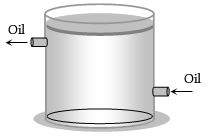
- 8The top of insulated cylindrical container is covered by a disc having emissivity $0.6$ and thickness $1\, cm$. The temperature is maintained by circulating oil as shown in figure. If temperature of upper surface of disc is $127^o C$ and temperature of surrounding is $27^o C$, then the radiation loss to the surroundings will be (Take $\sigma = \frac{{17}}{3} \times {10^{ - 8}}W/{m^2}{K^4})$View Solution
- 9Two spherical black bodies of radii ${r_1}$ and ${r_2}$ and with surface temperature ${T_1}$and ${T_2}$ respectively radiate the same power. Then the ratio of ${r_1}$ and ${r_2}$ will beView Solution
- 10A solid cylinder of length $L$ and radius $r$ is heat upto same temperature as that of a cube of edge length $a$. If both have same material, volume and allowed to cool under similar conditions, then ratio of amount of radiations radiated will be (Neglect radiation emitted from flat surfaces of the cylinder)View Solution