Sixty four conducting drops each of radius $0.02 m$ and each carrying a charge of $5 \,\mu C$ are combined to form a bigger drop. The ratio of surface density of bigger drop to the smaller drop will be ............
JEE MAIN 2022, Medium
Download our app for free and get started
Let $R=$ radius of combined drop
$r=$ radius of smaller drop
Volume will remain same
$\frac{4}{3} \pi R ^{3}=64 \times \frac{4}{3} \pi r ^{3}$
$R =4 r$
$Q =64 q ;$
$q$ : charge of smaller drop
$Q$ : Charge of combined drop
$\frac{\sigma_{\text {bigger }}}{\sigma_{\text {smaller }}}=\frac{\frac{ Q }{4 \pi R ^{2}}}{\frac{ q }{4 \pi r ^{2}}}=\frac{ Q }{ q } \cdot \frac{ r ^{2}}{ R ^{2}}$
$=64 \frac{ r ^{2}}{16 r ^{2}}=4$
$\frac{\sigma_{\text {bigger }}}{\sigma_{\text {smaller }}}=\frac{4}{1}$

Download our appand get started for free
Experience the future of education. Simply download our apps or reach out to us for more information. Let's shape the future of learning together!No signup needed.*
Similar Questions
- 1A proton and an anti-proton come close to each other in vacuum such that the distance between them is $10 \,cm$. Consider the potential energy to be zero at infinity. The velocity at this distance will be ........... $\,m / s$View Solution
- 2A conducting body $1$ has some initial charge $Q$, and its capacitance is $C$. There are two other conducting bodies, $2$ and $3$, having capacitances : $C_2 = 2C$ and $C_3 \rightarrow \infty$ . Bodies $2 $ and $3 $ are initially uncharged. "Body $2$ is touched with body $1$. Then, body $2$ is removed from body $1 $ and touched with body $3$, and then removed." This process is repeated $N$ times. Then, the charge on body $1$ at the end must beView Solution
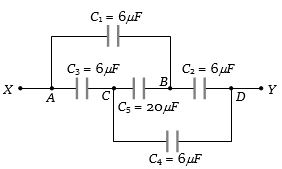
- 3What is the effective capacitance between points $X$ and $Y$.......$\mu F$View Solution
- 4A charge $+q$ is fixed at each of the points $x = x_0,\,x = 3x_0,\,x = 5x_0$, .... upto $\infty $ on $X-$ axis and charge $-q$ is fixed on each of the points $x = 2x_0,\,x = 4x_0,\,x = 6x_0$, .... upto $\infty $ . Here $x_0$ is a positive constant. Take the potential at a point due to a charge $Q$ at a distance $r$ from it to be $\frac{Q}{{4\pi {\varepsilon _0}r}}$. Then the potential at the origin due to above system of charges will beView Solution
- 5A capacitor $C$ is charged to a potential difference $V$ and battery is disconnected. Now if the capacitor plates are brought close slowly by some distance :View Solution
- 6View SolutionA parallel plate capacitor is first charged and then a dielectric slab is introduced between the plates. The quantity that remains unchanged is
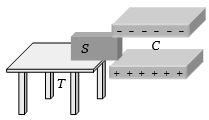
- 7A frictionless dielectric plate $S$ is kept on a frictionless table $T$. A charged parallel plate capacitance $C$ (of which the plates are frictionless) is kept near it. The plate $S$ is between the plates. When the plate $S$ is left between the platesView Solution
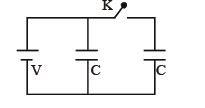
- 8Consider the arrangement shown in figure. The total energy stored is $U_1$ when key is closed. Now the key $K$ is made off (opened) and two dielectric slabs of relative permittivity ${ \in _r}$ are introduced between the plates of the two capacitors. The slab tightly fit in between the plates. The total energy stored is now $U_2$. Then the ratio of $U_1/U_2$ isView Solution
- 9The radii of the inner and outer spheres of a condenser are $9\,cm$ and $10\,cm$ respectively. If the dielectric constant of the medium between the two spheres is $6$ and charge on the inner sphere is $18 \times {10^{ - 9}}\;coulomb$, then the potential of inner sphere will be, if the outer sphere is earthed........$volts$View Solution
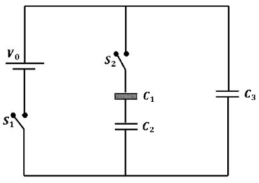
- 10Three identical capacitors $\mathrm{C}_1, \mathrm{C}_2$ and $\mathrm{C}_3$ have a capacitance of $1.0 \mu \mathrm{F}$ each and they are uncharged initially. They are connected in a circuit as shown in the figure and $\mathrm{C}_1$ is then filled completely with a dielectric material of relative permittivity $\varepsilon_{\mathrm{r}}$. The cell electromotive force (emf) $V_0=8 \mathrm{~V}$. First the switch $S_1$ is closed while the switch $S_2$ is kept open. When the capacitor $C_3$ is fully charged, $S_1$ is opened and $S_2$ is closed simultaneously. When all the capacitors reach equilibrium, the charge on $\mathrm{C}_3$ is found to be $5 \mu \mathrm{C}$. The value of $\varepsilon_{\mathrm{r}}=$. . . .View Solution
(image)