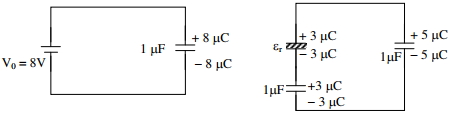
Three identical capacitors $\mathrm{C}_1, \mathrm{C}_2$ and $\mathrm{C}_3$ have a capacitance of $1.0 \mu \mathrm{F}$ each and they are uncharged initially. They are connected in a circuit as shown in the figure and $\mathrm{C}_1$ is then filled completely with a dielectric material of relative permittivity $\varepsilon_{\mathrm{r}}$. The cell electromotive force (emf) $V_0=8 \mathrm{~V}$. First the switch $S_1$ is closed while the switch $S_2$ is kept open. When the capacitor $C_3$ is fully charged, $S_1$ is opened and $S_2$ is closed simultaneously. When all the capacitors reach equilibrium, the charge on $\mathrm{C}_3$ is found to be $5 \mu \mathrm{C}$. The value of $\varepsilon_{\mathrm{r}}=$. . . .
(image)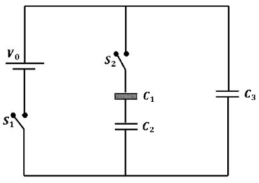
IIT 2018, Medium


Download our appand get started for free
Experience the future of education. Simply download our apps or reach out to us for more information. Let's shape the future of learning together!No signup needed.*
Similar Questions
- 1From a supply of identical capacitors rated $8\ \mu F$, $250\ V$, the minimum number of capacitors required to form a composite $16$ $\mu F$, $1000$ $V$ is :View Solution
- 2A capacitor of capacitance $C$ is charged to potential difference $V_0$. Now this capacitor is connected to an ideal inductor. When $25\%$ of energy of capacitor is transferred to inductor then at that time what will be potential difference across capacitorView Solution
- 3If electric potential of the inner sphere is $10\, volt$ and that of the outer shell is $50\, volt$ then potential at common centre is :-......$V$View Solution
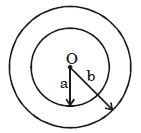
- 4A hollow metal sphere of radius $5\,\, cm$ is charged so that the potential on its surface is $10\,\, V$. The potential at the centre of the sphere is.....$V$View Solution
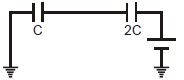
- 5In the circuit shown in figure battery is $10 \ V$ and $C = 6\,\mu F$ . The charge stored in capacitor of capacity $C$ is......$\mu C$View Solution
- 6Assertion : If the distance between parallel plates of a capacitor is halved and dielectric constant is three times, then the capacitance becomes $6\,times$.View Solution
Reason : Capacity of the capacitor does not depend upon the nature of the material.
- 7There is a uniform spherically symmetric surface charge density at a distance $R_0$ from the origin. The charge distribution is initially at rest and starts expanding because of mutual repulsion. The figure that represents best the speed $V(R(t))$ of the distribution as a function of its instantaneous radius $R(t)$ isView Solution
- 8Two charge $ + \,q$ and $ - \,q$ are situated at a certain distance. At the point exactly midway between themView Solution
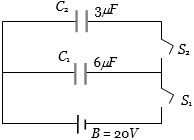
- 9In the circuit shown here ${C_1} = 6\,\mu F,\;{C_2} = 3\,\mu F$ and battery $B = 20\,V$. The switch ${S_1}$ is first closed. It is then opened and afterwards ${S_2}$ is closed. What is the charge finally on ${C_2}$.......$\mu C$View Solution
- 10View SolutionIf eight identical drops are joined to form a bigger drop, the potential on bigger as compared to that on smaller drop will be