Question
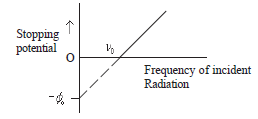
Sketch a graph between frequency of incident radiations and stopping potential for a given photosensitive material. What information can be obtained from the value of the intercept on the potential axis? A source of light of frequency greater than the threshold frequency is placed at a distance of 1 m from the cathode of a photo-cell. The stopping potential is found to be V. If the distance of the light source from the cathode is reduced, explain giving reasons, what change will you observe in the.
  1. photoelectric current,
  2. stopping potential.

Answer


Work function or

  1. Photoelectric current increases, due to increase of intensity.
  2. o change, as stopping Potential is independent of intensity.

Need a full question paper?

Generate a complete, print-ready paper with questions like this in minutes — across 16+ boards, with answer keys.

Start Generating Free

Similar questions

Electromotive forces of two cells are $E_1$ and $E _2$ and their internal resistances are $r_1$ and $r_2$. Find equivalent electromotive force and equivalent internal resistance on joining them in series.
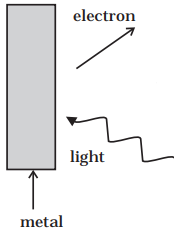
Consider Fig. for photoemission.
How would you reconcile with momentum-conservation? Note light (photons) have momentum in a different direction than the emitted electrons.

(a) A closed loop is held stationary in the magnetic field between the north and south poles of two permanent magnets held fixed. Can we hope to generate current in the loop by using very strong magnets?
(b) A closed loop moves normal to the constant electric field between the plates of a large capacitor. Is a current induced in the loop (i) when it is wholly inside the region between the capacitor plates (ii) when it is partially outside the plates of the capacitor? The electric field is normal to the plane of the loop.
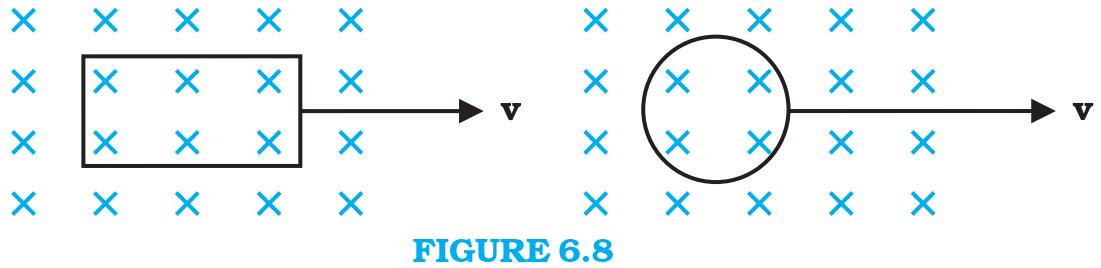
(c) A rectangular loop and a circular loop are moving out of a uniform magnetic field region (Fig. 6.8) to a field-free region with a constant velocity $v$. In which loop do you expect the induced emf to be constant during the passage out of the field region? The field is normal to the loops.
Image
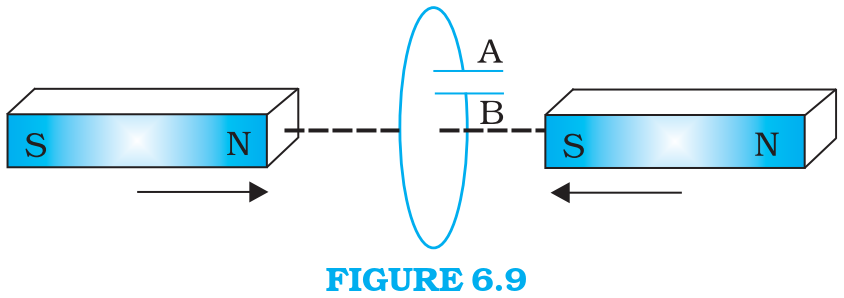
(d) Predict the polarity of the capacitor in the situation described by Fig. 6.9.

Image
The heat current is written as $\frac{\triangle\text{Q}}{\triangle\text{t}}.$ Why don't we write $\frac{\text{dQ}}{\text{dt}}?$
Write Gauss's law and explain.
An object P is focused by a microscope M. A glass slab of thickness 2.1cm is introduced between P and M. If the refractive index of the slab is 1.5, by what distance should the microscope be shifted to focus the object again?
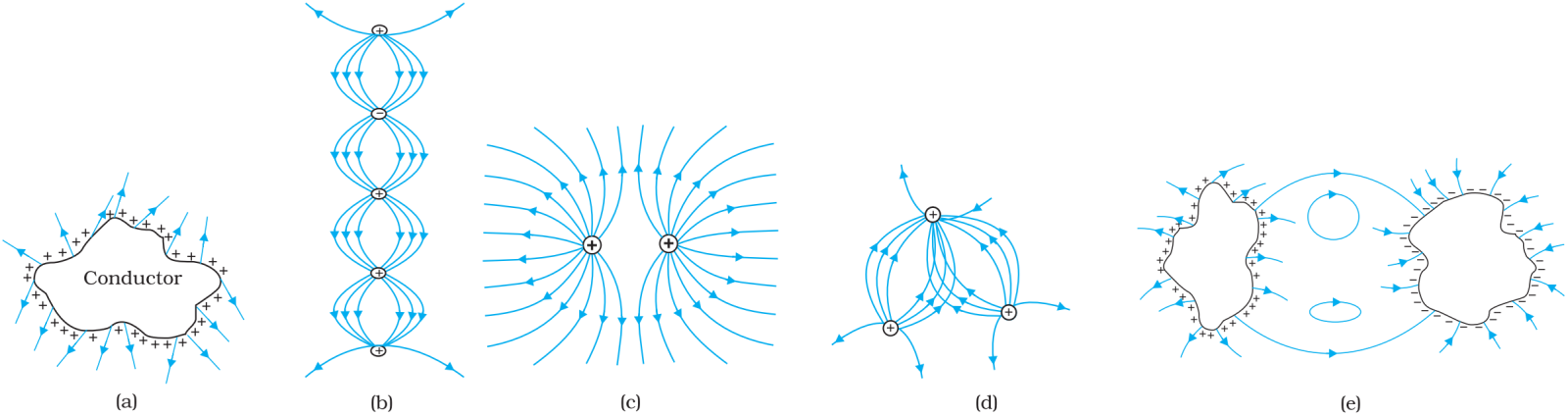
Which among the curves shown in figure cannot possibly represent electrostatic field lines?

Find the ratio of the lengths of an iron rod and an aluminium rod for which the difference in the lengths is independent of temperature. Coefficients of linear expansion of iron and aluminium are 12 × 10-6 °C-1 and 23 × 10-6 °C-1 respectively.
What conclusion can you draw about displacement current and conduction current?
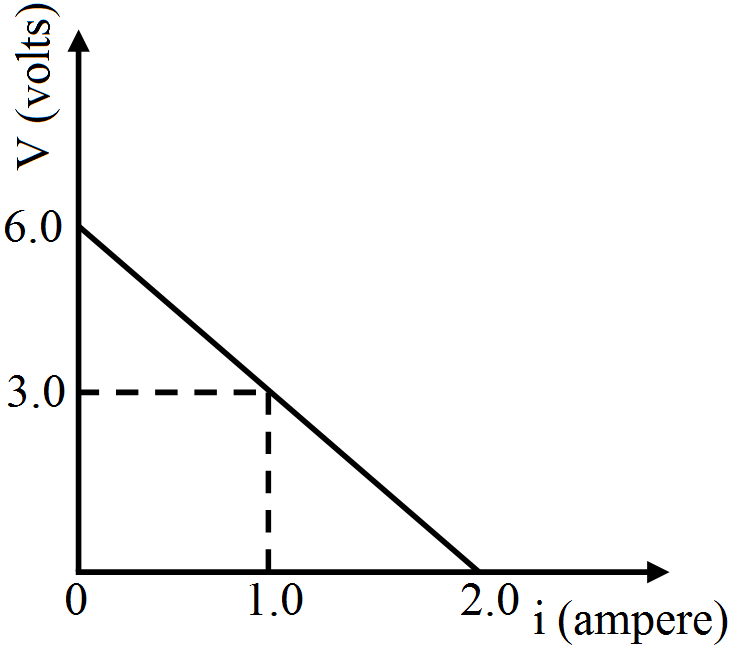
The graph shown here shows the variation of terminal potential difference V, across a combination of three cells in series to a resistor, versus current i:

  1. Calculate the emf of each cell.
  2. For what current i, will the power dissipation of the circuit be maximum?