Question
Sketch, label and classify the following organisms: Leench.
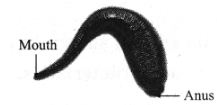
Answer


Image
Classification:
Kingdom: Animalia
Division: Non-chordata
Phylum: Annelida
Example: Leech

Need a full question paper?

Generate a complete, print-ready paper with questions like this in minutes — across 16+ boards, with answer keys.
Start Generating Free

Similar questions

Can the following groups of elements be classified as Dobereiner's triads?
  1. Na, Si, Cl.
  2. Be, Mg, Ca.
Give reason for your answer.

(Atomic masses: Be 9; Na 23; Mg 24; Si 28; Cl 35. 5; Ca 40)
Draw schematic of power plant based on natural gas and answer the following questions:
i. At which place natural gas power plant is situated in Maharashtra?
ii. How is pollution reduced in natural gas based power plant?
iii. Give two examples of eco-friendly electricity process.
An element X belongs to group 2 and another element Y belongs to group 15 of the periodic table:
  1. What is the number of valence electrons in X?
  2. What is the valency of X?
  3. What is the number of valence electrons in Y?
  4. What is the valency of Y? Explain how you have arrived at your answers.
The sea water contains water beetles, tadpole, fish and weeds.
  1. Write a food chain comprising all the given organisms?
  2. Which organisms in the food chain are (i) herbivore, and (ii) carnivores?
  3. Which organisms are (i) predators, and (ii) prey?
  4. Which organisms can trap solar energy to make food?
  5. Which organism is a secondary consumer?
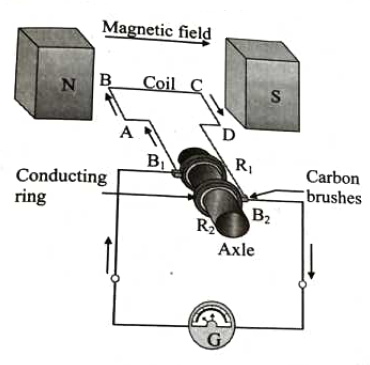
Observe the following diagram and write the answers of the given sub-questions:
Image

i. Which instrument the above figure shows?
ii. Which rule is used to determine the direction of the current produced?
iii. State the rule.
iv. In which direction ( $B_1$ to $B_2$ or $B_2$ to $B_1$ ) will the current flow in the external circuit in that situation?
v. What change will have to be made in the coil for increasing the current several times without changing the magnet?
The human body contains a large number of cells A which are very long and branched, and look like electric wires. The longest branch of this cell is B whereas there are many small branches C. Any two A cells do not join to one another completely in the human body. There is a microscopic gap D between every pair of adjacent A cells through which electric impulses can pass by the release of a chemical substance.
  1. What are cells A?
  2. What is the name of (i) branch B, and (ii) branches C?
  3. What is the microscopic gap D known as?
  4. What is the function of cells like A in the human body?
  5. The cells A are of three types. name the three types.
Explain structure of modern periodic table in short.
An organic compound $A ($molecular formula $C_2H_4O_2)$ reacts with Na metal to form a compound $B$ and evolves a gas which burns with a pop sound. Compound $A$ on treatment with an alcohol $C$ in the presence of a little of concentrated sulphuric acid forms a sweet-smelling compound $D ($molecular formula $C_3H_6O_2)$. Compound $D$ on treatment with NaOH solution gives back $B$ and $C.$ Identify $A, B, C$ and $D.$
Read the following paragraph and answer the questions:
If heat is exchanged between a hot and cold object, the temperature of the cold object goes on increasing due to gain of energy and the temperature of the hot object goes on decreasing due to loss of energy.

The change in temperature continues till the temperatures of both the objects attain the same value. In this process, the cold object gains heat energy and the hot object loses’ heat energy. If the system of both the objects is isolated from the environment by keeping it inside a heat resistant box (meaning that the energy exchange takes place between the two objects only), then no energy can flow from inside the box or come into the box.
(1) Heat is transferred from where to where?
(2) Which principle do we learn about from this process?
(3) How will you state the principle briefly?
(4) Which property of the substance is measured using this principle?

Name five stimuli which act on plants. Name the type of tropism produced by each one of these stimuli.