Question
Solve $0.35(4 x-2)=0.05(12 x+0.4)$

Answer

We have, $0.35(4 x-2)=0.05(12 x+0.4)$
Let us open the bracket,
$ \begin{array}{l} \text { LHS }=0.35 \times 4 x-0.35 \times 2=1.4 x-0.7 \\ \text { RHS }=0.05 \times 12 x+0.05 \times 0.04=0.6 x+0.02 \end{array} $
Now, the equation is
$14 x-0.7=0.6 x+0.02 \Rightarrow 1.4 x-0.6 x=0.7+0.02\quad$
[transposing $0.6 x$ to LHS and -0.7 to RHS]
$\Rightarrow \quad 0.8 x=0.72 \Rightarrow x=\frac{0.72}{0.8}$
$\therefore \quad x=0.9$

Need a full question paper?

Generate a complete, print-ready paper with questions like this in minutes — across 16+ boards, with answer keys.
Start Generating Free

Similar questions

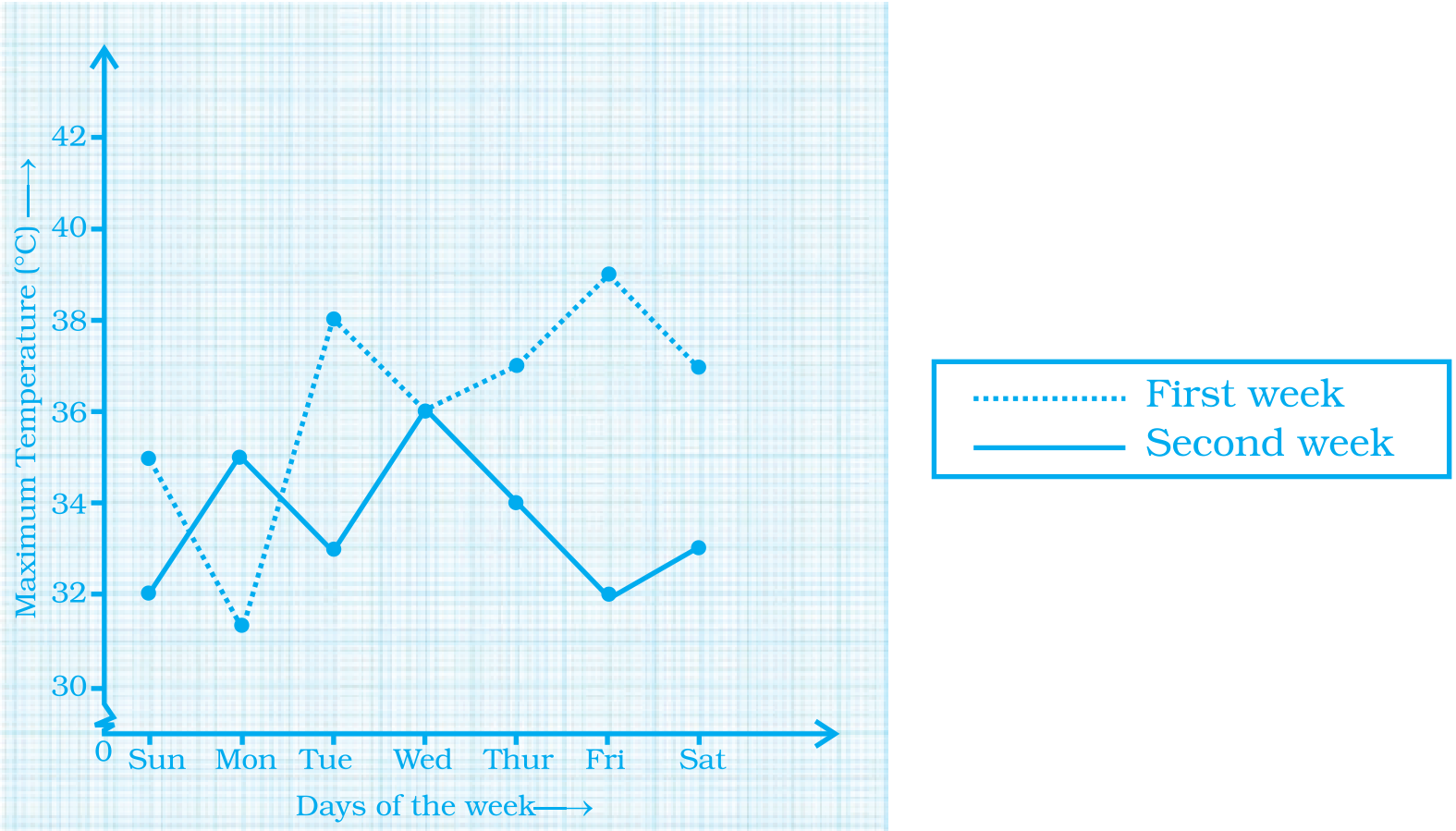
The graph shows the maximum temperatures recorded for two consecutive weeks of a town. Study the graph and answer the questions that follow.

$a.$ What information is given by the two axes?
$b.$ In which week was the temperature higher on most of the days
$c.$ On which day was the temperature same in both the weeks
$d.$ On which day was the difference in temperatures the maximum for both the weeks?
$e.$ What were the temperatures for both the weeks on Thursday?
$f.$ On which day was the temperature $35^\circ C$ for the first week?
$g.$ On which day was the temperature highest for the second week?
Write the cubes of $5$ natural numbers which are of the form $3n + 1$ $($e.g. $4, 7, 10, ...)$ and verify the following: 'The cube of a natural number of the form $3n + 1$ is a natural number of the same form i.e. when divided by 3 it leaves the remainder $1'$.
A wooden cylindrical pole is $7\ m$ high and its base radius is $10\ cm$. Find its weight if the wood weighs $225\ kg$ per cubic metre.
Solve the following equation and also check your result in case: $\frac{(3\text{x}+1)}{16}+\frac{(2\text{x}-3)}{7}=\frac{(\text{x}+3)}{8}+\frac{(3\text{x}-1)}{14}$
Construct a quadrilateral $ABCD$ in which $AB = BC = 3\ cm, AD = CD = 5\ cm$, and $\angle\text{B}=120^\circ.$
Show that each diagonal of a rhombus bisects the angle through which it passes.
Abhay borrowed $Rs. 16000$ at $7\frac{1}{2}\%$ per annum simple interest. On the same day, he lent it to Gurmeet at the same rate but compounded annually. What does he gain at the end of $2$ years$?$
A can do a piece of work in $14$ days while $B$ can do it in $21$ days.They began together and worked at it for $6$ days. Then, $A$ fell ill and $B$ had to complete the remaining work alone. In how many days was the work completed$?$
Multiply the monomial by the binomial and find the value of $x = -1, y = 0.25$ and $ z = 0.05: -3 x\left(y^2+z^2\right) $
Divide $Rs. 7000$ among $A, B$ and $C$ such that $A$ gets $50\%$ of what $B$ gets and $B$ gets $50\%$ of what C gets.