Question
Solve the following equation: $( a + b )^2 x ^2-4 abx -( a - b )^2=0$

Answer

$(a+b)^2 x^2-4 a b x-(a-b)^2=0 $
$ \text { As, }-(a+b)^2+(a-b)^2=-a^2-b^2-2 a b+a^2+b^2-2 a b=-4 a b$
$ (a+b)^2 x^2-\left[(a+b)^2-(a-b)^2\right] x-(a-b)^2=0$
$ (a+b)^2 x^2-(a+b)^2 x+(a-b)^2 x-(a-b)^2=0 $
$ \left\{(a+b)^2 x\right\}(x-1)+\left\{(a-b)^2\right\}(x-1)=0 $
$(x-1)\left[(a+b)^2 x+(a-b)^2\right]=0 $
$ x-1=0 \text { and }(a+b)^2 x+(a-b)^2=0$
$ x=1 \text { and } x=-\frac{(a-b)^2}{(a+b)^2}$
$ x=1 \text { and } x=-\left(\frac{a-b}{a+b}\right)^2$

Need a full question paper?

Generate a complete, print-ready paper with questions like this in minutes — across 16+ boards, with answer keys.
Start Generating Free

Similar questions

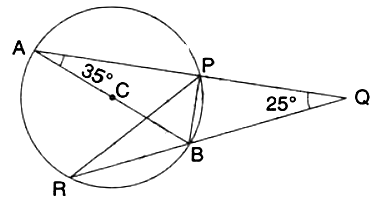
AB is a diameter of the circle APBR as shown in the figure. APQ and RBQ are straight lines. Find: ∠ BPR
If $A=\left[\begin{array}{ll}4 & 2 \\ 1 & 1\end{array}\right]$ Find $(A-2I)(A - 3I)$
Draw the histogram for the given data :
Marks0 - 2020 - 4040 - 6060 - 100
Number of students10152025
If $A =\left[\begin{array}{ll}3 & 7 \\ 2 & 4\end{array}\right], B =\left[\begin{array}{ll}0 & 2 \\ 5 & 3\end{array}\right]$ and $C =\left[\begin{array}{cc}1 & -5 \\ -4 & 6\end{array}\right]$ Find $AB -5 C$
A person bought 360 ten - rupee shares paying $12 \%$ dividend at par and sold them at ₹ $ 21$. The proceeds were invested in five - rupee shares paying $4 \frac{1}{2} \%$ at ₹ $ 3.5$ per share. Find (i) sale proceeds (ii) the number of five - rupee shares bought (iii) the percentage increase in income.
Solve the following equation by factorization
$
\sqrt{x(x-7)}=3 \sqrt{2}
$
Find the volume of the largest cylinder formed when a rectangular piece of paper 44 cm by 33 cm is rolled along it : shorter side.
Find the ratio in which the line $2x + y = 4$ divides th line segment joining the point $p(2,-2)$ and $Q(3,7)$.
In a square ABCD, its diagonal AC and BD intersect each other at point O. The bisector of angle DAO meets BD at point M and bisector of angle ABD meets AC at N and AM at L. Show that - ALOB is a cyclic quadrilateral.
Write down the equation of the line whose gradient is $\frac{3}{2}$and which passes through P. where P divides the line segment joining $A(−2, 6)$ and $B(3, −4)$ in the ratio $2 : 3$