MCQ
Solve the following in equations $\frac{2\text{x}+4}{\text{x}-1}\geq5$
- A$\big(1,2\big]$
- B$\big(1,3\big)$
- C$\big(1,3\big]$
- D$\big(1,4\big]$
Solution:
$\frac{2\text{x}+4}{\text{x}-1}\geq5$
$\Rightarrow\frac{2\text{x}+4}{\text{x}-1}-5\geq0$
$\Rightarrow\frac{2\text{x}+4-5(\text{x-1})}{\text{x-1}}\geq0$
$\Rightarrow\frac{2\text{x}+4-\text{5x+5}}{\text{x-1}}\geq0$
$\Rightarrow\frac{9-3\text{x}}{\text{x-1}}\geq0$
$\Rightarrow\frac{-3\text{(x-3)}}{\text{x}-1}\geq0$
Multiplying each side of an inequality by a negative number $\big(\frac{-1}{3}\big)$ reverses the direction of the inequality symbol.
$\Rightarrow\frac{(\text{x}-3)}{\text{x}-1}\leq0$ Here $\text{x}-1\neq0\Rightarrow\text{x}\neq1$
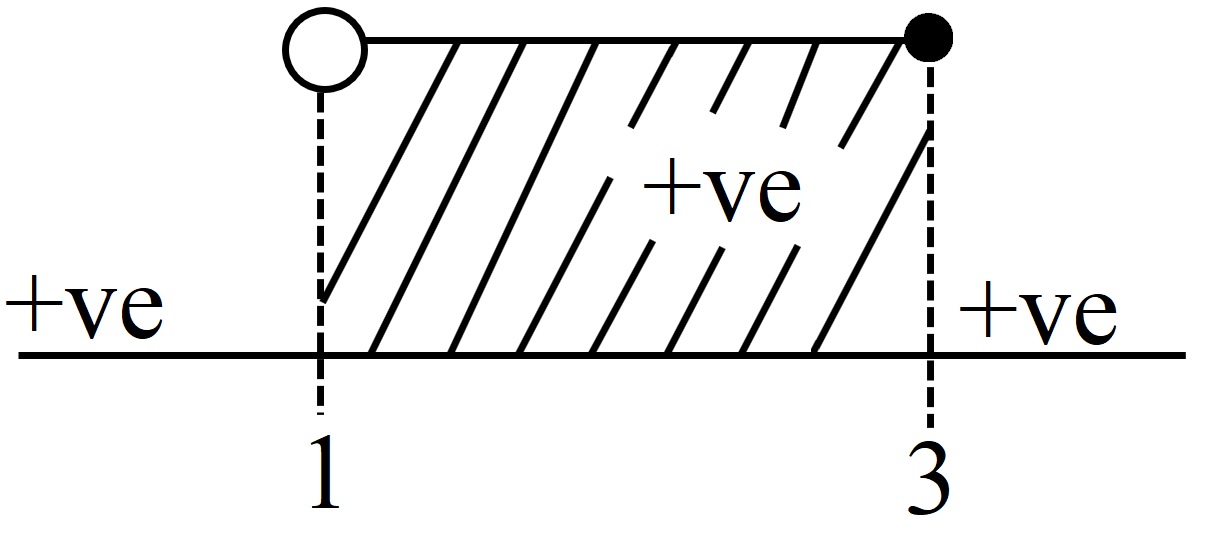
Hence the solution set of the given in equations is $\big(1, 3\big]$
Generate a complete, print-ready paper with questions like this in minutes — across 16+ boards, with answer keys.
A(6, 3), B(-3, 5), C(4, -2) and D(x, 3x) are four points. If $\triangle\text{DBC} : \triangle\text{ABC}= 1 : 2,$ then x is equal to:
If xn - 1 is divisible by x - k, then the least positive integral value of k is:
One coin is tossed once. Find the probability of getting A head.
A line passes through (2, 2) and is perpendicular to the line 3x + y = 3. Its yintercept is:
$\frac{1}{3}$
$\frac{2}{3}$
$1$
$\frac{4}{3}$