Question
Solve the following quadratic equation:$6x^2 + 11x + 3 = 0$

Answer

$6x^2 + 11x + 3 = 0$
$\Rightarrow 6x^2 + 9x + 2x + 3 = 0$
$\Rightarrow 3x(2x + 3) + 1(2x + 3) = 0$
$\Rightarrow (2x + 3)(3x + 1) = 0$
$\Rightarrow (2x + 3) = 0 or (3x + 1) = 0$
$\Rightarrow\text{x}=\frac{-3}{2}$ or $\text{x}=\frac{-1}{3}$
Hence, $\frac{-3}{2}$ and $\frac{-1}{3}$ are the roots of $6x^2 + 11x + 3 = 0$

Need a full question paper?

Generate a complete, print-ready paper with questions like this in minutes — across 16+ boards, with answer keys.
Start Generating Free

Similar questions

Write the correct alternative for the following question.
What is the amount of dividend received per share of face value Rs. 10 and dividend declared is 50%.
Prove the following trigonometric identities.
$\tan^2\theta-\sin^2\theta=\tan^2\theta\sin^2\theta$
Solve the following quadratic equation by factorization.
$6x - \frac{2}{x} = 1$
Find the first term and common difference for each of the A.P.
127, 135, 143, 151, . . .
Without actually performing the long division, state whether state whether the following rational numbers will have a terminating decimal expansion or a non terminating repeating decimal expansion.
$\frac{35}{50}$
Obtain the quadratic equation if roots are $-3,-7$.
Tickets numbered 1 to 20 are mixed up and then a ticket is drawn at random. What is the probability that the ticket drawn bears a number which is a multiple of 3?
Show that the point (0, 9) is equidistant from the point (-4, 1) and (4, 1)
Evaluate the following:
Verify the following:
$2\sin30^\circ\cos30^\circ=\sin60^\circ$
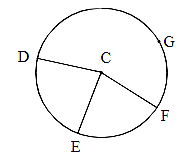
In figure, points G, D, E, F are concyclic points of a circle with centre C

$\angle E C F=70^{\circ}, m(\operatorname{arc} D G F)=200^{\circ}$
Find $m$ (arc DEF) by completing activity.
$ m(\operatorname{arc} E F)=\angle E C F \quad \ldots \ldots[\text { Definition of measure of } \operatorname{arc}]$
$\therefore m(\operatorname{arc} E F)=\square$
$B u t ; m(\operatorname{arc} D E)+m(\operatorname{arc} E F)+m(\operatorname{arc} D G F)=\square \quad \ldots \ldots[\text { Measure of a complete circle] }$
$\therefore m(\operatorname{arc} D E)=\square$
$\therefore m(\operatorname{arc} D E F)=m(\operatorname{arc} D E)+m(\operatorname{arc} E F)$
$\therefore m(\operatorname{arc} D E F)=\text { square } $