Question
Solve the following quadratic equation by using formula method:
$3 x^2+8 x+3=0$

Answer

$\frac{-4+\sqrt{7}}{3}$ and $\frac{-4-\sqrt{7}}{3}$

Need a full question paper?

Generate a complete, print-ready paper with questions like this in minutes — across 16+ boards, with answer keys.
Start Generating Free

Similar questions

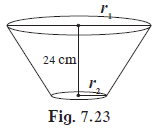
The circumferences of circular faces of a frustum are 132 cm and 88 cm and its height is 24 cm. To find the curved surface area of the frustum complete the following activity.$\left(\pi=\frac{22}{7}\right)$

Circumference $_1=2 \pi r_1=132$
$r_1=\frac{132}{2 \pi}=\square$
Circumference $_2=2 \pi \mathrm{r}_2=88$
$r_2=\frac{88}{2 \pi}=\square$
Slant height of frustum, $l=\sqrt{h^2+\left(r_1-r_2\right)^2}$
$=\sqrt{\square \square^2+\square^2}$
$=\square c m$
Curved Surface area of frustum $=\pi\left(r_1+r_2\right)$ l
$=\pi \times \square \times \square$
$=\square \text { sq. } \mathrm{cm}$
Show that the progressions given below is an AP. Find the first term, common difference and next term.
$-1,\frac{-5}{6},\frac{-2}{3},\frac{-1}{2},....$
If A, B, C are the interior angles of a triangle ABC, prove that.
$\sin\Big(\frac{\text{B+C}}{2}\Big)=\cos\frac{\text{ A}}{2}$
Find the value of discriminant for of the following quadratic equation:
$x^2+4 x+4=0$
Write sample space ‘S’ and number of sample point n(S) for each of the following experiments. Also write events A, B, C in the set form and write n(A), n(B), n(C).
One coin and one die are thrown simultaneously.
Condition for event A : To get head and an odd number.
Condition for event B : To get a head or tail and an even number.
Condition for event C : Number on the upper face is greater than 7 and tail on the coin.

How many tangents can a circle have?
Solve the following simultaneous equation.
2x – 3y = 9; 2x + y = 13
Check whether the first polynomial is a factor of the second polynomial by applying the division algorithm:
$g(t) = t^2 - 3, f(t) = 2t^4 + 3t^3 - 2t^2 - 9t - 12.$
Solve the following quadratic equations by factorization:
(2x + 3)(3x - 7) = 0
Show that the point $(11, – 2)$ is equidistant from $(4, – 3)$ and $(6, 3)$