Question
Solve the following quadratic equations by factorisation : 3y² = 15 y

Answer


$\begin{array}{l}
3 y^2=15 y \\
\therefore 3 y^2-15 y=0 \\
\therefore 3 y(y-5)=0 \\
\therefore 3 y=0 \text { or }(y-5)=0 \\
\therefore y=0 \text { or } y=5
\end{array}$
$\therefore 0$ and $5$ are the roots of quadratic equation.

Need a full question paper?

Generate a complete, print-ready paper with questions like this in minutes — across 16+ boards, with answer keys.
Start Generating Free

Similar questions

Prove the following trigonometric identities.
$\frac{1+\tan^2\theta}{1+\cot^2\theta}=\Big(\frac{1-\tan\theta}{1-\cot\theta}\Big)^2=\tan^2\theta$
Express the following as a fraction in simplest form:
$0.\bar8$
If $\alpha$ and $\beta$ are the zeroes of the quadratic polynomial $f(x) = x^2 - x - 2$, find the value of $\frac{1}{\alpha}-\frac{1}{\beta}$
An iron pole consisting of a cylindrical portion $110\ cm$ high and of base diameter $12\ cm$ is surmounted by a cone $9\ cm$ high. Find the mass of the pole, given that $1\ cm^3$​​​​​​​ of iron has $8$ gram mass approximately. $\Big(\text{Use}:\ \pi=\frac{355}{115}\Big)$
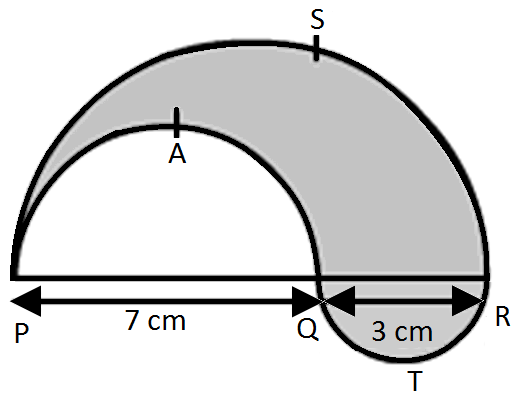
In the the following figure, PSR, RTQ and PAQ are three semicircles of diameter 10cm, 3cm and 7cm respectively. Find the perimeter of shaded region.
If the equation $\left(1+m^2\right) x^2+2 m c x+\left(c^2-a^2\right)=0$ has equal roots, prove that $c^2=a^2\left(1+m^2\right)$.
A solid metallic sphere of diameter 21cm is melted and recast into a number of smaller cones, each of diameter 3.5cm and height 3cm Find the number of cones so formed.
₹ 1000 is invested at 10 percent simple interest. Check at the end of every year if the total interest amount is in A.P. If this is an A.P. then find interest amount after 20 years. For this complete the following activity.
$\text { Simple interest }=\frac{P \times R \times N}{100}$
Simple interest after 1 year $=\frac{1000 \times 10 \times 1}{100}=\square$
Simple interest after 2 year $=\frac{1000 \times 10 \times 2}{100}=\square$
Simple interest after 3 year $=\frac{\square \times \square \times \square}{100}=300$
According to this the simple interest for $4,5,6$ years will be 400, $\square$ $\square$ respectively.
From this $d =$ $\square$ and $a =$ $\square$
Amount of simple interest after 20 years
$t_n+a+(n-1) d $
$t_{20}=\square+(20-1) \square $
$t_{20}=\square$
Amount of simple interest after 20 years is $=$ $\square$
If $\cot\theta=\frac{1}{\sqrt{3}},$ find the value of $\frac{1+\cos^2\theta}{2-\sin^2\theta}$.
The perimeter of a sector of a circle of radius 5.7m is 27.2m. Find the area of the sector.