Question 13 Marks
The roots of each of the following quadratic equation are real and equal, find k.
kx (x-2) + 6 = 0
Answer$kx ( x -2)+6=0 \Rightarrow kx ^2-2 kx +6=0 $
$\Rightarrow kx ^2-2 kx +6=0 \text { compare with } ax ^2+ bx + c =0$
$\Rightarrow a = k , b =-2 k \text { and } c =6 $
$\therefore b ^2-4 ac =(-2 k )^2-4( k )(6) $
$=4 k ^2-24 k$
If roots are equal and real then, $\therefore b ^2-4 ac =0$
$4 k ^2-24 k =0 $
$\Rightarrow 4 k ( k -6)=0 $
$\Rightarrow 4 k =0 \text { and } k -6=0 $
$\therefore k =0 \text { and } k =6$
View full question & answer→Question 23 Marks
The roots of each of the following quadratic equation are real and equal, find k.
$3 y^2+k y+12=0$
Answer$3 y ^2- ky +12=0 \text { compare with } ax ^2+ bx + c =0 $
$\Rightarrow a =3, b=- k \text { and } c =12$
$\therefore b ^2-4 ac =- k ^2-4(3)(12)$
$= k ^2-144$
If roots are equal and real then, $\therefore b^2-4 a c=0$
$k ^2-144=0 $
$\Rightarrow k ^2=144 $
$\Rightarrow k = \pm 12$
$\therefore k =12 \text { and } k =-12$
View full question & answer→Question 33 Marks
$\alpha^3+\beta^3$
Answer$(\alpha+\beta)^3=\alpha^3+\beta^3+3 \alpha \beta(\alpha+\beta) $
$ \Rightarrow(2)^3=\alpha^3+\beta^3+3(-7)(2) $
$\Rightarrow 8+42=\alpha^3+\beta^3 $
$ \Rightarrow \alpha^3+\beta^3=50$
View full question & answer→Question 43 Marks
$\alpha^2+\beta^2$
Answer$y^2-2 y-7=0 $
$ \alpha+\beta=2 \text { and } \alpha \beta=-7 $
$ \text { (1). }(\alpha+\beta)^2=\alpha^2+\beta^2+2 \alpha \beta$
$ \Rightarrow(2)^2=\alpha^2+\beta^2+2(-7) $
$ \Rightarrow 4+14=\alpha^2+\beta^2$
$ \Rightarrow \alpha^2+\beta^2=18$
View full question & answer→Question 53 Marks
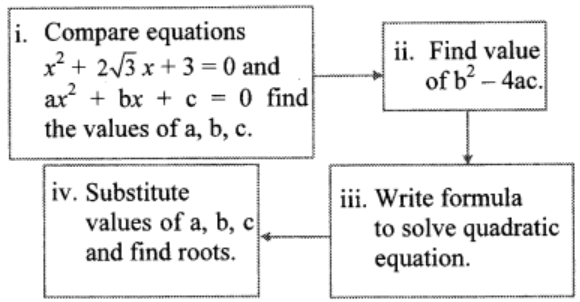
With the help of the flow chart given below solve the equation $x^2+2 \sqrt{3} x+3=0$ using the formula.
Answer$x^2+2 \sqrt{3} x+3=0 \text { compare with } a^2+b x+c=0 $
$ \Rightarrow a=1, b=2 \sqrt{3} \text { and } c=3 $
$ \therefore b^2-4 a c=(2 \sqrt{3})^2-4(1)(3) $
$ =12-12 $
$ =0 $
$ x=\frac{-b \pm \sqrt{b^2-4 a c}}{2 a} $
$ \Rightarrow x=\frac{-2 \sqrt{3} \pm \sqrt{0}}{2 \times 1} $
$\Rightarrow x=\frac{-2 \sqrt{3}}{2}$
View full question & answer→Question 63 Marks
Solve using formula.
$5 x^2+13 x+8=0$
Answer$5 x^2+13 x +8=0 \text { compare with } ax ^2+ bx + c =0$
$ \Rightarrow a =5, b=13 \text { and } c =8 $
$ \therefore b ^2-4 ac =13^2-4(5)(8) $
$ =169-160$
$=9$
$ x =\frac{- b \pm \sqrt{ b ^2-4 a c}}{2 a }$
$\Rightarrow x =\frac{-13 \pm \sqrt{9}}{2 \times 5} $
$ \Rightarrow x =\frac{-13 \pm 3}{10}$
$ \Rightarrow x =\frac{-13+3}{10} \text { or } x =\frac{-13-3}{10} $
$ \Rightarrow x =\frac{-10}{10} \text { or } x =\frac{-16}{10} $
$ \Rightarrow x =-1 \text { or } x =-\frac{8}{5}$
View full question & answer→Question 73 Marks
Solve using formula.
$y^2 + \frac{1}{3}y = 2$
Answer$3 y^2+y-6=0 $
$\Rightarrow 3 y^2+y-6=0 \text { compare with } a x^2+b x+c=0 $
$ \Rightarrow a=3, b=1 \text { and } c=-6 $
$ \therefore b^2-4 a c=1^2-4(3)(-6) $
$ =1+72$
$ =73$
$ Y=\frac{-b \pm \sqrt{b^2-4 a c}}{2 a}$
$ \Rightarrow y=\frac{-1 \pm \sqrt{73}}{2 \times 3} $
$ \Rightarrow y=\frac{-1 \pm \sqrt{73}}{6} $
$\Rightarrow y=\frac{-1+\sqrt{73}}{6} \text { or } y=\frac{-1-\sqrt{73}}{6}$
View full question & answer→Question 83 Marks
Solve using formula.
$5 m^2-4 m-2=0$
Answer$5 m^2-4 m-2=0 \text { compare with } ax ^2+ bx + c =0 $
$ \Rightarrow a =5, b=-4 \text { and } c=-2$
$ \therefore b ^2-4 ac =(-4)^2-4(5)(-2) $
$=16+40 $
$=56 $
$ m=\frac{- b \pm \sqrt{ b ^2-4 a c}}{2 a } $
$ \Rightarrow m =\frac{-(-4) \pm \sqrt{56}}{2 \times 5}$
$ \Rightarrow m =\frac{4 \pm 2 \sqrt{14}}{10} $
$\Rightarrow m =\frac{4+2 \sqrt{14}}{10} \text { or } m =\frac{4-2 \sqrt{14}}{10} $
$\Rightarrow m =\frac{2+\sqrt{14}}{5} \text { or } m =\frac{2-\sqrt{14}}{5}$
View full question & answer→Question 93 Marks
$3 m^2+2 m-7=0$
Answer$3 m^2+2 m-7=0 \text { compare with } ax ^2+ bx + c =0 $
$ \Rightarrow a =3, b=2 \text { and } c =-7 $
$ \therefore b ^2-4 ac =2^2-4(3)(-7) $
$ =4+84 $
$ =88 $
$ m=\frac{- b \pm \sqrt{ b ^2-4 ac }}{2 a } $
$ \Rightarrow m =\frac{-2 \pm \sqrt{88}}{2 \times 3} $
$ \Rightarrow m =\frac{-2 \pm \sqrt{88}}{6} $
$ \Rightarrow m =\frac{-2+2 \sqrt{22}}{6} \text { or } m =\frac{-2-2 \sqrt{22}}{6} $
$ \Rightarrow m =\frac{-1+\sqrt{22}}{3} \text { or } m =\frac{-1-\sqrt{22}}{3}$
View full question & answer→Question 103 Marks
Solve using formula.
$x^2-3 x-2=0$
Answer$x^2+3 x-2=0 \text { compare with } a x^2+b x+c=0 $
$\Rightarrow a=1, b=3 \text { and } c=-2$
$ \therefore b^2-4 a c=3^2-4(1)(-2) $
$ =9+8 $
$ =17 $
$x=\frac{-b \pm \sqrt{b^2-4 a c}}{2 a} $
$\Rightarrow x=\frac{-3 \pm \sqrt{17}}{2 \times 1} $
$\Rightarrow x=\frac{-3 \pm \sqrt{17}}{2} $
$\Rightarrow x=\frac{-3+\sqrt{17}}{2} \text { or } x=\frac{-3-\sqrt{17}}{2}$
View full question & answer→Question 113 Marks
Solve using formula.
$x^2+6 x+5=0$
Answer$x^2+6 x+5=0 $
$\Rightarrow x ^2+6 x +5=0 \text { compare with } ax ^2+ bx + c =0 $
$\Rightarrow a =1, b=6 \text { and } c =5 $
$\therefore b ^2-4 ac =6^2-4(1)(5) $
$=36-20 $
$=16 $
$x=\frac{-b \pm \sqrt{b^2-4 a c}}{2 a} $
$x=\frac{-6 \pm \sqrt{16}}{2 \times 1}=\frac{-6 \pm 4}{2} $
$\Rightarrow x =\frac{-6+4}{2} \text { or } x =\frac{-6-4}{2} $
$\Rightarrow x =-\frac{2}{2} \text { or } x =-\frac{10}{2} $
$\Rightarrow x =-1 \text { or } x =-5$
View full question & answer→Question 123 Marks
Solve the following quadratic equation by completing the square method.
$5 x^2=4 x+7=0$
Answer$5 x^2-4 x-7=0 $
$ \Rightarrow x^2-\frac{4}{5} x-\frac{7}{5}=0 $
$ \left.\Rightarrow x^2-\frac{4}{5} x+\frac{4}{25}=\frac{7}{5}+\frac{4}{25} \text { (Adding and Subtracting } \frac{4}{25}\right) $
$ \Rightarrow\left(x+\frac{2}{5}\right)^2=\frac{35+4}{25} $
$ \Rightarrow\left(x+\frac{2}{5}\right)^2=\frac{39}{25} $
$ \Rightarrow x+\frac{2}{5}=\sqrt{\frac{39}{25}}$
$ \Rightarrow x+\frac{2}{5}= \pm \frac{\sqrt{39}}{5} $
$ x=\frac{\sqrt{39}}{5}-\frac{2}{5} \text { or } x=-\frac{\sqrt{39}}{5}-\frac{2}{5} $
$x=\frac{\sqrt{39}}{5}-2 { or } x=\frac{-\sqrt{39}-2}{5}$
View full question & answer→Question 133 Marks
Solve the following quadratic equation by completing the square method.
$2 y^2+9 y+10=0$
Answer$2 y^2+9 y+10=0$
Steps involved in solving quadratic equation by completing the square method are -
1. Making the first variable free of coefficient
Dividing by the coefficient of 2 , we get, $\Rightarrow y^2+\frac{9}{2} y+5=0$
2. The coefficient of linear variable(variable with degree 1) is then squared and then added and subtracted from the equation.
$\Rightarrow y^2+\frac{9}{2} y+\frac{81}{16}-\frac{81}{16}+5=0$
3. Take out the terms following the formula $(a+b)^2=a^2+b^2+2 a b$
$\Rightarrow\left(y^2+\frac{9}{2} y+\frac{81}{16}\right)-\left(\frac{81}{16}-5\right)=0$
$\Rightarrow\left(y+\frac{9}{4}\right)^2=\frac{81}{16}-5$
$\Rightarrow\left(y+\frac{9}{2}\right)^2=\frac{81-80}{16}$
$\Rightarrow\left(y+\frac{9}{2}\right)^2=\frac{1}{16}$
$\Rightarrow y +\frac{9}{2}=\sqrt{\frac{1}{16}}$
$\Rightarrow y +\frac{9}{2}= \pm \frac{1}{4}$
$\Rightarrow y +\frac{9}{2}=\frac{1}{4} \text { or } y +\frac{9}{2}=-\frac{1}{4}$
$\Rightarrow y =\frac{1}{4}-\frac{9}{2} \text { or } y =-\frac{1}{4}-\frac{9}{2}$
$\Rightarrow y =\frac{1-18}{4} \text { or } y =\frac{-1}{4}$
$\Rightarrow y =-\frac{17}{4} \text { or } y =-\frac{19}{4}$
View full question & answer→Question 143 Marks
Solve the following quadratic equation by completing the square method.
$9 y^2-12 y+2=0$
Answer$9y^2-12y + 2 =0$
$(3 y)^2-2 \times 3 y \times 4+(4)^2-(4)^2+2=0$
$(3 y)^2-2 \times 3 y \times 4+(4)^2-16+2=0$
$(3 y-4)^2-14=0$
$(3 y-4)^2=14$
$3 y-14= \pm \sqrt{ } 14$
$3 y=14 \pm \sqrt{ } 14$
$y=(14 \pm \sqrt{ } 14) / 3$
View full question & answer→Question 153 Marks
Solve the following quadratic equation by completing the square method.
$m^2-5 m=-3$
Answer$m ^2-5 m+3=0 \Rightarrow m ^2-5 m+\frac{25}{4}-\frac{25}{4}+3=0$ (Adding and Subtracting $\frac{25}{4}$)
$ \Rightarrow\left( m ^2-5 m+\frac{25}{4}\right)=\frac{25}{4}-3$
$\Rightarrow\left( m -\frac{5}{2}\right)^2=\frac{25-12}{4} $
$ \Rightarrow\left( m -\frac{5}{2}\right)^2=\frac{13}{4} $
$ \Rightarrow m -\frac{5}{2}=\sqrt{\frac{13}{4}} $
$ \Rightarrow m -\frac{5}{2}= \pm \frac{\sqrt{13}}{2} $
$ \Rightarrow m -\frac{5}{2}=\frac{\sqrt{13}}{2} \text { or } m -\frac{5}{2}=-\frac{\sqrt{13}}{2} $
$ \Rightarrow m =\frac{\sqrt{13}}{2}+\frac{5}{2} \text { or } m =-\frac{\sqrt{13}}{2}-\frac{5}{2} $
$ \Rightarrow m =\frac{\sqrt{13}+5}{2} \text { or } m =\frac{-\sqrt{13}-5}{2}$
View full question & answer→Question 163 Marks
Solve the following quadratic equation by completing the square method.
$x^2+2 x-5=0$
Answer$x^2+2 x-5=0 $
$ \Rightarrow x^2+2 x+1-1-5=0 $
$ \Rightarrow\left(x^2+2 x+1\right)-(1+5)=0 $
$ \Rightarrow(x+1)^2-6=0 $
$ \Rightarrow(x+1)^2=6 $
$ \Rightarrow x+1=\sqrt{6}$
$ \Rightarrow x+1= \pm \sqrt{6} $
$ \Rightarrow x+1=\sqrt{6} \text { or } x+1=-\sqrt{6} $
$ \Rightarrow x=\sqrt{6}-1 \text { or } x=-\sqrt{6}-1$
View full question & answer→Question 173 Marks
Solve the following quadratic equation by completing the square method.
$x^2+x-20=0$
Answer$x^2+x-20=0 $
$\Rightarrow x ^2+ x +\frac{1}{4}-\frac{1}{4}-20=0 $
$\Rightarrow\left(x^2+x+\frac{1}{4}\right)+\left(\frac{1}{4}-20\right)=0 $
$\Rightarrow\left( x +\frac{1}{2}\right)^2-\frac{1+80}{4}=0 $
$\Rightarrow\left(x+\frac{1}{2}\right)^2=\frac{81}{4} $
$\Rightarrow x +\frac{1}{2}=\sqrt{\frac{81}{4}} $
$\Rightarrow x+\frac{1}{2}= \pm \frac{9}{2} $
$\Rightarrow x +\frac{1}{2}=\frac{9}{2} \text { or } x +\frac{1}{2}=-\frac{9}{2} $
$\Rightarrow x =\frac{9}{2}-\frac{1}{2} \text { or } x =-\frac{9}{2}-\frac{1}{2} $
$\Rightarrow x =\frac{8}{2} \text { or } x =-\frac{10}{2} $
$\Rightarrow x=4 \text { or } x=-5$
View full question & answer→Question 183 Marks
Mukund possesses ₹50 more than what Sagar possesses. The product of the amount they have is 15,000. Find the amount each one has.
AnswerLet Sagar has x amountMukund’s amount $= x +50$
$ x(x + 50) = 15000$
$\Rightarrow x^2 +50x - 15000 = 0$
Splitting the middle term we get:-
$\Rightarrow x^2-100 x+150 x-15000=0$
$\Rightarrow x(x-100)+150(x-100)$
$\Rightarrow(x-100)(x+150)$
$\therefore x=(-150), 100$
$x =100$ as money cant be negative therefore we ignore $(-150)$
$\therefore$ Sagar has 100 Rs and Mukund has $150$ Rs
View full question & answer→Question 193 Marks
Form the quadratic equation if its roots are
$(\sqrt{2}+\sqrt{3})$ and $(\sqrt{2}-\sqrt{3})$
Answer$x^2-2 \sqrt{2} x-1=0$
View full question & answer→Question 203 Marks
Form the quadratic equation if its roots are
$\frac{1}{2}$ and $\frac{-3}{4}$
View full question & answer→Question 213 Marks
Form the quadratic equation if its roots are
0 and -4
Question 223 Marks
Find the value of $k$ for which given quadratic equation are real and equal roots.
$4 x^2-3 k x+1=0$
Answer$k=\frac{-4}{3}$ or $k=\frac{4}{3}$
View full question & answer→Question 233 Marks
Find the value of $k$ for which given quadratic equation are real and equal roots.
$k^2 x^2-2(k-1) x+4=0$
Answer$k=-1$ or $k=\frac{1}{3}$
View full question & answer→Question 243 Marks
Find $k$, if one root of the equation $5 x^2+6 x+k=0$ is five times the other.
View full question & answer→Question 253 Marks
If $\alpha$ and $\beta$ are the roots of equation $x^2-4 x+1=0$, find
$\alpha^3+\beta^3$
View full question & answer→Question 263 Marks
If $\alpha$ and $\beta$ are the roots of equation $x^2-4 x+1=0$, find
$\alpha^2+\beta^2$
View full question & answer→Question 273 Marks
Mukund possesses ₹50 more than what Sagar possesses. The product of the amount they have is 15,000. Find the amount each one has.
AnswerLet Sagar has $x$ amount
$\begin{array}{l}
\text { Mukund's amount }=x+50 \\
x(x+50)=15000 \\
\Rightarrow x^2+50 x-15000=0
\end{array}$
Splitting the middle term we get:-|
$\begin{array}{l}
\Rightarrow x^2-100 x+150 x-15000=0 \\
\Rightarrow x(x-100)+150(x-100) \\
\Rightarrow(x-100)(x+150) \\
\therefore x=(-150), 100 \\
x=100 \text { as money cant be negative therefore we ignore (-150) } \\
\therefore \text { Sagar has 100Rs and Mukund has 150Rs }
\end{array}$
View full question & answer→Question 283 Marks
The roots of each of the following quadratic equation are real and equal, find k.
kx (x-2) + 6 = 0
Answer
$\begin{array}{l}
kx ( x -2)+6=0 \Rightarrow kx ^2-2 kx +6=0 \\
\Rightarrow kx ^2-2 kx +6=0 \text { compare with } ax ^2+ bx + c =0 \\
\Rightarrow a = k , b =-2 k \text { and } c =6 \\
\therefore b ^2-4 ac =(-2 k )^2-4( k )(6) \\
=4 k ^2-24 k
\end{array}$
If roots are equal and real then, $. b ^2-4 ac =0$
$\begin{array}{l}
4 k^2-24 k =0 \\
\Rightarrow 4 k ( k -6)=0
\end{array}$
$\begin{array}{l}\Rightarrow 4 k =0 \text { and } k -6=0 \\ \therefore k =0 \text { and } k =6\end{array}$
View full question & answer→Question 293 Marks
The roots of each of the following quadratic equation are real and equal, find k.
3y2 + ky + 12 = 0
Answer
$\begin{array}{l}
3 y^2-k y+12=0 \text { compare with } a x^2+b x+c=0 \\
\Rightarrow a=3, b=-k \text { and } c=12 \\
\therefore b^2-4 a c=-k^2-4(3)(12) \\
= k ^2-144
\end{array}$
If roots are equal and real then, $. b ^2-4 ac =0$
$\begin{array}{l}
k ^2-144=0 \\
\Rightarrow k ^2=144 \\
\Rightarrow k = \pm 12
\end{array}$
∴k=12 and k=-12
View full question & answer→Question 303 Marks
$\alpha, \beta$ are roots of $y^2-2 y-7=0$ find : α3 + β3
Answer
$\begin{array}{l}(\alpha+\beta)^3=\alpha^3+\beta^3+3 \alpha \beta(\alpha+\beta) \\ \Rightarrow(2)^3=\alpha^3+\beta^3+3(-7)(2) \\ \Rightarrow 8+42=\alpha^3+\beta^3 \\ \Rightarrow \alpha^3+\beta^3=50\end{array}$
View full question & answer→Question 313 Marks
$\alpha, \beta$ are roots of $y^2-2 y-7=0$ find : α2 + β2
Answer
$\begin{array}{l} y ^2-2 y -7=0 \\ \alpha+\beta=2 \text { and } \alpha \beta=-7 \\ \text { (1). }(\alpha+\beta)^2=\alpha^2+\beta^2+2 \alpha \beta \\ \Rightarrow(2)^2=\alpha^2+\beta^2+2(-7) \\ \Rightarrow 4+14=\alpha^2+\beta^2 \\ \Rightarrow \alpha^2+\beta^2=18\end{array}$
View full question & answer→Question 323 Marks
Answer
$\begin{array}{l}x^2+2 \sqrt{3} x+3=0 \text { compare with } a x^2+b x+c=0 \\ \Rightarrow a=1, b=2 \sqrt{3} \text { and } c=3 \\ \therefore b^2-4 a c=(2 \sqrt{3})^2-4(1)(3) \\ =12-12 \\ =0 \\ x=\frac{-b \pm \sqrt{b^2-4 a c}}{2 a} \\ \Rightarrow x=\frac{-2 \sqrt{3} \pm \sqrt{0}}{2 \times 1}\end{array}$
$\Rightarrow x=\frac{-2 \sqrt{3}}{2}$
View full question & answer→Question 333 Marks
Solve using formula.
5x2 + 13x + 8 = 0
Answer
$\begin{array}{l}5 x ^2+13 x +8=0 \text { compare with } ax ^2+ bx + c =0 \\ \Rightarrow a =5, b =13 \text { and } c =8 \\ \therefore b ^2-4 ac =13^2-4(5)(8) \\ =169-160 \\ =9 \\ x =\frac{-b \pm \sqrt{ b ^2-4 ac }}{2 a } \\ \Rightarrow x =\frac{-13 \pm \sqrt{9}}{2 \times 5}\end{array}$
$\begin{array}{l}\Rightarrow x=\frac{-13 \pm 3}{10} \\ \Rightarrow x=\frac{-13+3}{10} \text { or } x=\frac{-13-3}{10} \\ \Rightarrow x=\frac{-10}{10} \text { or } x=\frac{-16}{10} \\ \Rightarrow x=-1 \text { or } x=-\frac{8}{5}\end{array}$
View full question & answer→Question 343 Marks
Solve using formula.
$y^2+\frac{1}{3} y=2$
Answer
$\begin{array}{l}3 y^2+y-6=0 \\ \Rightarrow 3 y^2+y-6=0 \text { compare with } a x^2+b x+c=0 \\ \Rightarrow a=3, b=1 \text { and } c=-6 \\ \therefore b^2-4 a c=1^2-4(3)(-6) \\ =1+72 \\ =73 \\ Y=\frac{-b \pm \sqrt{b^2-4 a c}}{2 a}\end{array}$
$\begin{array}{l}\Rightarrow y=\frac{-1 \pm \sqrt{73}}{2 \times 3} \\ \Rightarrow y=\frac{-1 \pm \sqrt{73}}{6} \\ \Rightarrow y=\frac{-1+\sqrt{73}}{6} \text { or } y=\frac{-1-\sqrt{73}}{6}\end{array}$
View full question & answer→Question 353 Marks
Solve using formula.
5m2 – 4m – 2 = 0
Answer
$\begin{array}{l}5 m^2-4 m-2=0 \text { compare with } a x^2+b x+c=0 \\ \Rightarrow a=5, b=-4 \text { and } c=-2 \\ \therefore b^2-4 a c=(-4)^2-4(5)(-2) \\ =16+40 \\ =56 \\ m=\frac{-b \pm \sqrt{b^2-4 a c}}{2 a} \\ \Rightarrow m=\frac{-(-4) \pm \sqrt{56}}{2 \times 5}\end{array}$
$\begin{array}{l}\Rightarrow m =\frac{4 \pm 2 \sqrt{14}}{10} \\ \Rightarrow m =\frac{4+2 \sqrt{14}}{10} \text { or } m =\frac{4-2 \sqrt{14}}{10} \\ \Rightarrow m =\frac{2+\sqrt{14}}{5} \text { or } m =\frac{2-\sqrt{14}}{5}\end{array}$
View full question & answer→Question 363 Marks
Solve using formula.
3m2 + 2m – 7 = 0
Answer
$\begin{array}{l}3 m ^2+2 m -7=0 \text { compare with } ax ^2+ bx + c =0 \\ \Rightarrow a =3, b =2 \text { and } c =-7 \\ \therefore b ^2-4 ac =2^2-4(3)(-7) \\ =4+84 \\ =88 \\ m =\frac{- b \pm \sqrt{ b ^2-4 ac }}{2 a } \\ \Rightarrow m =\frac{-2 \pm \sqrt{88}}{2 \times 3}\end{array}$
$\begin{array}{l}\Rightarrow m =\frac{-2 \pm \sqrt{88}}{6} \\ \Rightarrow m =\frac{-2+2 \sqrt{22}}{6} \text { or } m =\frac{-2-2 \sqrt{22}}{6} \\ \Rightarrow m =\frac{-1+\sqrt{22}}{3} \text { or } m =\frac{-1-\sqrt{22}}{3}\end{array}$
View full question & answer→Question 373 Marks
Solve using formula.
x2 – 3x – 2 = 0
Answer
$\begin{array}{l}x^2+3 x-2=0 \text { compare with } a x^2+b x+c=0 \\ \Rightarrow a=1, b=3 \text { and } c=-2 \\ \therefore b^2-4 a c=3^2-4(1)(-2) \\ =9+8 \\ =17 \\ x=\frac{-b \pm \sqrt{b^2-4 a c}}{2 a} \\ \Rightarrow x=\frac{-3 \pm \sqrt{17}}{2 \times 1}\end{array}$
$\begin{array}{l}\Rightarrow x=\frac{-3 \pm \sqrt{17}}{2} \\ \Rightarrow x=\frac{-3+\sqrt{17}}{2} \text { or } x=\frac{-3-\sqrt{17}}{2}\end{array}$
View full question & answer→Question 383 Marks
Solve using formula.
x2 + 6x + 5 = 0
Answer
$\begin{array}{l}x^2+6 x+5=0 \\ \Rightarrow x^2+6 x+5=0 \text { compare with } a x^2+b x+c=0 \\ \Rightarrow a=1, b=6 \text { and } c=5 \\ \therefore b^2-4 a c=6^2-4(1)(5) \\ =36-20 \\ =16 \\ x=\frac{-b \pm \sqrt{b^2-4 a c}}{2 a}\end{array}$
$\begin{array}{l}x=\frac{-6 \pm \sqrt{16}}{2 \times 1}=\frac{-6 \pm 4}{2} \\ \Rightarrow x=\frac{-6+4}{2} \text { or } x=\frac{-6-4}{2} \\ \Rightarrow x=-\frac{2}{2} \text { or } x=-\frac{10}{2} \\ \Rightarrow x=-1 \text { or } x=-5\end{array}$
View full question & answer→Question 393 Marks
Solve the following quadratic equation by completing the square method.
5x2 = 4x + 7 = 0
Answer
$\begin{array}{l}5 x^2-4 x-7=0 \\ \Rightarrow x^2-\frac{4}{5} x-\frac{7}{5}=0 \\ \Rightarrow x^2-\frac{4}{5} x+\frac{4}{25}=\frac{7}{5}+\frac{4}{25} \text { (Adding and Subtracting } \frac{4}{25}) \\ \Rightarrow\left(x+\frac{2}{5}\right)^2=\frac{35+4}{25} \\ \Rightarrow\left(x+\frac{2}{5}\right)^2=\frac{39}{25} \\ \Rightarrow x+\frac{2}{5}=\sqrt{\frac{39}{25}}\end{array}$
$\begin{array}{l}\Rightarrow x+\frac{2}{5}= \pm \frac{\sqrt{39}}{5} \\ x=\frac{\sqrt{39}}{5}-\frac{2}{5} \text { or } x=-\frac{\sqrt{39}}{5}-\frac{2}{5} \\ x=\frac{\sqrt{39}-2}{5} \text { or } x=\frac{-\sqrt{39}-2}{5}\end{array}$
View full question & answer→Question 403 Marks
Solve the following quadratic equation by completing the square method.
2y2 + 9y + 10 = 0
Answer
$2 y^2+9 y+10=0$
Steps involved in solving quadratic equation by completing the square method are -
1. Making the first variable free of coefficient
Dividing by the coefficient of 2 , we get,
$\Rightarrow y^2+\frac{9}{2} y+5=0$
2. The coefficient of linear variable(variable with degree 1 ) is then squared and then added and subtracted from the equation.
$\Rightarrow y ^2+\frac{9}{2} y +\frac{81}{16}-\frac{81}{16}+5=0$
3. Take out the terms following the formula $(a+b)^2=a^2+b^2+2 a b$
$\Rightarrow\left(y^2+\frac{9}{2} y+\frac{81}{16}\right)-\left(\frac{81}{16}-5\right)=0$
$\begin{array}{l}\Rightarrow y+\frac{9}{2}=\frac{1}{4} \text { or } y+\frac{9}{2}=-\frac{1}{4} \\ \Rightarrow y=\frac{1}{4}-\frac{9}{2} \text { or } y=-\frac{1}{4}-\frac{9}{2} \\ \Rightarrow y=\frac{1-18}{4} \text { or } y=\frac{-1-18}{4} \\ \Rightarrow y=-\frac{17}{4} \text { or } y=-\frac{19}{4}\end{array}$
View full question & answer→Question 413 Marks
Solve the following quadratic equation by completing the square method.
9y2 – 12y + 2 = 0
Answer
$9 y^2-12 y+2=0$
(3y)2 - 2 × 3y × 4 + (4)2 - (4)2 + 2 = 0
(3y)2 - 2 × 3y × 4 + (4)2 - 16 + 2 = 0
(3y - 4)2 - 14 = 0
(3y - 4)2 = 14
3y - 14 = ±√14
3y = 14 ± √14
y = (14 ± √14)/3
View full question & answer→Question 423 Marks
Solve the following quadratic equation by completing the square method.
m2 – 5m = -3
Answer
$\begin{array}{l}m^2-5 m+3=0 \\ \Rightarrow m^2-5 m+\frac{25}{4}-\frac{25}{4}+3=0 \text { (Adding and Subtracting } \frac{25}{4} \\ \Rightarrow\left(m^2-5 m+\frac{25}{4}\right)=\frac{25}{4}-3 \\ \Rightarrow\left(m-\frac{5}{2}\right)^2=\frac{25-12}{4} \\ \Rightarrow\left(m-\frac{5}{2}\right)^2=\frac{13}{4} \\ \Rightarrow m-\frac{5}{2}=\sqrt{\frac{13}{4}}\end{array}$
$\begin{array}{l}\Rightarrow m -\frac{5}{2}= \pm \frac{\sqrt{13}}{2} \\ \Rightarrow m -\frac{5}{2}=\frac{\sqrt{13}}{2} \text { or } m -\frac{5}{2}=-\frac{\sqrt{13}}{2} \\ \Rightarrow m =\frac{\sqrt{13}}{2}+\frac{5}{2} \text { or } m =-\frac{\sqrt{13}}{2}-\frac{5}{2} \\ \Rightarrow m =\frac{\sqrt{13}+5}{2} \text { or } m =\frac{-\sqrt{13}-5}{2}\end{array}$
View full question & answer→Question 433 Marks
Solve the following quadratic equation by completing the square method.
x2 + 2x – 5 = 0
Answer
$\begin{array}{l}x^2+2 x-5=0 \\ \Rightarrow x^2+2 x+1-1-5=0 \\ \Rightarrow\left(x^2+2 x+1\right)-(1+5)=0 \\ \Rightarrow(x+1)^2-6=0 \\ \Rightarrow(x+1)^2=6 \\ \Rightarrow x+1=\sqrt{6} \\ \Rightarrow x+1= \pm \sqrt{6} \\ \Rightarrow x+1=\sqrt{6} \text { or } x+1=-\sqrt{6}\end{array}$
$\Rightarrow x=\sqrt{6}-1$ or $x=-\sqrt{6}-1$
View full question & answer→Question 443 Marks
Solve the following quadratic equation by completing the square method.
x2 + x – 20 = 0
Answer
$\begin{array}{l}x^2+x-20=0 \\ \Rightarrow x^2+x+\frac{1}{4}-\frac{1}{4}-20=0 \\ \Rightarrow\left(x^2+x+\frac{1}{4}\right)+\left(\frac{1}{4}-20\right)=0 \\ \Rightarrow\left(x+\frac{1}{2}\right)^2-\frac{1+80}{4}=0 \\ \Rightarrow\left(x+\frac{1}{2}\right)^2=\frac{81}{4} \\ \Rightarrow x+\frac{1}{2}=\sqrt{\frac{81}{4}}\end{array}$
$\begin{array}{l}\Rightarrow x+\frac{1}{2}= \pm \frac{9}{2} \\ \Rightarrow x+\frac{1}{2}=\frac{9}{2} \text { or } x+\frac{1}{2}=-\frac{9}{2} \\ \Rightarrow x=\frac{9}{2}-\frac{1}{2} \text { or } x=-\frac{9}{2}-\frac{1}{2} \\ \Rightarrow x=\frac{8}{2} \text { or } x=-\frac{10}{2} \\ \Rightarrow x=4 \text { or } x=-5\end{array}$
View full question & answer→Question 453 Marks
There is a rectangular onion storehouse in the farm of Mr. Ratnakarrao at Tivasa. The length of rectangular base is more than its breadth by 7 m and diagonal is more than length by 1 m. Find length and breadth of the storehouse.
AnswerLet breadth of the storehouse be $x m$.
$\therefore$ length $=(x+7) m$, diagonal $=x+7+1=(x+8) m$
By Pythagorus theorem
$\begin{aligned}
& x^2+(x+7)^2=(x+8)^2 \\
& x^2+x^2+14 x+49=x^2+16 x+64 \\
\therefore & x^2+14 x-16 x+49-64=0 \\
\therefore & x^2-2 x-15=0 \\
\therefore & x^2-5 x+3 x-15=0 \\
\therefore & x(x-5)+3(x-5)=0 \\
\therefore & (x-5)(x+3)=0 \\
\therefore & x-5=0 \text { or } x+3=0
\end{aligned}$
$\therefore x=5 \text { or } x=-3$
But length is never negative $\therefore x \neq-3$
$\therefore x=5 \text { and } x+7=5+7=12$
$\therefore$ Length of the base of storehouse is $12 m$ and breadth is $5 m$.
View full question & answer→Question 463 Marks
If $\alpha$ and $\beta$ are the roots of $x^2+5 x-1=0$ then find :
1. $\alpha^3+\beta^3$
2. $\alpha^2+\beta^2$.
Answer
$\begin{array}{l}\quad x^2+5 x-1=0 \\ \quad a=1, b=5, c=-1 \\ \alpha+\beta=-\frac{b}{a}=\frac{-5}{1}=-5 \\ \alpha \times \beta=\frac{c}{a}=\frac{-1}{1}=-1\end{array}$
(i)
$
\begin{aligned}
\alpha^3+\beta^3 & =(\alpha+\beta)^3-3 \alpha \beta(\alpha+\beta) \\
& =(-5)^3-3 \times(-1) \times(-5) \\
& =-125-15 \\
\alpha^3+\beta^3 & =-140
\end{aligned}
$
(ii)
$\begin{aligned} \alpha^2+\beta^2 & =(\alpha+\beta)^2-2 \alpha \beta \\ & =(-5)^2-2 \times(-1) \\ & =25+2 \\ \alpha^2+\beta^2 & =27\end{aligned}$
View full question & answer→Question 473 Marks
The difference between the roots of the equation $x^2-13 x+\mathrm{k}=0$ is 7 find $\mathrm{k}$.
AnswerComparing $x^2-13 x+\mathrm{k}=0$ with $a x^2+b x+c=0$
$
a=1, b=-13, c=\mathrm{k}
$
Let $\alpha$ and $\beta$ be the roots of the equation.
$
\alpha+\beta=-\frac{b}{a}=-\frac{(-13)}{1}=13 \ldots
$
But
$
\begin{aligned}
\alpha-\beta & =7 \ldots \ldots \ldots \text { (given) (II) } \\
2 \alpha & =20 \ldots \text { (adding (I) and (II)) } \\
\therefore \alpha & =10 \\
\therefore 10 & +\beta=13 \ldots(\text { from (I)) } \\
\therefore \beta & =13-10 \\
\therefore \beta & =3
\end{aligned}
$
But $\alpha \times \beta=\frac{c}{a}$
$
\begin{array}{l}
\therefore 10 \times 3=\frac{k}{1} \\
\therefore \mathrm{k}=30
\end{array}
$
View full question & answer→Question 483 Marks
Answer
$\begin{array}{c}x^2+x+5=0 \text { comparing with } \\ a x^2+b x+c=0 \\ \text { we get } a=1, b=1, c=5, \\ \therefore b^2-4 a c=(1)^2-4 \times 1 \times 5 \\ =1-20 \\ =-19 \\ x=\frac{-b \pm \sqrt{b^2-4 a c}}{2 a} \\ =\frac{-1 \pm \sqrt{-19}}{2 \times 1}\end{array}$
$=\frac{-1 \pm \sqrt{-19}}{2}$
But $\sqrt{-19}$ is not a real number. Hence roots of the equation are not real.
View full question & answer→Question 493 Marks
Solve : 25x² + 30x + 9 = 0
Answer
$\begin{array}{l}25 x^2+30 x+9=0 \text { comparing } \\ \text { the equation with } a x^2+b x+c=0 \\ \text { we get } a=25, b=30, c=9, \\ \therefore b^2-4 a c=(30)^2-4 \times 25 \times 9 \\ \qquad=900-900=0 \\ \qquad x=\frac{-b \pm \sqrt{b^2-4 a c}}{2 a} \\ \quad=\frac{-30 \pm \sqrt{0}}{2 \times 25} \\ \therefore x=\frac{-30+0}{50} \text { or } x=\frac{-30-0}{50}\end{array}$
$\therefore \quad x=-\frac{30}{50}$ or $x=-\frac{30}{50}$
$\therefore x=-\frac{3}{5}$ or $x=-\frac{3}{5}$
that is both the roots are equal.
Also note that $25 x^2+30 x+9=0$
means $(5 x+3)^2=0$
View full question & answer→Question 503 Marks
Solve : m² - 14 m + 13 = 0
Answer
$\begin{array}{l}m^2-14 m+13=0 \text { comparing } \\ \text { with } a x^2+b x+c=0 \\ \text { we get } a=1, b=-14, c=13, \\ \therefore b^2-4 a c=(-14)^2-4 \times 1 \times 13 \\ =196-52 \\ =144 \\ \qquad \begin{array}{l} m=\frac{-b \pm \sqrt{b^2-4 a c}}{2 a} \\ = \frac{-(-14) \pm \sqrt{144}}{2 \times 1} \\ =\frac{14 \pm 12}{2}\end{array}\end{array}$
$\therefore m=\frac{14+12}{2}$ or $m=\frac{14-12}{2}$
$\therefore m=\frac{26}{2}$ or $m=\frac{2}{2}$
$\therefore m=13$ or $m=1$
$\therefore 13$ and 1 are roots of the equation.
View full question & answer→Question 513 Marks
Solve the following quadratic equations by factorisation : x² = 3
Answer
$\begin{aligned}
& x^2=3 \\
\therefore & x^2-3=0 \\
\therefore & x^2-(\sqrt{3})^2=0 \\
\therefore & (x+\sqrt{3})(x-\sqrt{3})=0 \\
\therefore & (x+\sqrt{3})=0 \text { or }(x-\sqrt{3})=0 \\
\therefore & x=-\sqrt{3} \text { or } x=\sqrt{3}
\end{aligned}$
$\therefore-\sqrt{3}$ and $\sqrt{3}$ are the roots of given quadratic equation.
View full question & answer→Question 523 Marks
Solve the following quadratic equations by factorisation : m² - 14 m + 13 = 0
Answer
$\begin{aligned}
& m^2-14 m+13=0 \\
\therefore & m^2-13 m-1 m+13=0 \\
\therefore & \overline{m(m-13)} \overline{-1(m-13)}=0 \\
\therefore & (m-13)(m-1)=0 \\
\therefore & m-13=0 \text { or } m-1=0 \\
\therefore & m=13 \text { or } m=1
\end{aligned}$
$\therefore 13$ and 1 are the roots of the given quadratic equation.
View full question & answer→Question 533 Marks
Solve the following quadratic equations by factorisation : 3y² = 15 y
Answer
$\begin{array}{l}
3 y^2=15 y \\
\therefore 3 y^2-15 y=0 \\
\therefore 3 y(y-5)=0 \\
\therefore 3 y=0 \text { or }(y-5)=0 \\
\therefore y=0 \text { or } y=5
\end{array}$
$\therefore 0$ and $5$ are the roots of quadratic equation.
View full question & answer→Question 543 Marks
Solve the following quadratic equations by factorisation: 3x² - x - 10 = 0
Answer
$\begin{array}{l}
\quad 3 x^2-x-10=0 \\
\therefore 3 x^2-6 x+5 x-10=0 \\
\therefore 3 x(x-2)+5(x-2)=0 \\
\therefore(3 x+5)(x-2)=0 \\
\therefore(3 x+5)=0 \text { or }(x-2)=0 \\
\therefore x=-\frac{5}{3} \text { or } x=2
\end{array}$
$\therefore-\frac{5}{3}$, and 2 are the roots of the given quadratic equation.
View full question & answer→Question 553 Marks
If $\alpha$ and $\beta$ are the roots of equation $x^2-4 x+1=0$, find
$\alpha^3+\beta^3$
View full question & answer→Question 563 Marks
If $\alpha$ and $\beta$ are the roots of equation $x^2-4 x+1=0$, find
$\alpha^2+\beta^2$
View full question & answer→Question 573 Marks
Form the quadratic equation if its roots are
$(\sqrt{2}+\sqrt{3})$ and $(\sqrt{2}-\sqrt{3})$
Answer$x^2-2 \sqrt{2} x-1=0$
View full question & answer→Question 583 Marks
Form the quadratic equation if its roots are
$\frac{1}{2}$ and $\frac{-3}{4}$
View full question & answer→Question 593 Marks
Form the quadratic equation if its roots are
0 and -4
Question 603 Marks
Find the value of $k$ for which given quadratic equation are real and equal roots.
$k^2 x^2-2(k-1) x+4=0$
Answer$k=-1$ or $k=\frac{1}{3}$
View full question & answer→Question 613 Marks
Find the value of $k$ for which given quadratic equation are real and equal roots.
$4 x^2-3 k x+1=0$
Answer$k=\frac{-4}{3}$ or $k=\frac{4}{3}$
View full question & answer→Question 623 Marks
Find $k$, if one root of the equation $5 x^2+6 x+k=0$ is five times the other.
View full question & answer→