Question
Solve the following simultaneous equations by the substitution method$:\ 2x + 3y = 31,5x - 4 = 3y$

Answer

The given equations are
$ 2 x+3 y=31 ....(i)$
$5 x-4=3 y ....(ii) $
Now, consider equation
$ 2 x+3 y=31$
$\Rightarrow 2 x=31-3 y$
$\Rightarrow x=\frac{31-3 y}{2} ....(iii) $
Substituting the value of $x$ in eqn. $(ii),$ we get
$ 5\left(\frac{31-3 y}{2}\right)-4=3 y$
$\Rightarrow \frac{155-15 y}{2}-4=3 y$
$\Rightarrow \frac{155-15 y-8}{2}=3 y$
$\Rightarrow 147-15 y=6 y$
$\Rightarrow 21 y=147$
$\Rightarrow y=\frac{147}{21}=7 $
Putting the value of $y$ in eqn. $(iii),$ we get
$ x=\frac{31-3(7)}{2}$
$=\frac{31-21}{2}$
$=\frac{10}{2}$
$=5 $
Thus, the solution set is $(5,7)$.

Need a full question paper?

Generate a complete, print-ready paper with questions like this in minutes — across 16+ boards, with answer keys.
Start Generating Free

Similar questions

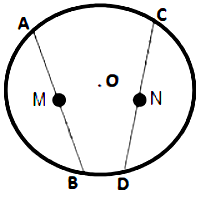
$M$ and $N$ are the mid$-$points of two equal chords $AB$ and $CD$ respectively of a circle with center $O.$Prove that: $(i) \angle BMN = \angle DNM;(ii) \angle AMN = \angle CNM$
​​​​​​​
If $a \cot \theta=b$, prove that $\frac{a \sin \theta-b \cos \theta}{a \sin \theta+b \cos \theta}=\frac{a^2-b^2}{a^2+b^2}$
If $\frac{2}{ m } \times 1 \frac{1}{5}=\frac{3}{7}$ of $2 \frac{1}{2}$, find the value of $' m\ '$.
Construct a trapezium $\text{ABCD}$ in which $AB = 4.6\ cm, BC = 6.4\ cm, CD = 5.6\ cm, \angle B = 60^\circ $ and $AD \| BC.$
Using a scale of $1 \ cm$ to $1$ unit for both the axes, draw the graphs of the following equations: $6y = 5x + 10, y = 5x - 15$.From the graph find :$(i)$ the coordinates of the point where the two lines intersect;$(ii)$the area of the triangle between the lines and the $x-$axis.
A man buys two articles at $Rs.410.$ He sells both at the same price. On one he makes a profit of $15\%$ and on the other a loss of $10\%.$ Find the cost price of both.
Solve the following equations graphically$:\ x-2 y=2 , \frac{x}{2}-y=1$
From a point $O$ in the interior of a $\triangle ABC$, perpendicular $OD, OE$ and $OF$ are drawn to the sides $BC, CA$ and $AB$ respectively. Prove that: $AF^2 + BD^2 + CE^2 = AE^2 + CD^2 + BF^{2 }$
A town has 15625 inhabitants. If the population of this town increases at the rate of 4% per annum, find the number of inhabitants of the town at the end of 3 years.
The class marks of a frequency distribution are $: 15, 25, 35, 45, 55, 65$ and $75.$ Determine the class limits.