Question
Solve the following system of equations graphically:
3x + 2y = 4,
2x - 3y = 7

Answer

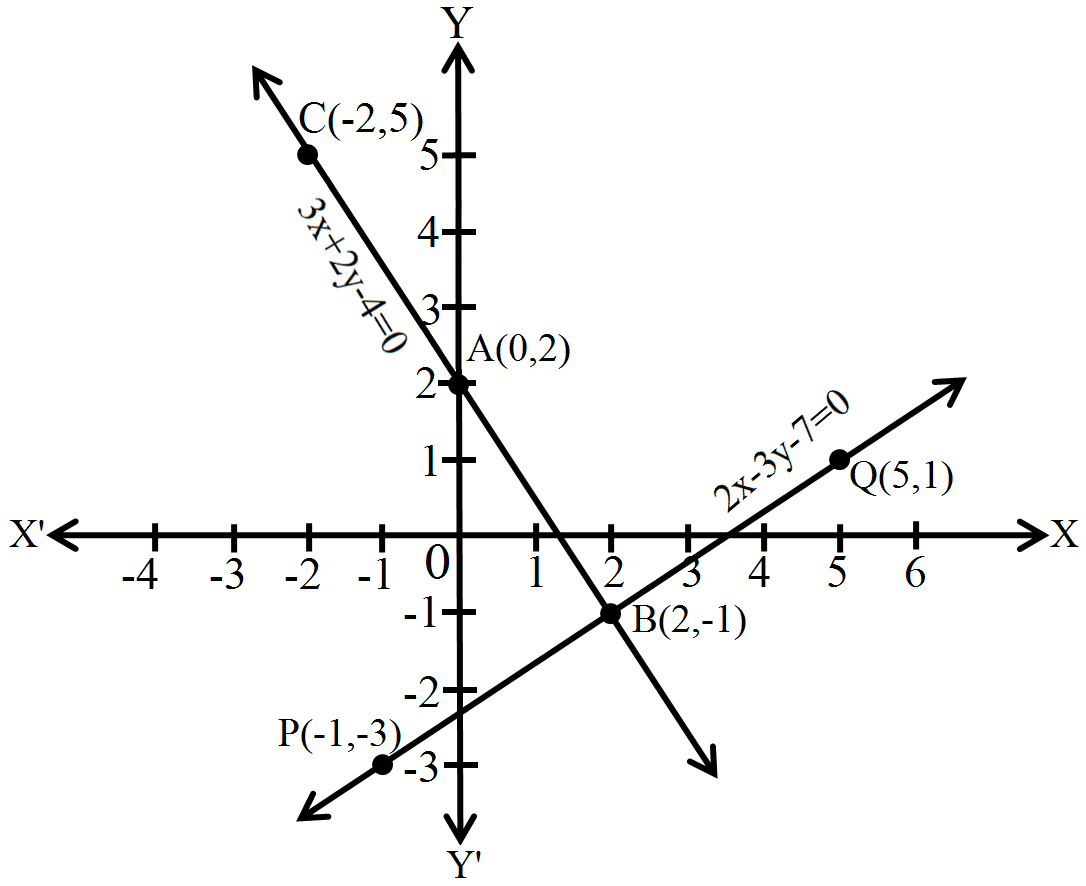
On a graph paper, draw a horizontal line X'OX and a vertical line YOY' representing the x-axis and y-axis, respectively. Graph of 3x + 2y = 4: 3x + 2y = 4 $\Rightarrow\text{y}=\frac{4-\text{3x}}{2}$ Thus we have the following table for 3x + 2y = 4
x:
0
2
-2
y:
2
-1
5
Plot the points A(0, 2), B(2, -1) and C(-2, 5) on the graph paper. Join AB and AC to get the graph line BC. Extend it on both ways. Thus, the line BC is the graph of 3x + 2y = 4. Graph of 2x - 3y = 7: $\Rightarrow\text{y}=\frac{\text{2x}-7}{3}$ Thus, we have the following table for 2x - 3y = 7 is
x:
2
-1
5
y:
-1
-3
1
Now, on the same graph paper plot the points P(-1, -3) and Q(5, 1). The point B(2, -1) has already been plotted. Join PB and QB and extend it on both ways. Thus, line PQ is the graph of 2x - 3y = 7.
The two graph lines intersect at B(2, -1). $\therefore$ x = 2, y = -1 is the solution of the given system of equations.

Need a full question paper?

Generate a complete, print-ready paper with questions like this in minutes — across 16+ boards, with answer keys.

Start Generating Free

Similar questions

The following table gives the production yield per hectare of wheat of 100 farms of a village.
Production yield (kg/ha)
50-55
55-60
60-65
65-70
70-75
75-80
Number of farms
2
8
12
24
38
16
Change the distribution to a 'more than type' distribution and draw its ogive. Using ogive, find the median of the given data.
Find a cubic polynomial whose zeroes are $\frac{1}{2},$ $1$ and $−3$.
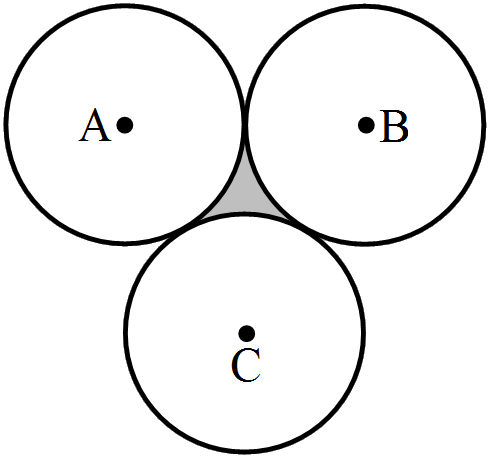
Three equal circles, each of radius 6cm, touch one another as shown in the figune. find the area enclosed between them. $\big[\text{Take }\pi=3.14\text{ and }\sqrt{3}=1.732.\big]$
If $\Big(\frac{\text{x}}{\text{a}}\sin\theta-\frac{\text{y}}{\text{b}}\cos\theta\Big)=1$ and $\Big(\frac{\text{x}}{\text{a}}\cos\theta+\frac{\text{y}}{\text{b}}\sin\theta\Big)=1,$ prove that $\Big(\frac{\text{x}^2}{\text{a}^2}+\frac{\text{y}^2}{\text{b}^2}\Big)=2.$
Short-Answer Question:
If $\alpha$ and $\beta$ are the zeroes of a polynomial $f(x) = 5x^2 - 7x + 1$, find the value of $\Big(\frac{1}{\alpha}+\frac{1}{\beta}\Big).$
A hollow sphere of external and internal diameters 8cm and 4cm, respectively is melted into a solid cone of base diameter 8cm. Find the height of the cone.
Prove the following identities:
$\frac{1+\cos\theta+\sin\theta}{1+\cos\theta-\sin\theta}=\frac{1+\sin\theta}{\cos\theta}$
Draw two concentric circles of radii 4cm and 6cm. Contruct a tangent to the smaller circle from a point on the larger circle. Measure the length of this tangent.
Find the mean of the following frequency distribution using step-deviation method.
Class
0-10
10-20
20-30
30-40
40-50
Frequency
7
10
15
8
10
If $\text{a}\not=\text{b}\not=\text{c},$ prove that $(a, a^2), (b. b^2), (0, 0)$ will not be collinear.