Question
Solve the previous problem if the friction coefficient between the $2.0\ kg$ block and the plane below it is $0.5$ and the plane below the $4.0\ kg$ block is frictionless.
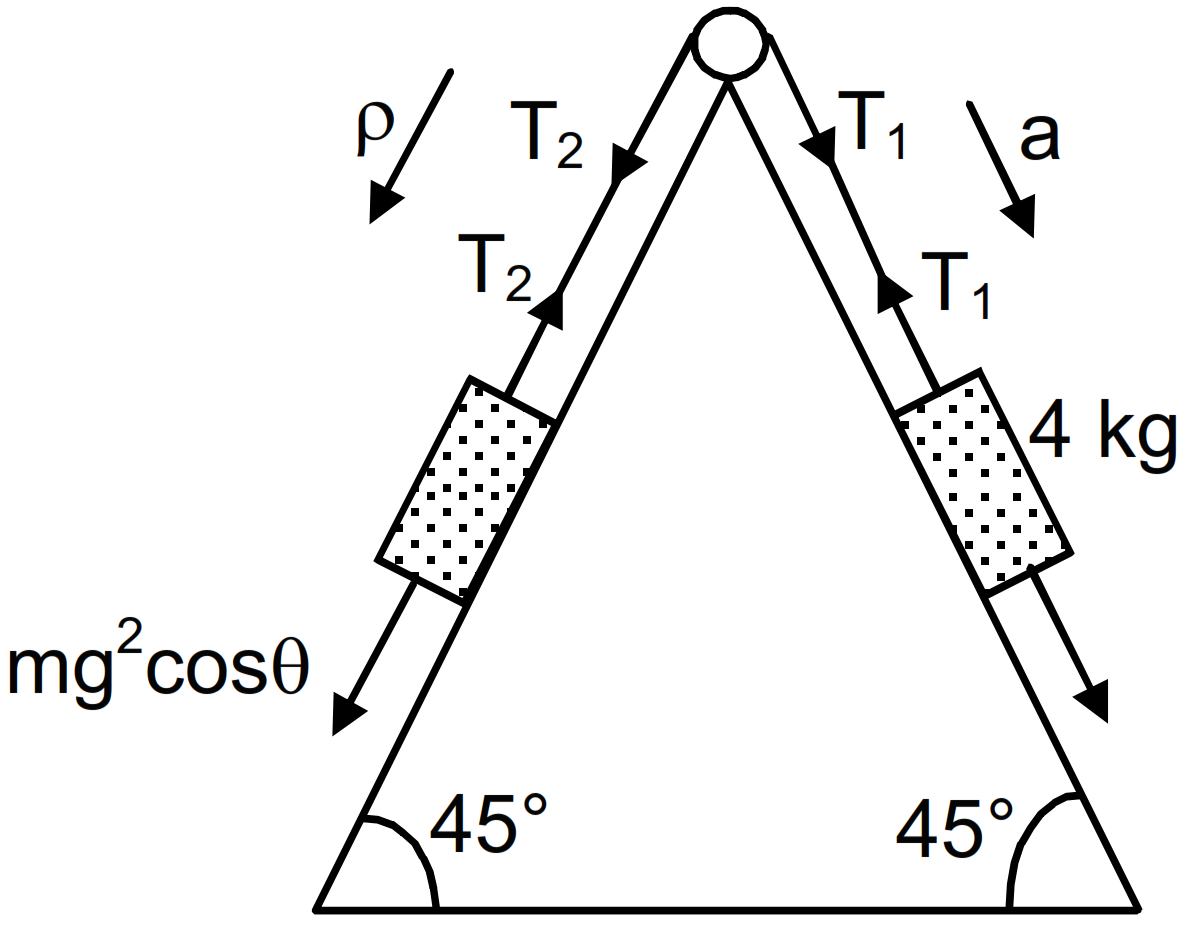
Answer


$m_1 = 4\ kg, m_2 = 2\ kg$
Frictional co $-$ efficient between $2\ kg$ block and surface $= 0.5$
$R = 10\ cm = 0.1m$
$I = 0.5\ kg-m^2$
$\text{m}_1\text{g}\sin\theta-\text{T}_1=\text{m}_1\text{a}\ \dots(1)$
$\text{T}_2-(\text{m}_2\text{g}\sin\theta+\mu\text{m}_2\text{g}\cos\theta)=\text{m}_2\text{a}\ \dots(2)$
$(\text{T}_1-\text{T}_2)=\frac{\text{la}}{\text{r}^2}$
Adding equation $(1)$ and $(2)$ we will get
$\text{m}_1\text{g}\sin\theta-(\text{m}_2\text{g}\sin\theta+\mu\text{m}_2\text{g}\cos\theta)+(\text{T}_1+\text{T}_2)=\text{m}_1\text{a}+\text{m}_2\text{a}$
$\Rightarrow4\times9.8\times\Big(\frac{1}{\sqrt2}\Big)-\Big\{\Big(2\times9.8\times\Big(\frac{1}{\sqrt2}\Big)+0.5\times2\times9.8\times\Big(\frac{1}{\sqrt2}\Big)\Big\}$
$=\Big(4+2+\frac{0.5}{0.01}\Big)\text{a}$
$\Rightarrow27.80-(13.90+6.95)=65\text{a}$
$\Rightarrow\text{a}=0.125\text{ms}^{-2}$

Need a full question paper?

Generate a complete, print-ready paper with questions like this in minutes — across 16+ boards, with answer keys.
Start Generating Free

Similar questions

In a Young's double slit experiment using monochromatic light, the fringe pattern shifts by a certain distance on the screen when a mica sheet of refractive index $1.6$ and thickness $1.964$ micron $(1$ micron $= 10^{-6}m)$ is introduced in the path of one of the interfering waves. The mica sheet is then removed and the distance between the screen and the slits is doubled. It is found that the distance between the successive maxima now is the same as the observed fringe$-$shift upon the introduction of the mica sheet. Calculate the wavelength of the monochromatic light used in the experiment.
What is meant by forward bias and reverse bias of p-n junction diode? Draw experimental electrical circuit diagram to study V-I characteristic in forward bias and reverse bias of p-n junction diode. Draw forward bias and reverse bias V-I characteristic curves of p-n junction diode and briefly explain the following :
(i) Threshold or cut-in voltage
(ii) Breakdown voltage.
A ball of mass m moving at a speed $v$ makes a head$-$on collision with an identical ball at rest. The kinetic energy of the balls after the collision is three fourths of the original. Find the coefficient of restitution.
A long straight horizontal cable carries a current of $2.5 A$ in the direction $10^\circ$ south of west to $10^\circ$ north of east. The magnetic meridian of the place happens to be $10^\circ$ west of the geographic meridian. The earth’s magnetic field at the location is $0.33 G,$  and the angle of dip is zero. Locate the line of neutral points $($ignore the thickness of the cable$). ($At neutral points, magnetic field due to a current $-$ carrying cable is equal and opposite to the horizontal component of earth’s magnetic field.$)$
A proton projected in a magnetic field of $0.020T$ travels along a helical path of radius $5.0\ cm$ and pitch $20\ cm.$ Find the components of the velocity of the proton along and perpendicular to the magnetic field. Take the mass of the proton $= 1.6 \times 10^{-27}kg$
$4 \times 10^{23}$ tritium atoms are contained in a vessel. The half-life of decay tritium nuclei is $12.3y.$ Find:
  1. The activity of the sample.
  2. The number of decay in the next $10$ hours.
  3. The number of decays in the next $6.15y.$
Two charges of$5 \times 10^{-8} C$ and $-3 \times 10^{-8}$ are located at a distance of 16 cm apart. At what point on the line joining the two charges is the electric potential zero? Take the potential at infinity to be zero.
Image
Deuteron is a bound state of a neutron and a proton with a binding energy $B = 2.2\ \text{MeV}. A γ-$ ray of energy $E$ is aimed at a deuteron nucleus to try to break it into a $($neutron $+$ proton$)$ such that the $n$ and $p$ move in the direction of the incident $γ-$ray. If $E = B,$ show that this cannot happen. Hence calculate how much bigger than $B$ must $E$ be for such a process to happen.
A smooth sphere of radius R is made to translate in a straight line with a constant acceleration a. A particle kept on the top of the sphere is released from there at zero velocity with respect to the sphere. Find the speed of the particle with respect to the sphere as a function of the angle $\theta$ it slides.
A parallel-plate capacitor of plate area A and plate separation d is charged to a potential difference V and then the battery is disconnected. A slab of dielectric constant K is then inserted between the plates of the capacitor so as to fill the space between the plates. Find the work done on the system in the process of inserting the slab.