Question 15 Marks
A uniform metre stick of mass $200g$ is suspended from the ceiling through two vertical strings of equal lengths fixed at the ends. A small object of mass $20g$ is placed on the stick at a distance of $70\ cm$ from the left end. Find the tensions in the two strings.
Answer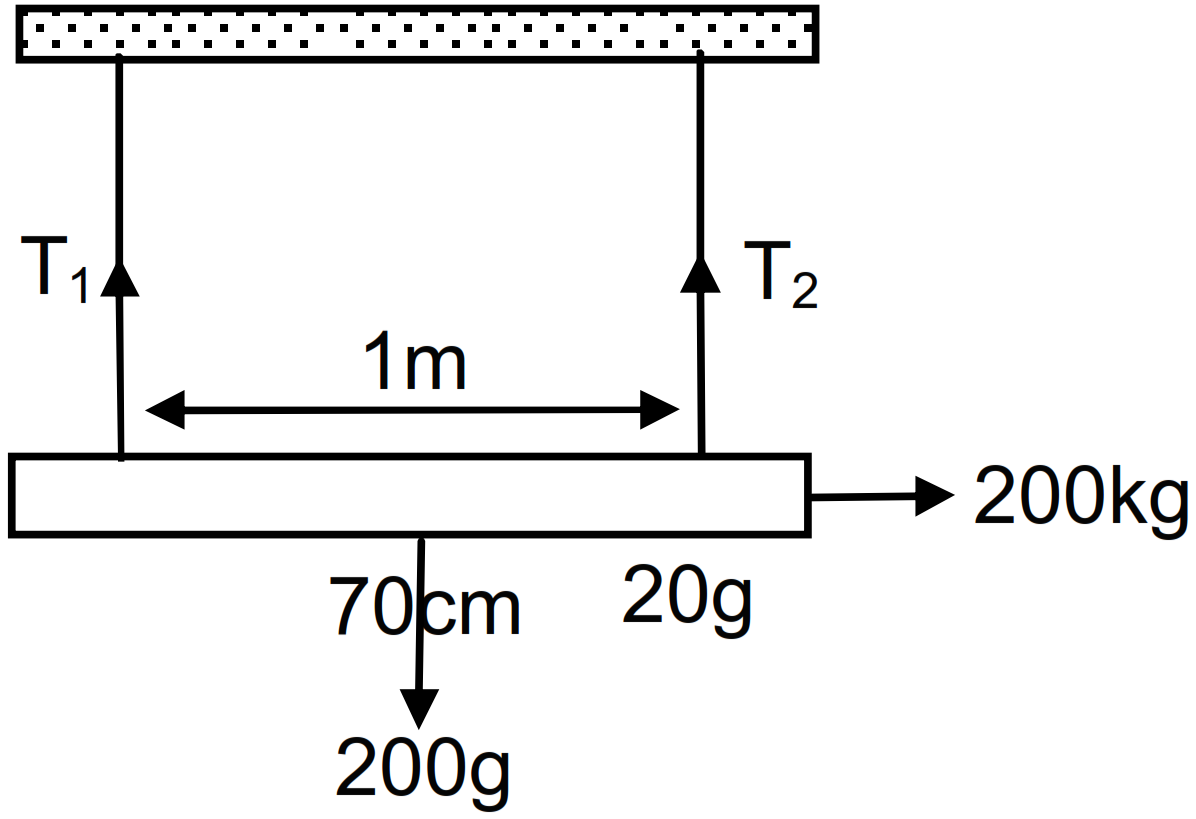
According to the question
$m_1 = 200g, I = 1m, m_2 = 20g$
Therefore $, (T_1 \times r_1) - (T_2 \times r_2) - (m_1f \times r_3g) = 0$
$\Rightarrow T_1 \times 0.7 - T_2 \times 0.3 - 2 \times 0.2 \times g = 0$
$\Rightarrow 7T_1 - 3T_2 = 3.92 ...(1)$
$T_1 + T_2 = 0.2 \times 9.8 + 0.02 \times 9.8 = 2.156 ...(2)$
From the equation $(1)$ and $(2)$ we will get
$10T_1 = 10.3$
$\Rightarrow T_1 = 1.038N = 1.04N$
Therefore $, T_2 = 2.156 - 1.038 = 1.118 = 1.12N.$
View full question & answer→According to the question
$m_1 = 200g, I = 1m, m_2 = 20g$
Therefore $, (T_1 \times r_1) - (T_2 \times r_2) - (m_1f \times r_3g) = 0$
$\Rightarrow T_1 \times 0.7 - T_2 \times 0.3 - 2 \times 0.2 \times g = 0$
$\Rightarrow 7T_1 - 3T_2 = 3.92 ...(1)$
$T_1 + T_2 = 0.2 \times 9.8 + 0.02 \times 9.8 = 2.156 ...(2)$
From the equation $(1)$ and $(2)$ we will get
$10T_1 = 10.3$
$\Rightarrow T_1 = 1.038N = 1.04N$
Therefore $, T_2 = 2.156 - 1.038 = 1.118 = 1.12N.$
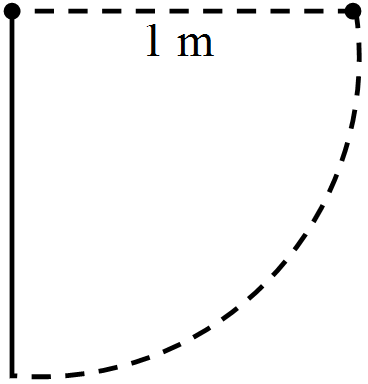
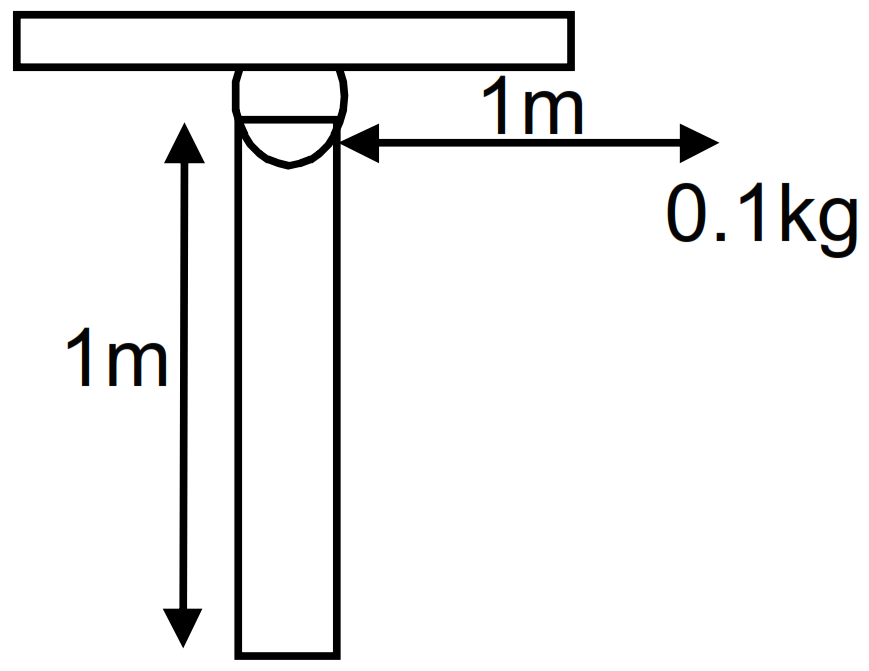 $\frac{1}{2}\text{l}\omega^2-0=0.1\times10\times1$
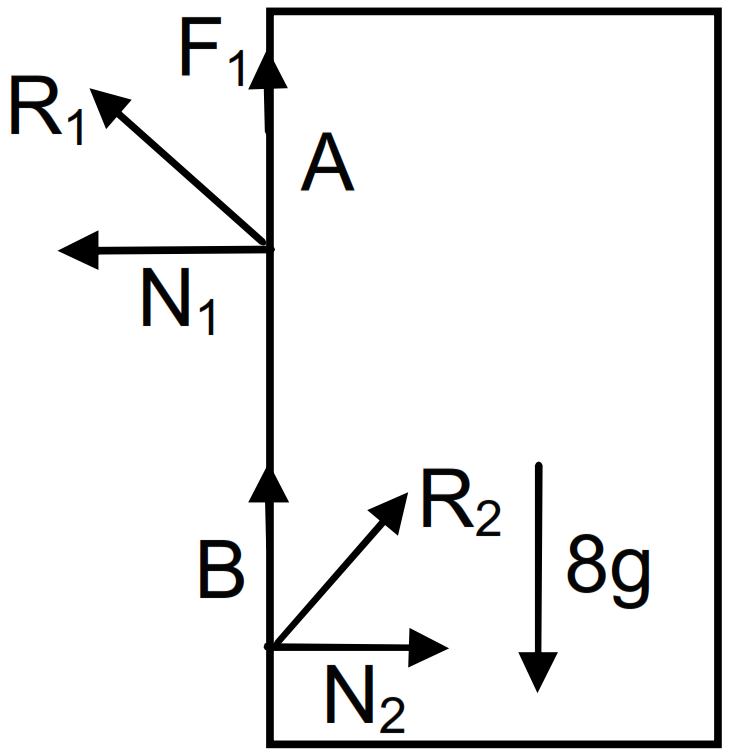
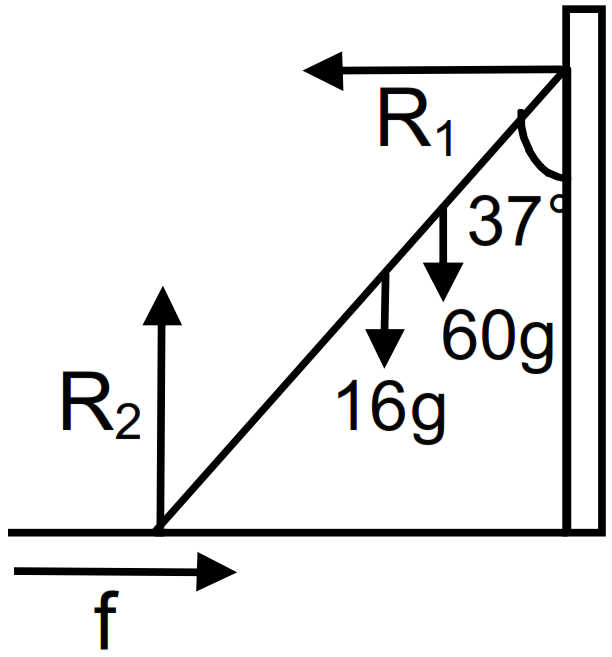 $\mu=0.54,\ \text{R}_2=16\text{g}+\text{mg};\ \text{R}_1=\mu\text{R}_2$
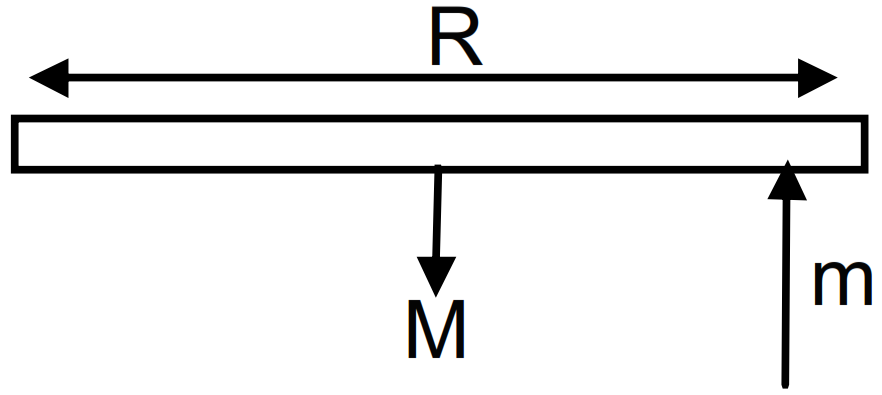 Let the mass of the particle = m & the mass of the rod = M.
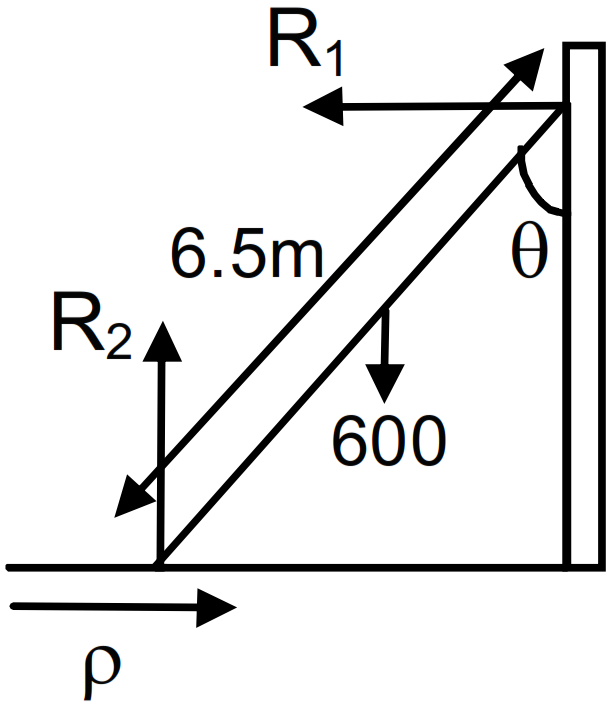 m = 60kg, ladder length = 6.5m, height of the wall = 6m
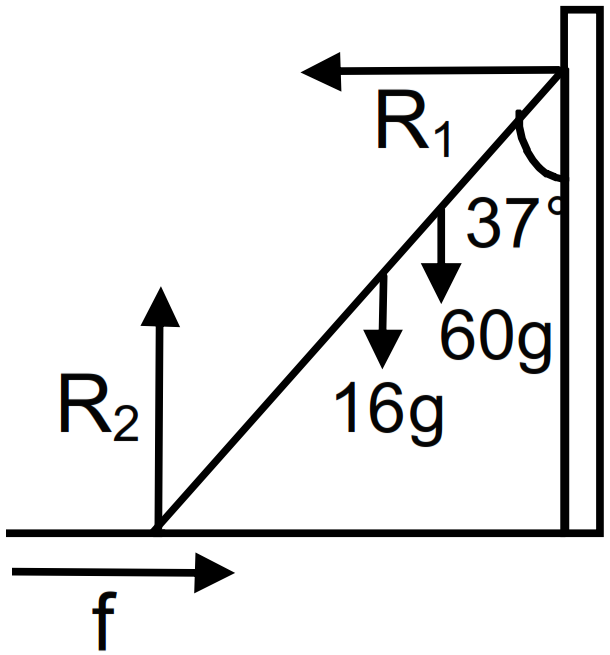 $\text{R}_1=\mu\text{R}_2,\ \text{R}_2=16\text{g}+60\text{g}=745\text{N}$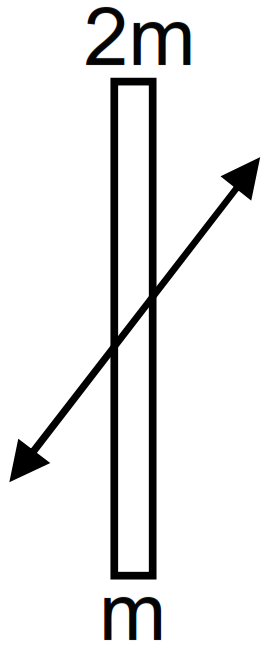
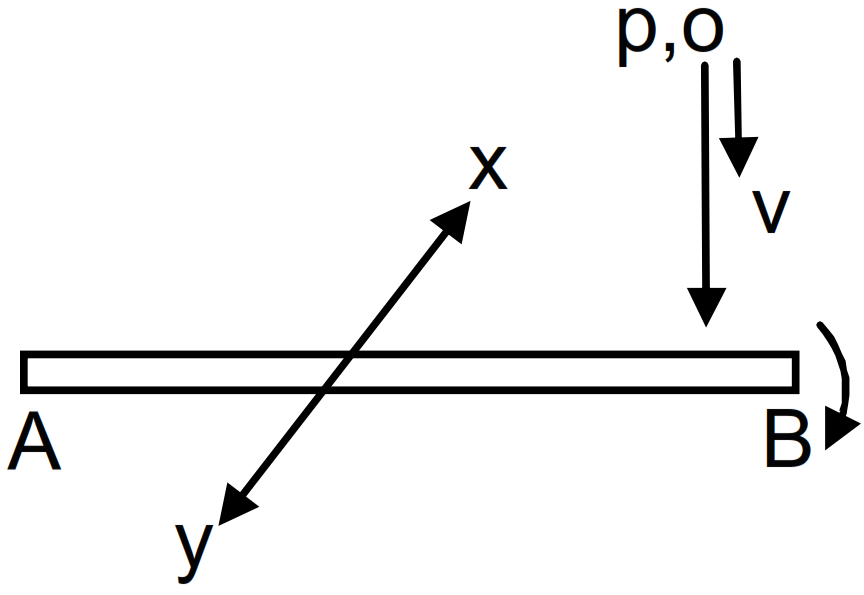
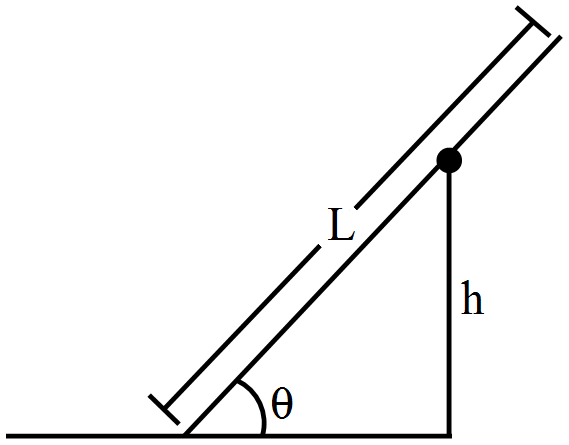
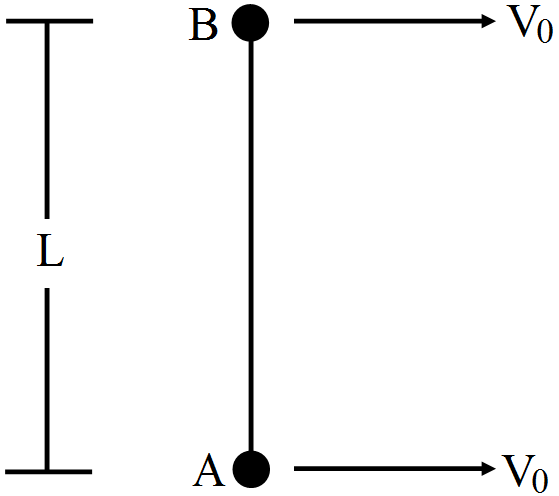
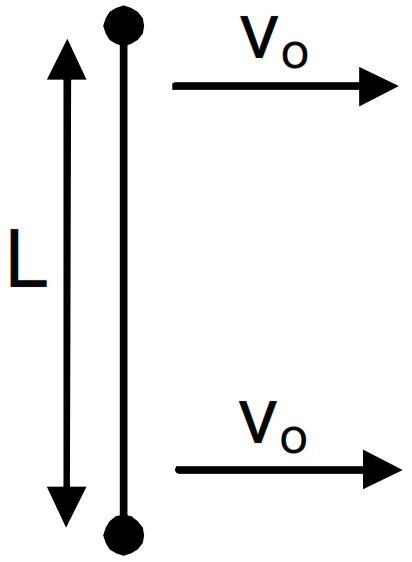
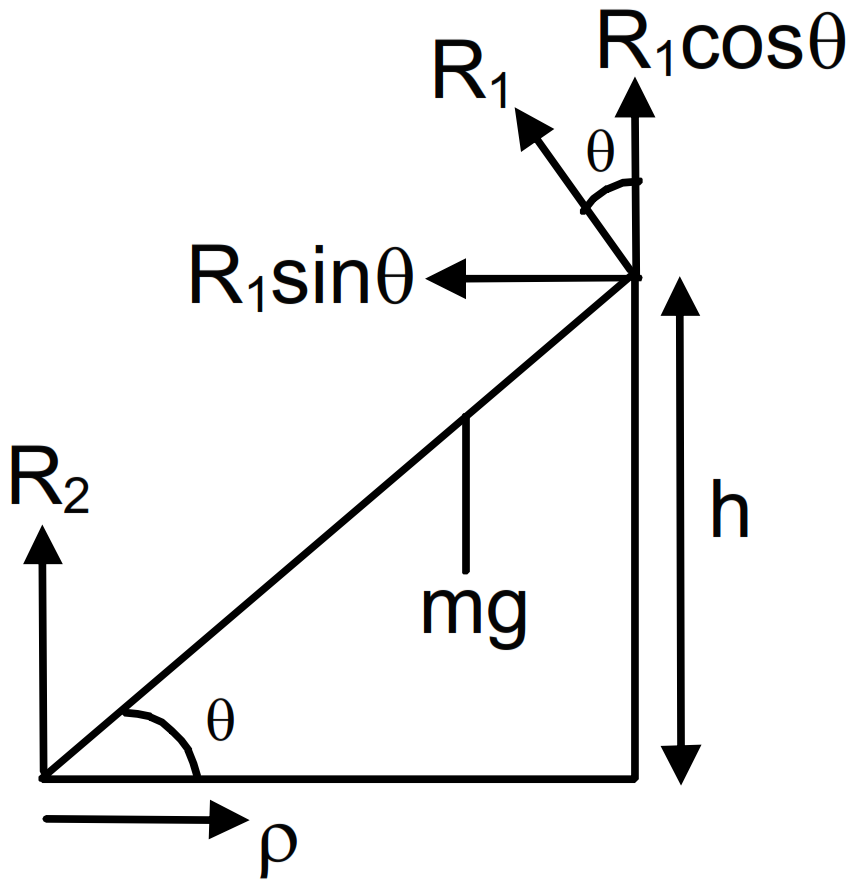 Rod has a length = L
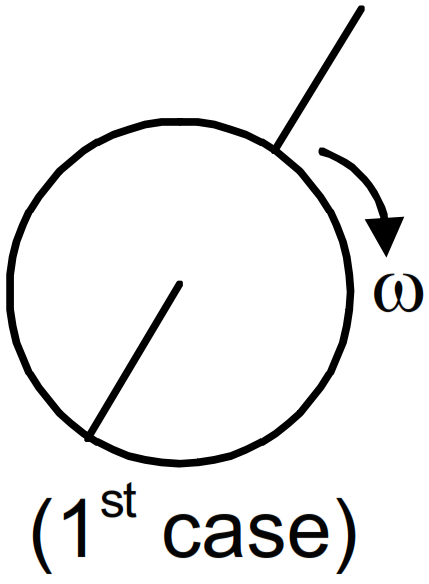
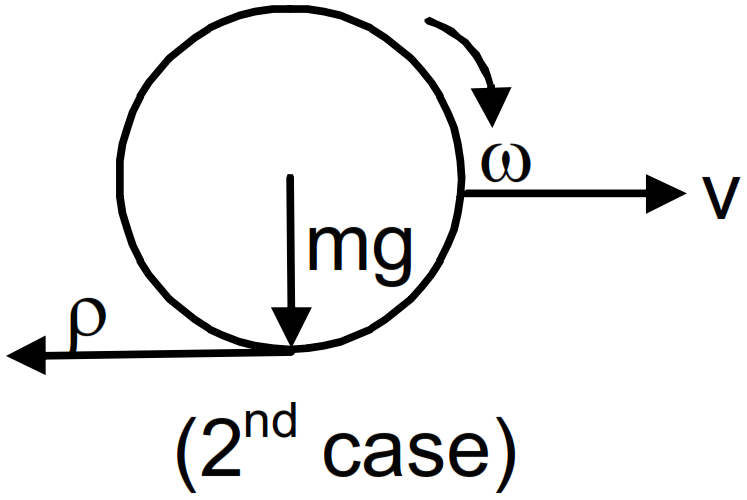 If we consider the net moment at A then it is zero. Therefore the net angular momentum before pure rolling & after pure rolling remains constant Before rolling the wheel was only rotating around its axis. Therefore Angular momentum $=\ell\omega=\Big(\frac{1}{2}\Big)\text{MR}^2\omega\ \dots(1)$ After pure rolling the velocity of the wheel let v Therefore angular momentum $=\ell_{\text{cm}}\omega+\text{m}(\text{v}\times\text{R})$$=\Big(\frac{1}{2}\Big)\text{m}\text{R}^2\Big(\frac{\text{v}}{\text{R}}\Big)+\text{mvR}=\frac{3}{2}\text{mvR}\ \dots(2)$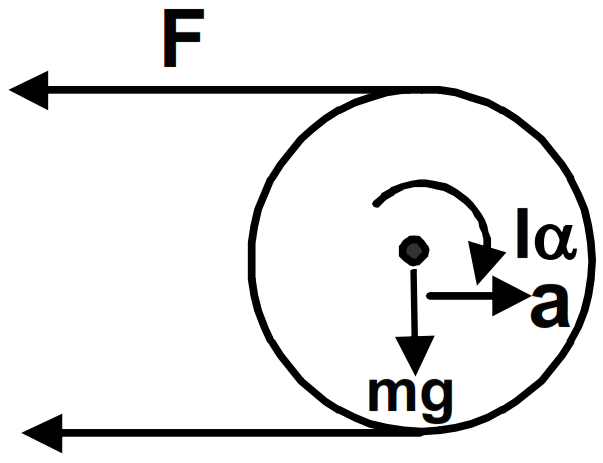
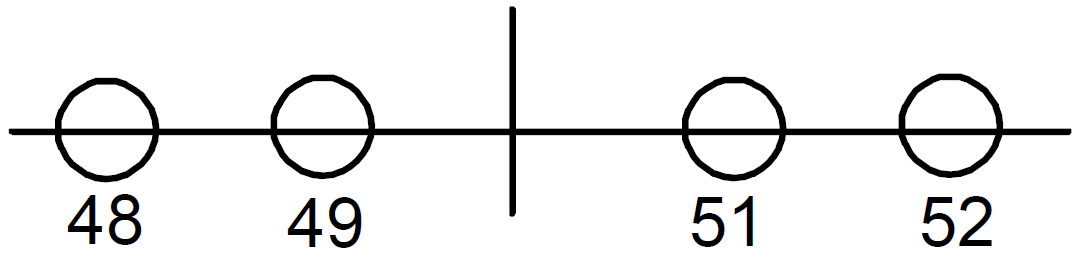
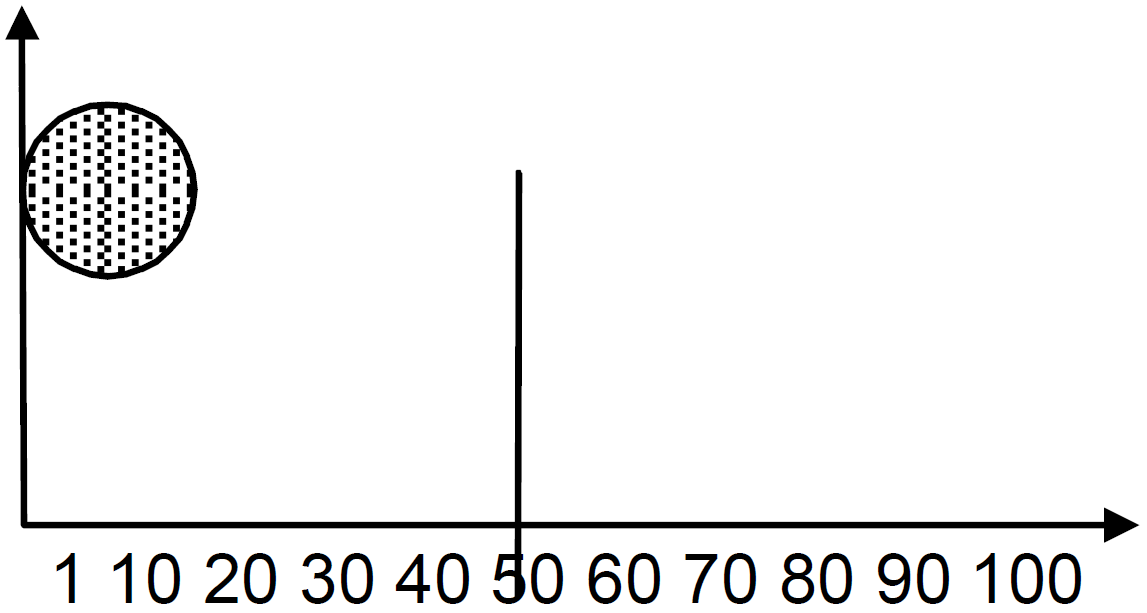 Therefore on the $\text{L.H.S}$. side of the axis there will be $49$ particles and on the $\text{R.H.S}$. side there are $50$ particles.