Question
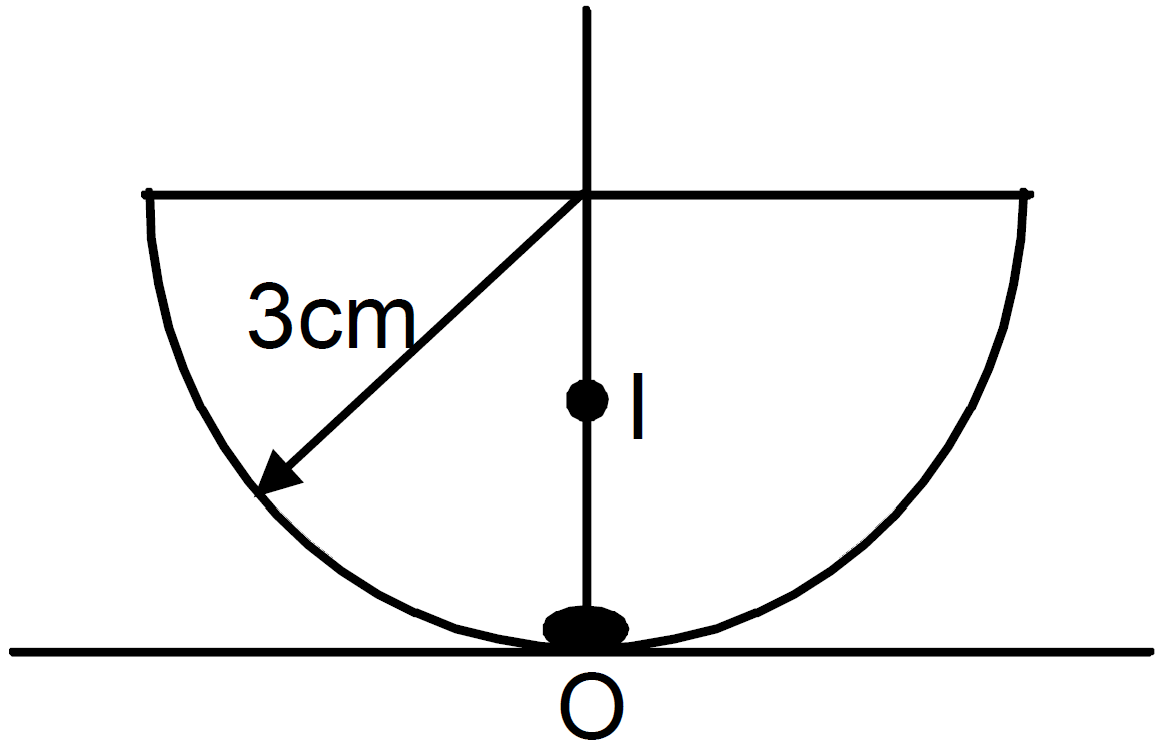
Solve the previous problem if the paperweight is inverted at its place so that the spherical surface touches the paper.
Answer

Thickness of glass $=3\text{cm}, \ \mu_{\text{g}}=1.5$ Image shif $=3\Big(1-\frac{1}{1.5}\Big)$ [Treating it as a simple refraction problem because the upper surface is flat and the spherical surface is in contact with the object]$=3\times\frac{0.5}{1.5}=1\text{cm}.$
The image will appear 1 cm above the point P.

Need a full question paper?

Generate a complete, print-ready paper with questions like this in minutes — across 16+ boards, with answer keys.
Start Generating Free

Similar questions

  1. A giant refracting telescope at an observatory has an objective lens of focal length 15 m. If an eyepiece of focal length 1.0 cm is used, what is the angular magnification of the telescope?
  2. If this telescope is used to view the moon, what is the diameter of the image of the moon formed by the objective lens? The diameter of the moon is $3.48 \times 10^6m,$ and the radius of lunar orbit is $3.8 \times 10^8m.$
In the relation to the photoelectric effect, write the definition of the terms 'stopping potential' and 'threshold frequency'. How are these physical quantities determined using Einstein's equation?
A hot gas emits radiation of wavelengths 46.0nm, 82.8nm and 103.5nm only. Assume that the atoms have only two excited states and the difference between consecutive energy levels decreases as energy is increased. Taking the energy of the highest energy state to be zero, find the energies of the ground state and the first excited state.
  1. Define the term ‘intensity of radiation’ in terms of photon picture of light.
  2. Two monochromatic beams, one red and the other blue, have the same intensity. In which case (i) The number of photons per unit area per second is larger, (ii) The maximum kinetic energy of the photoelectrons is more? Justify your answer.
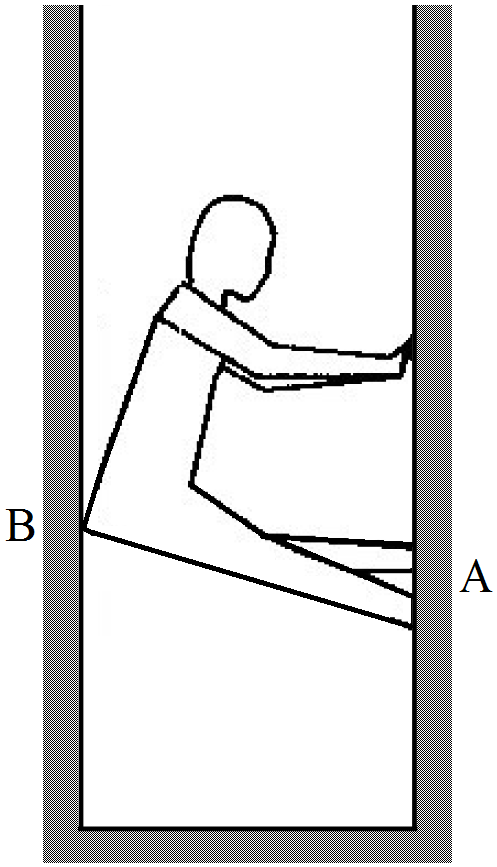
A person (40kg) is managing to be at rest between two vertical walls by pressing one wall A by his hands and feet and the other wall B by his back. Assume that the friction coefficient between his body and the walls is 0.8 and that limiting friction acts at all the contacts.
  1. Show that the person pushes the two walls with equal force.
  2. Find the normal force exerted by either wall on the person. Take $g = 10m/s^2.$
Two electric charges $+Q$ and $-Q(x-y)$ are placed at the points $\left(-x_2, 0\right)$ and $\left(x_1, 0\right)$ respectively in the plane. Find the magnitude and direction of the resultant electric field at the origin $(0,0)$.
(a) Which of the following can be a source for origin of electromagnetic waves? Give reason.
(i) A charge moving with constant speed
(ii) Charge undergoing circular motion
(iii) Fixed charge.
(b) Name that part of electromagnetic spectrum with which waves of frequency
(i) $10^{20} Hz$,
(ii) $10^9 Hz$ associated.
  1. Draw the equipotential surfaces corresponding to a uniform electric field in the z-direction.
  2. Derive an expression for the electric potential at any point along the axial line of an electric dipole.
Identify the following electromagnetic radiations as per the wavelengths given below.
Write one application of each.
  1. $10^{–3}nm$
  2. $10^{–3} m$
  3. $1 nm$

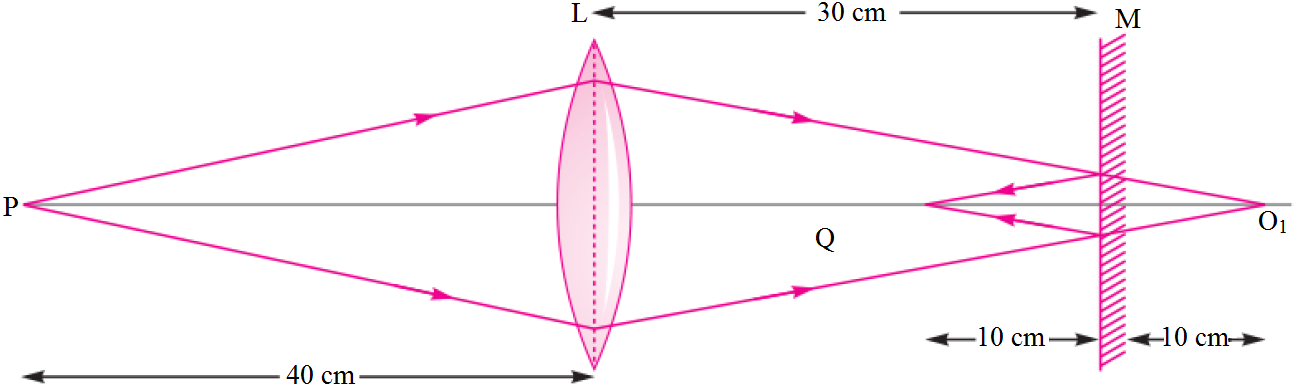
A convex lens, of focal length 20cm, has a point object placed on its principle axis at distance of 40cm from it. A plane mirror is placed 30cm behind the convex lens. Locate the position of image formed by this combination.