Question
Solve the previous question if the closed loop is completely enclosed in the circuit containing the switch.
  1. An anticlockwise current-pulse.
  2. A clockwise current-pulse.
  3. An anticlockwise current-pulse and then a clockwise current-pulse.
  4. A clockwise current-pulse and then an anticlockwise current-pulse.
Answer

  1. An anticlockwise current-pulse and then a clockwise current-pulse.

Explanation:

An anticlockwise current-pulse generated and then a clock-wise current pulse.

Need a full question paper?

Generate a complete, print-ready paper with questions like this in minutes — across 16+ boards, with answer keys.

Start Generating Free

Similar questions

A wave equation is given as $y = cos\,\,(500t - 70x),$ where $y$ is in $mm$, $x$ in $m$ and $t$ is in $sec$.
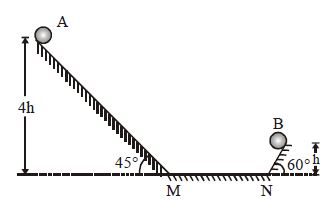
Two identical balls $A$ and $B$ are released from the positions shown in figure. They collide elastically on horizontal portion $MN$ . The ratio of the heights attained by $A$ and $B$ after collision will be : (neglect friction)
A target is made of two plates, one of wood and the other of iron. The thickness of the wooden plate is $4\,cm$ and that of iron plate is $2\,cm$. A bullet fired goes through the wood first and then penetrates $1\,cm$ into iron. A similar bullet fired with the same velocity from opposite direction goes through iron first and then penetrates $2\,cm$ into wood. If $a_1$ and $a_2$ be the retardations offered to the bullet by wood and iron plates respectively, then
A travelling wave is partly reflected and partly transmitted from a rigid boundary. Let $a_i, a_r$ and $a_t$ be the amplitude of incident wave, reflected wave and transmitted wave and $I_i, I_r$ and $I_t$ be the corresponding intensities. Then choose the correct alternatives
Consider a photon of continuous X-ray and a photon of characteristic X-ray of the same wavelength. Which of the following is/are different for the two photons?
  1. Frequency.
  2. Energy.
  3. Penetrating power.
  4. Method of creation.
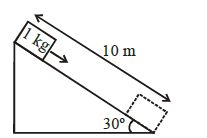
Find work done by friction if block reaches to the end with constant velocity
$Assertion :$ In pressure-temperature $(P-T)$ phase diagram of water, the slope of the melting curve is found to be negative.
$Reason :$ Ice contracts on melting to water.
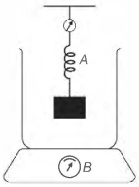
A spring balance $A$ reads $2 \,kg$ with a block of mass $m$ suspended from it. Another balance $B$ reads $3 \,kg$ when a beaker with a liquid is put on its pan. The two balances are now so arranged that the hanging mass $m$ is fully immersed inside the liquid in the beaker as shown in the figure given below.In this situation,
For frictionless surfaces in given arrangement tension $T_2$ is :-
A uniform metal plate shaped like a triangle $A B C$ has a mass of $540 \,g$. The length of the sides $A B, B C$ and $C A$ are $3 \,cm , 5 \,cm$ and $4 \,cm$, respectively. The plate is pivoted freely about the point $A$. What mass must be added to a vertex, so that the plate can hang with the long edge horizontal?