Question
Solve using formula.
$x^2+6 x+5=0$

Answer

$x^2+6 x+5=0 $
$\Rightarrow x ^2+6 x +5=0 \text { compare with } ax ^2+ bx + c =0 $
$\Rightarrow a =1, b=6 \text { and } c =5 $
$\therefore b ^2-4 ac =6^2-4(1)(5) $
$=36-20 $
$=16 $
$x=\frac{-b \pm \sqrt{b^2-4 a c}}{2 a} $
$x=\frac{-6 \pm \sqrt{16}}{2 \times 1}=\frac{-6 \pm 4}{2} $
$\Rightarrow x =\frac{-6+4}{2} \text { or } x =\frac{-6-4}{2} $
$\Rightarrow x =-\frac{2}{2} \text { or } x =-\frac{10}{2} $
$\Rightarrow x =-1 \text { or } x =-5$
 

Need a full question paper?

Generate a complete, print-ready paper with questions like this in minutes — across 16+ boards, with answer keys.
Start Generating Free

Similar questions

In the following system of equation determine whether the system has a unique solution, no solution or infinitely many solutions. In case there is a unique solution, find it:
$2x + y = 5$
$4x + 2y = 10$
The radii of two cones are in the ratio $2 : 1$ and their volumes are equal. What is the ratio of their heights?
A lawn is in the from of a rectangle whose sides are in the ratio $5 : 3$ and its area is $3375\ m^2$. Find the cost of fencing the lawn at $₹ 20$ per meter.
A well of diameter $3\ m$ is dug $14\ m$ deep. The earth taken out of it has been spread evenly all around it to a width of $4\ m$ to form an embankment. Find the height of the embankment.
Find the value of $k$ for which root are real and equal in the following equations:
$2kx^2 - 40x + 25 = 0$
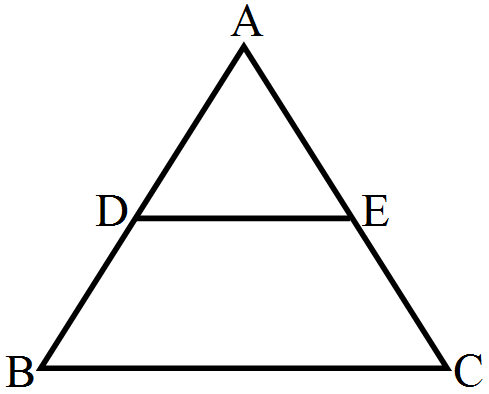
D and E are points on the sides AB and AC respectively of a $\triangle\text{ABC}.$ In the following cases, determine whether DE || BC or not.
AD = 5.7cm, DB = 9.5cm, AE = 4.8cm and EC = 8cm.
>Radius of a sector of a circle is 7 cm. If measure of arc of the sector is –
(I) $30^{\circ}$
(II) $210^{\circ}$
(lll) three right angles
Find the area of sector in each case.
If One coin and one die are thrown simultaneously, find the probability of the following events.
 i) Event A : To get a tail and an even number.
 ii) Event B: To get head and an odd number. 
If a $\triangle\text{ABC},$ AD is the bisector of $\angle\text{A},$ Meeting side BC at D.
If AC = 4.2cm, DC = 6cm and BC = 10cm, find AB.
Solve the following equations by using the method of completing the square:
$4x^2 + 4bx - (a^2 - b^2) = 0$