Spherical balls of radius $ 'r'$ are falling in a viscous fluid of viscosity '$\eta$' with a velocity $ 'v'. $ The retarding viscous force acting on the spherical ball is
AIEEE 2004, Easy


Download our appand get started for free
Experience the future of education. Simply download our apps or reach out to us for more information. Let's shape the future of learning together!No signup needed.*
Similar Questions
- 1Blood velocity: The flow of blood in a large artery of an anesthetised dog is diverted through a Venturi meter. The wider part of the meter has a crosssectional area equal to that of the artery. $A = 8\; mm^2$. The narrower part has an area $a = 4 \;mm^2$. The pressure drop in the artery is $24\; Pa$. What is the speed (in $m/s$) of the blood in the artery?View Solution
- 2If two liquids of same volume but different densities ${\rho _1}$ and ${\rho _2}$ are mixed, then density of mixture is given byView Solution
- 3View SolutionWith rise in temperature, density of a given body changes according to one of the following relations
- 4A cubical block of wood of specific gravity $0.5$ and a chunk of concrete of specific gravity $2.5$ are fastened together. The ratio of the mass of wood to the mass of concrete which makes the combination to float with its entire volume submerged under water isView Solution
- 5In an experiment, a small steel ball falls through a Iiquid at a constant speed of $10\, cm/s$. If the steel ball is pulled upward with a force equal to twice its effective weight, how fast will it move upward ? ......... $cm/s$View Solution
- 6A raindrop with radius $R=0.2\, {mm}$ fells from a cloud at a height $h=2000\, {m}$ above the ground. Assume that the drop is spherical throughout its fall and the force of buoyance may be neglected, then the terminal speed attainde by the raindrop is : (In ${ms}^{-1}$)View Solution
[Density of water $f_{{w}}=1000\;{kg} {m}^{-3}$ and density of air $f_{{a}}=1.2\; {kg} {m}^{-3}, {g}=10 \;{m} / {s}^{2}$ Coefficient of viscosity of air $=18 \times 10^{-5} \;{Nsm}^{-2}$ ]
- 7A flat plate of area $10\,cm^2$ is separated from a large plate by a layer of glycerine $1\, mm$ thick. If the coefficient of viscosity of glycerine is $20$ poise, the force required to keep the plate moving with a velocity of $1\,cm/sec$ is .......... $dyne$View Solution
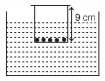
- 8A wide bottom cylindrical massless plastic container of height $9 \,cm$ has $40$ identical coins inside it and is floating on water with $3 \,cm$ inside the water. If we start putting more of such coins on its lid, it is observed that after $N$ coins are put, its equilibrium changes from stable to unstable. Equilibrium in floating is stable if the geometric centre of the submerged portion is above the centre of the mass of the object). The value of $N$ is closed toView Solution
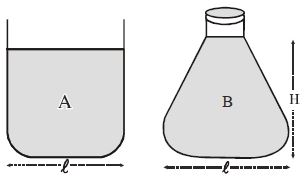
- 9Two vessels $A$ and $B$ have the same base area and contain water to the same height, but the mass of water in $A$ is four times that in $B$. The ratio of the liquid thrust at the base of $A$ to that at the base of $B$ isView Solution
- 10A boy has $60\, kg$ weight. He wants to swim in a river with the help of a wooden log. If relative density of wood is $0.6$, what is the minimum volume of wooden log? (density of river water is $1000\, kg/m^3$)View Solution