MCQ
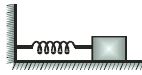
Spring of spring constant $1200\, Nm^{-1}$ is mounted on a smooth frictionless surface and attached to a block of mass $3\, kg$. Block is pulled $2\, cm$ to the right and released. The angular frequency of oscillation is .... $ rad/sec$
  • A
    $5$
  • B
    $30$
  • C
    $10$
  • $20$

Answer

Correct option: D.
$20$
d
Angular frequency

$\omega=\sqrt{\frac{\mathrm{K}}{\mathrm{m}}}=\sqrt{\frac{1200}{3}}=20 \mathrm{rad} / \mathrm{sec}$

Need a full question paper?

Generate a complete, print-ready paper with questions like this in minutes — across 16+ boards, with answer keys.

Start Generating Free

Similar questions

The contact angle between as solid and a liquid is a property of:
Which of the diagrams shown in represents variation of total mechanical energy of a pendulum oscillating in air as function of time?
If displacement $x$ and velocity $v$ are related as $4v^2 = 25 -x^2$ in a $SHM$. Then time Period of given $SHM$ is (Consider $SI\, units$)
Two sinusoidal waves with same wavelengths and amplitudes travel in opposite directions along a string with a speed $10 ms^{-1}$. If the minimum time interval between two instants when the string is flat is $0.5\, s$, the wavelength of the waves is .... $m$
A liquid cools from $50^oC$ to $45^oC$ in 5 minutes and from $45 ^o C$ to $41.5 ^o C$ in the next $5$ minutes. The temperature of the surrounding is ...... $^oC$
The $x-t$ graph of a particle moving along a straight line is shown in figure The speed-time graph of the particle is correctly shown by
A swimmer swims in still water at a speed $= 5\,\, km/hr$. He enters a $200\,\, m$ wide river, having river flow speed $= 4\,\, km/hr$ at point A and proceeds to swim at an angle of $127^o$ (sin $37^o = 0.6$) with the river flow direction.Another point $B$ is located directly across Aon the other side. The swimmer lands on the other bank at a point $C$, from which he walks the distance $CB$ with a speed $= 3\,\, km/hr.$ The total time in which he reachrs from $A$ to $B$ is..........$minutes$
The radius of a metal sphere at room temperature $T$ is $R$, and the coefficient of linear expansion of the metal is $\alpha.$ The The sphere is heated a little by a temperature $\Delta\text{T}$ so that its new temperature is $\text{T}+\Delta\text{T}.$ The increase in the volume of the sphere is approximately:
Consider the following two equations:
$A. \overrightarrow{\text{R}}=\frac{1}{\text{M}}\sum\limits_{\text{i}}\text{m}_\text{i}\overrightarrow{\text{r}}_\text{i}$
$B. \overrightarrow{\text{a}}_\text{cm}=\frac{\overrightarrow{\text{F}}}{\text{M}}$
In a noninertial frame
A block of mass $m$ (initially at rest) is sliding up (in vertical direction) against a rough vertical wall with the help of a force $F$ whose magnitude is constant but direction is changing. $\theta  = {\theta _0}t$  where $t$ is time in sec. At $t$ = $0$ , the force is in vertical upward direction and then as time passes its direction is getting along normal, i.e., $\theta  = \frac{\pi }{2}$ .The value of $F$ so that the block comes to rest when $\theta  = \frac{\pi }{2}$ , is