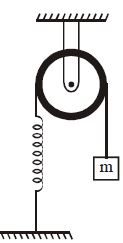
Springs of spring constants $K, 2K, 4K, 8K,$ ..... are connected in series. A mass $40\, gm$ is attached to the lower end of last spring and the system is allowed to vibrate. What is the time period of oscillation ..... $\sec$. (Given $K = 2\, N/cm$)
Medium


Download our appand get started for free
Experience the future of education. Simply download our apps or reach out to us for more information. Let's shape the future of learning together!No signup needed.*
Similar Questions
- 1View SolutionIdentify correct statement among the following
- 2A linear harmonic oscillator of force constant $2 \times 10^6\,Nm^{-1}$ and amplitude $0.01\, m$ has a total mechanical energy of $160\, J.$ ItsView Solution
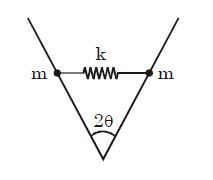
- 3Two particles of mass $m$ are constrained to move along two horizontal frictionless rails that make an angle $2\theta $ with respect to each other. They are connected by a spring with spring constant $k$ . The angular frequency of small oscillations for the motion where the two masses always stay parallel to each other (that is the distance between the meeting point of the rails and each particle is equal) isView Solution
- 4A particle executing simple harmonic motion along $Y- $axis has its motion described by the equation $y = A\sin (\omega \,t) + B$. The amplitude of the simple harmonic motion isView Solution
- 5A particle executing simple harmonic motion of amplitude $5\, cm$ has maximum speed of $31.4\, cm/s$. The frequency of its oscillation is ..... $Hz$View Solution
- 6A body oscillates with $S.H.M.$ according to the equation $x=(5.0 \,m ) \cos \left[\left(2 \pi \,rad s ^{-1}\right) t+\pi / 4\right]$ At $t=1.5 \,s$, its acceleration is ....... $m / s ^2$View Solution
- 7A particle moves with simple harmonic motion in a straight line. In first $\tau \,s,$ after starting from rest it travels a distance $a,$ and in next $\tau \,s$ it travels $2a,$ in same direction, thenView Solution
- 8Two bodies $M$ and $N $ of equal masses are suspended from two separate massless springs of force constants $k_1$ and $k_2$ respectively. If the two bodies oscillate vertically such that their maximum velocities are equal, the ratio of the amplitude $M$ to that of $N$ isView Solution
- 9The amplitude of a damped oscillator becomes one third in $2\, sec$. If its amplitude after $6\, sec$ is $1/n$ times the original amplitude then the value of $n$ isView Solution
- 10A mass $m = 8\,kg$ is attahced to a spring as shown in figure and held in position so that the spring remains unstretched. The spring constant is $200\,N/m$. The mass $m$ is then released and begins to undergo small oscillations. The maximum velocity of the mass will be ..... $m/s$ $(g = 10\,m/s^2)$View Solution