Question
“Stability of carbocations depends upon the electron releasing inductive effect of groups adjacent to positively charged carbon atom involvement of neighbouring groups in hyperconjugation and resonance.”
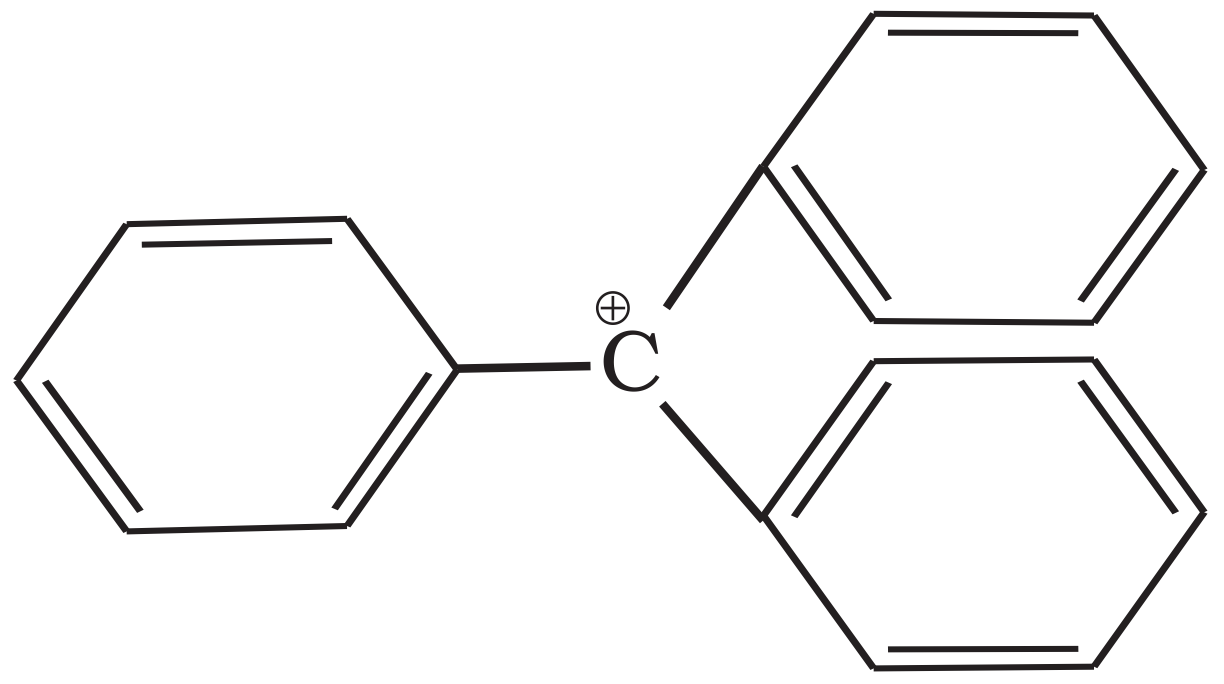
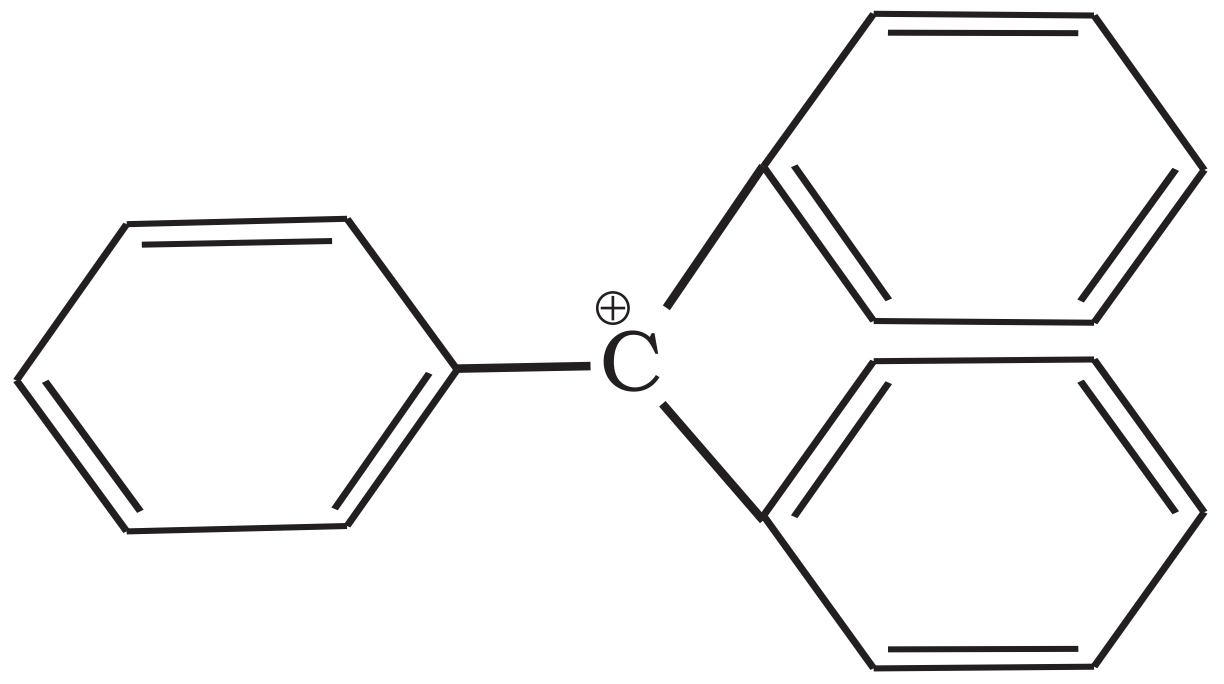
The structure of triphenylmethyl cation is given below. This is very stable and some of its salts can be stored for months. Explain the cause of high stability of this cation.
Answer

Triphenylmethyl cation is very stable because +ve charge of methyl carbon is delocalized in three phenyl rings. In each phenyl ring, +ve charge is developed on 2 ortho position and para position, i.e. three resonating structures. Total resonating structures given by triphenylmethyl cation are nine. Hence, it is very stable. These structures can be shown as.

Need a full question paper?

Generate a complete, print-ready paper with questions like this in minutes — across 16+ boards, with answer keys.

Start Generating Free

Similar questions

Identify the type of reactions:
  1. $\text{CH}_4+\text{Cl}_2\xrightarrow{\text{sunlight}}\text{CH}_3\text{Cl}+\text{HCl}$
  2. $\text{C}_6\text{H}_6+(\text{conc.})\text{HNO}_36\xrightarrow{\text{conc.}\text{H}_2\text{SO}_4}\text{C}_6\text{H}_5\text{NO}_2+\text{H}_2\text{O}$
  3. $ \ \ \ \ \ \ \ \ \ \ \ \ \ \ \ \ \ \ \ \ \ \ \ \ \ \ \ \ \ \ \ \ \ \ \ \ \ \ \ \ \ \ \ \ \ \ \ \ \ \ \ \ \ \ \ \ \ \ \ \ \ \ \ \ \ \text{Br}\\\ \ \ \ \ \ \ \ \ \ \ \ \ \ \ \ \ \ \ \ \ \ \ \ \ \ \ \ \ \ \ \ \ \ \ \ \ \ \ \ \ \ \ \ \ \ \ \ \ \ \ \ \ \ \ \ \ \ \ \ \ \ \ \ \ \ |\\\text{CH}_3-\text{CH}=\text{CH}_2+\text{HBr}\xrightarrow{\ \ \ \ \ \ \ }\text{CH}_3-\text{CH}-\text{CH}_3$
  4. $\ \ \ \ \ \ \ \ \ \ \ \ \ \text{O}\ \ \ \ \ \ \ \ \ \ \ \ \ \ \ \ \ \ \ \ \ \ \ \ \ \ \ \ \ \ \ \ \ \ \ \ \ \ \ \ \ \ \ \ \ \ \ \text{OH}\\\ \ \ \ \ \ \ \ \ \ \ \ \ \| \ \ \ \ \ \ \ \ \ \ \ \ \ \ \ \ \ \ \ \ \ \ \ \ \ \ \ \ \ \ \ \ \ \ \ \ \ \ \ \ \ \ \ \ \ \ \ \ \ \ |\\ \text{CH}_3-\text{C}-\text{CH}_3+\text{HCN}\xrightarrow{\ \ \ \ \ \ \ \ }\text{CH}_3-\text{C}-\text{CH}_3\\\ \ \ \ \ \ \ \ \ \ \ \ \ \ \ \ \ \ \ \ \ \ \ \ \ \ \ \ \ \ \ \ \ \ \ \ \ \ \ \ \ \ \ \ \ \ \ \ \ \ \ \ \ \ \ \ \ \ \ \ \ \ \ \ \ |\\\ \ \ \ \ \ \ \ \ \ \ \ \ \ \ \ \ \ \ \ \ \ \ \ \ \ \ \ \ \ \ \ \ \ \ \ \ \ \ \ \ \ \ \ \ \ \ \ \ \ \ \ \ \ \ \ \ \ \ \ \ \ \ \ \text{CN}$
  5. $\text{CH}_3-\text{CH}=\text{CH}_2\xrightarrow[\text{peroxide}]{\text{HBr}}\text{CH}_3\text{CH}_2\text{CH}_2\text{Br}$
  6. $\text{CH}_3\text{Cl}+\text{KOH}(\text{aq})\xrightarrow{\ \ \ \ \ \ \ \ \ }\text{CH}_3\text{OH}+\text{KCl}$
Calculate the equilibrium constant for the following reaction at 298K and 1atm pressure $\text{NO(g)}+\frac{1}{2}\text{O}_2(\text{g})\rightleftharpoons\text{NO}_2(\text{g})$
Given $\Delta \mathrm{H}_{\mathrm{f}}^{\circ}$ at $298 \mathrm{~K}^{-20} \mathrm{NO}(\mathrm{g})=90.4 \mathrm{~kJ} \mathrm{~mol}^{-1}$ and $\mathrm{NO}_2(\mathrm{~g})=33.8 \mathrm{~kJ} \mathrm{~mol}^{-1}, \Delta \mathrm{~S}^{\circ}$ at $298 \mathrm{~K}^{-}$for the reaction $=-70.0 \mathrm{JK}^{-}$ ${ }^1 \mathrm{~mol}^{-1}, \mathrm{R}=8.31 \mathrm{JK}^{-1} \mathrm{~mol}^{-1}$.
The water level in a metric measuring cup is 0.75L before the addition of a pebble weighing 150g. The water level after submerging the pebble is 0.82L. Determine the density of the pebble.
A nonmetallic element of group 13, used in making bullet proof vests is extremely hard solid of black colour. It can exist in many allotropic forms and has unusually high melting point. Its trifluoride acts as Lewis acid towards ammonia. The element exihibits maximum covalency of four. Identify the element and write the reaction of its trifluoride with ammonia. Explain why does the trifluoride act as a Lewis acid.
Why is $\mathrm{Li}_2 \mathrm{CO}_3$ decomposed at a lower temperature whereas $\mathrm{Na}_2 \mathrm{CO}_3$ at higher temperature?
When 3 grams of substance is burnt in a bomb calorimeter at a temperature of 298 K , an increase of 2 degree is observed in the temperature. If the calorimeter and heat capacity of water are $20.5 kJ K ^{-1}$ then calculate $\Delta U$. Molar mass of substance $=27$.
Explain the following:
  1. Boyle's law.
  2. Avogadro's law.
  3. Critical temperature.
221.4J is needed to heat 30 g of ethanol from $15^{\circ} C$ to $18^{\circ} C$. Calculate (a) specific heat capacity, and (b) molar heat capacity of ethanol.
An ion with mass number 37 possesses one unit of negative charge. If the ion conatins 11.1% more neutrons than the electrons, find the symbol of the ion.
A cell is constructed using $\frac{\text{Cu}^{2+}}{\text{Cu}}$ and $\frac{\text{Al}^{3+}}{\text{Al}}$ electrodes.
  1. Identify cathode and anode.
  2. Write the reactions at anode, cathode and net cell reaction.
  3. Calculate $\text{E}^0_\text{cell}$
$\text{E}^0_\frac{\text{Al}^{3+}}{\text{Ag}}=-1.66\text{V}$

$\text{E}^0_\frac{\text{Cu}^{2+}}{\text{Cu}}=+0.34\text{V}$