MCQ
Stars are not visible in the day time because
  • A
    Stars hide behind the sun
  • B
    Stars do not reflect sun rays during day
  • C
    Stars vanish during the day
  • Atmosphere scatters sunlight into a blanket of extreme brightness through which faint stars cannot be visible
Answer

Correct option: D.
Atmosphere scatters sunlight into a blanket of extreme brightness through which faint stars cannot be visible
d
During the night time the sunlight doesn't complete reach the part of earth we are residing in. Hence, the sky is darker compared to day time. So, the visibility of the stars increases and we can see them properly.

During the day time, the sunlight reaches the part of earth we are residing in directly. The particles present in the atmosphere causes the phenomenon of atmospheric scattering which causes the sunlight to scatter brightly across the sky. This brightness are so high that the light emitted by the stars are completely covered by the sunlight. Hence, we cannot see the stars in daytime.

Need a full question paper?

Generate a complete, print-ready paper with questions like this in minutes — across 16+ boards, with answer keys.

Start Generating Free

Similar questions

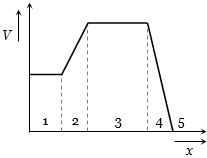
The figure gives the electric potential $V$ as a function of distance through five regions on $x$-axis. Which of the following is true for the electric field $E$ in these regions
Dip angle are $30^o$ and $45^o$ at two different places, then ratio of horizontal component of earth magnetic field at these place will be
A particle starts from rest at $x=0\; m$ with an acceleration of $1 \,m / s ^2$. At $t = 5\;s _{ s }$ it receives an additional acceleration in the same direction as its motion. At $t =10\; s$ its speed and position are $v$ and $x$, respectively. Had the additional acceleration not been provided, its speed and position would have been $v _0$ and $x _0$, respectively. It is found that $x - x _0$ is $12.5 \,m$. Then one can conclude that $v - v _0$ is .............. $\,m / s$
Which of the following is conserved when light waves interfere
A vector ${\overrightarrow F _1}$is along the positive $X-$axis. If its vector product with another vector ${\overrightarrow F _2}$ is zero then ${\overrightarrow F _2}$ could be
The angle of incidence at which reflected light is totally polarized for reflection from air to glass (refractive index n), is
In the figure one fourth part of $a$ uniform disc of radius $R$ is shown. The distance of the centre of mass of this object from centre $‘O’$ is:
A wire of cross-sectional area $3\,m{m^2}$ is first stretched between two fixed points at a temperature of $20°C$. Determine the tension when the temperature falls to $10°C$. Coefficient of linear expansion $\alpha = {10^{ - 5}}   { ^\circ}{C^{ - 1}}$ and $Y = 2 \times {10^{11}}\,N/{m^2}$  ........ $N$
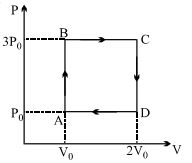
A ideal monoatomic gas is carried around the cycle $ABCDA$ as shown in the fig. The efficiency of the gas cycle is
In a conductor, if the number of conduction electrons per unit volume is $8.5 \times 10^{28}\, m^{-3}$ and mean free time is $25\,fs$ $($femto second$),$ its approximate resistivity is $\left( {{m_e} = 9.1 \times {{10}^{ - 31}}\,kg} \right)$