In a conductor, if the number of conduction electrons per unit volume is $8.5 \times 10^{28}\, m^{-3}$ and mean free time is $25\,fs$ $($femto second$),$ its approximate resistivity is $\left( {{m_e} = 9.1 \times {{10}^{ - 31}}\,kg} \right)$
JEE MAIN 2019, Medium
Download our app for free and get started
$\rho = \frac{{2m}}{{n{e^2}\tau }}$
$= 3.34 \times {10^{ - 8}}\,\Omega \,m$
$= 3.34 \times {10^{ - 8}}\,\Omega \,m$

Download our appand get started for free
Experience the future of education. Simply download our apps or reach out to us for more information. Let's shape the future of learning together!No signup needed.*
Similar Questions
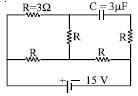
- 1In the circuit shown, the cell is ideal, with $emf$ $=$ $15$ $V$. Each resistance is of $3 $ $\Omega$ . The potential difference across the capacitor is.....$V$View Solution
- 2$A$ uniform copper wire carries a current $i$ amperes and has $p$ carriers per meter$^3$. The length of the wire is $\lambda$ meters and its cross-section area is $s$ meter $^2$. If the charge on a carrier is $q$ coulombs, the drift velocity in $ms^{-1}$ is given byView Solution
- 3Three copper rods are subjected to different potential difference. Compare the drift speed of electrons through them. Assume that all $3$ are at the same temperature.View Solution
Length Diameter Potential difference $(A)$ $L$ $3d$ $V$ $(B)$ $2L$ $d$ $2V$ $(C)$ $3L$ $2d$ $2V$ - 4A filament bulb $(500 \,W,\,\, 100 \,V)$ is to be used in a $230\, V$ main supply. When a resistance $R$ is connected in series, it works perfectly and the bulb consumes $500\,W.$ The value of $R$ is .................. $\Omega$View Solution
- 5Two wires of same length and thickness having specific resistances $6\, \Omega \,cm$ and $3 \,\Omega\, cm$ respectively are connected in parallel. The effective resistivity is $\rho\, \Omega \,cm$. The value of $\rho$ to the nearest integer, is ..... .View Solution
- 6$A$ battery is of $\mathrm{emf}$ $E$ is being charged from a charger such that positive terminal of the battery is connected to terminal $A$ of charger and negative terminal of the battery is connected to terminal $B$ of charger. The internal resistance of the battery is $r$.View Solution
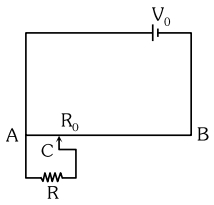
- 7The sliding contact $C$ is at one fourth of the length of the potentiometer wire $( AB )$ from $A$ as shown in the circuit diagram. If the resistance of the wire $AB$ is $R _0$, then the potential drop $( V )$ across the resistor $R$ isView Solution
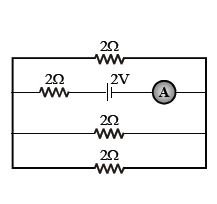
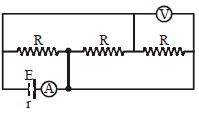
- 8View SolutionThe reading of the ammeter as shown in figure
- 9In the following circuit diagram, $E = 4\,V, r = 1\,\Omega$ and $R = 45\, \Omega$, then reading of the ammeter $A$ will beView Solution
- 10In the Wheatstone's bridge shown, $P = 2\,\Omega ,$ $Q = 3\,\Omega ,$ $R = 6\,\Omega $ and $S = 8\,\Omega $. In order to obtain balance, shunt resistance across '$S$' must be .............. $\Omega$View Solution