Units and Measurements — Physics STD 11 Science — Question
Maharashtra BoardEnglish MediumSTD 11 SciencePhysicsUnits and Measurements4 Marks
Question
State and describe the two supplementary units.
✓
Answer
The two supplementary units are:
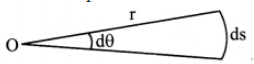
$i)$ Plane angle $(d\theta ):$
$a.$ The ratio of kngth of arc $(ds)$ of an circle to the radius $(r)$ of the circle is called as Plane angle $(d\theta )$.
i.e., $d \theta=\frac{ ds }{ r }$
$b.$ Thus, $d\theta$ is angle subtended by the arc at the centre of the circle.
$c.$ Unit: radian $($rad$)$
$d.$ Denoted as $\theta ^c$
$e.$ Length of arc of circle $=$ Circumference of circle $= 2\pi r.$
$\therefore$ plane angle subtended by entire circle at its centre is $\theta =\frac{2 \pi r }{ r }=2 \pi^{ c }$
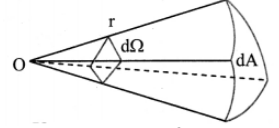
$ii)$ Solid angle $(dΩ):$
$a.$ solid angle is $3-$dimensional analogue of plane angle.
$b.$ Solid angle is defined as area of a portion of surface of a sphere to the square of radius of the sphere.
i.e., $d \Omega=\frac{d A}{r^2}$
$c.$ Unit: Steradian $(sr)$
$d.$ Denoted as $(Ω)$
$e.$ Surface area of sphere $=4 \pi r^2$
$\therefore$ solid angle subtended by entire sphere at its centre is $Ω =\frac{4 \pi r^2}{r^2}=4 \pi sr$
Need a full question paper?
Generate a complete, print-ready paper with questions like this in minutes — across 16+ boards, with answer keys.