Question
State and explain Maxwell’s Cork Screw Rule.

Answer

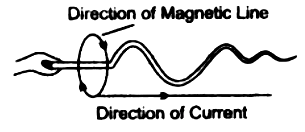
Maxwell’s Cork Screw Rule:

Imagine a right handed cork screw placed parallel to a current carrying conductor such that when it is rotated, it advances in the direction of the current. Then the direction in which the thumb rotates gives the direction of the magnetic lines of forces.

Need a full question paper?

Generate a complete, print-ready paper with questions like this in minutes — across 16+ boards, with answer keys.
Start Generating Free

Similar questions

A pendulum has a frequency of 5 vibrations per second. An observer starts the pendulum and fires a gun simultaneously. He hears echo from the cliff after 8 vibrations of the pendulum. If the velocity of sound in air is 340 m s-1, find the distance between the cliff and the observer.
State four differences between reflection and total internal reflection.
Explain why does a wine glass starts rattling, when a note of some particular frequency is struck by a piano?
Show by a diagram, the refraction of two light rays incident parallel to the principal axis on a concave lens by treating it as a combination of a glass block and two triangular glass prisms.
Draw a labelled diagram of an arrangement of two pulleys, one fixed and other movable. In the diagram, mark the directions of al forces acting on it. What is the ideal mechanical advantage of the system? How can it be achieved?
The world record for weight lifting was held by Sergei Didyk of the USSR. He lifted $261$ kg to a height of $2.3 \ m$ in 4s; find:
(a) Weight lifted by him
(b) Work done by him
(c) Power developed by him. $(g = 10m/s^2)$
Why upper surface of water contained in a beaker and above eye level appears silvery?
Explain why the p.d across the terminals of a cell is more in an open circuit and reduced in a closed circuit.
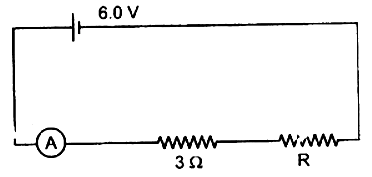
The figure shows a circuit. When the circuit is switched on, the ammeter reads $0.5 A.$

(i) Calculate the value of the unknown resistor $R.$
(ii) Calculate the charge passing through the $3 Ω$ resistor in $120 s.$
(iii) Calculate the power dissipated in the $3 Ω$ resistor.
A weight lifted a load of 200 kgf to a height of $2.5$ m in $5 s$. calculate: $(i)$ the work done, and $(ii)$ the power developed by him. Take $g= 10 N kg^{-1}.$