Question
State and prove Bernoulli's theorem.
$\Delta\text{x}_1=\text{P}_1\text{A}_1\text{v}\Delta\text{t}$
The work done by the liquid at B,$\Delta\text{x}_2=-(\text{P}_2\text{A}_2)$
$\Delta\text{x}_2=-\text{P}_2\text{A}_2\text{V}\Delta\text{t}$
The work done on the liquid at (Considering a small time $\Delta\text{t}$ so that area may be same) Net work done by pressure $=(\text{P}_1-\text{P}_2)\text{Av }\Delta\text{ t}$ since A1v1 = A2v2 From conservation of energy,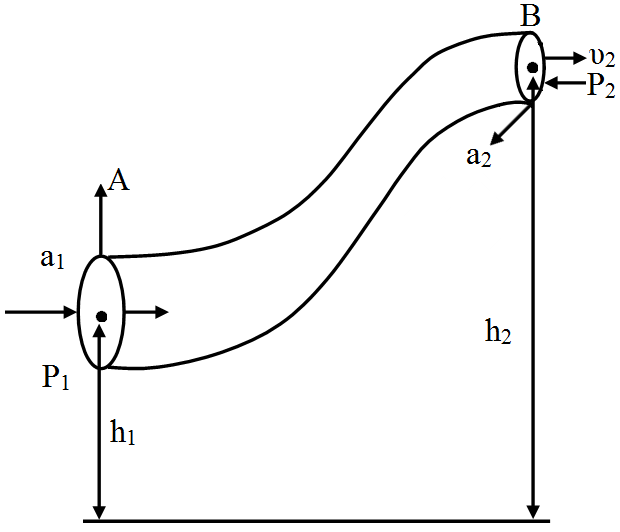
$(\text{P}_1-\text{P}_2)\text{Av}\Delta\text{t}=\text{Change in }(\text{K.E.}+\text{P.E.})$
$(\text{P}_1-\text{P}_2)\text{A}\text{v}\Delta\text{t}$
$=\text{Av}\rho\Delta\text{tg}(\text{h}_2-\text{h}_1)+\frac{1}{2}\text{Av}\Delta\text{t}\rho(\text{v}_2^2-\text{v}^2_1)$
$\therefore\text{P}_1-\text{P}_2=\rho\text{g}(\text{h}_2-\text{h}_1)+\frac{\rho}{2}(\text{v}^2_2-\text{v}^2_1)$
(i.e.) $\text{P}_1+\rho\text{gh}_1+\frac{\rho}{2}\text{v}^2_1=\text{P}_1+\rho\text{gh}_2+\frac{\rho}{2}\text{v}^2_2$$\therefore\frac{\text{P}}{\rho\text{g}}+\text{h}+\frac{\text{v}^2}{\text{2g}}=\text{constant}.$
Generate a complete, print-ready paper with questions like this in minutes — across 16+ boards, with answer keys.