Question
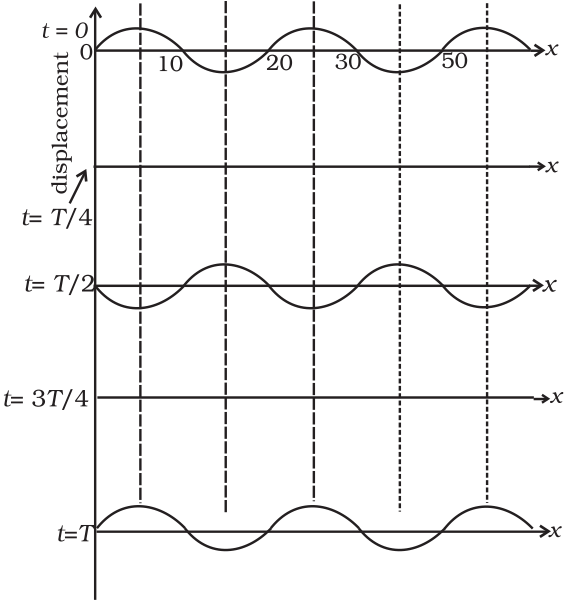
The wave pattern on a stretched string is shown in Interpret what kind of wave this is and find its wavelength.
Answer

The displacement of medium particlles at distance 10, 20, 30, 40, and 50cm are always rest which is the property of nodes in stationary wave.

$\text{AT}\ \text{t}=\frac{\text{T}}{4}$ and $\frac{\text{3T}}{4}$ all particle are at rest wgich is in stationary wave when the particle crossrs its mean position.

so thet praph of wave shos stationaty wave.

The wave at $\text{x}=10,\ 20,\ 30,\ 40\text{cm}$ there are nodes and distance between successive nodes is $\frac{\lambda}{2}$

$\therefore\frac{\lambda}{2}=(30-20)$ or $\lambda=20\text{cm.}$

Need a full question paper?

Generate a complete, print-ready paper with questions like this in minutes — across 16+ boards, with answer keys.

Start Generating Free

Similar questions

Write the effect of various factors on surface tension.
The temperatures of equal masses of three different liquids A, B and C are 12°C, 19°C and 28°C respectively. The temperature when A and B are mixed is 16°C, and when B and C are mixed, it is 23°C. What will be the temperature when A and C are mixed?
A thin lens made of a material of refractive index $\mu_2$ has a medium of refractive index $\mu_1$ on one side and a medium of refractive index $\mu_3$ on the other side. The lens is biconvex and the two radii of curvature have equal magnitude R. A beam of light travelling parallel to the principal axis is incident on the lens. Where will the image be formed if the beam is incident from:
  1. The medium $\mu_1$
  2. From the medium $\mu_3?$
A circular loop of string rotates about its axis on a frictionless horizontal plane at a uniform rate so that the tangential speed of any particle of the string is v. If a small transverse disturbance is produced at. a point of the loop, with what speed (relative to the string) will this disturbance travel on the string?
A box of 1.00m3 is filled with nitrogen at 1.5 atm at 300K. The box has a hole of an area 0.010 mm2. How much time is required for the pressure to reduce by 0.10atm, if the pressure outside is 1atm.
Air is pumped into an automobile tyre's tube up to a pressure of 200kPa in the morning when the air temperature is 20°C. During the day the temperature rises to 40°C and the tube expands by 2%. Calculate the pressure of the air in the tube at this temperature.
According to Stefan’s law of radiation, a black body radiates energy $\sigma=\text{T}^4$ from its unit surface area every second where T is the surface temperature of the black body and $\sigma=5.67\times10^{-8}\text{w}/\text{m}^2\text{K}^4$ is known as Stefan’s constant. A nuclear weapon may be thought of as a ball of radius 0.5m. When detonated, it reaches temperature of 106K and can be treated as a black body.

  1. Estimate the power it radiates.
  2. If surrounding has water at 30C°, how much water can 10% of the energy produced evaporate in 1s?

$\big[\text{s}_w=4186.0\text{J/ kgK and L}_v=22.6\times10^5\text{J/ kg}\big]$
  1. If all this energy U is in the form of radiation, corresponding momentum is $\rho=\frac{\text{U}}{\text{c}}$ How much momentum per unit time does it impart on unit area at a distance of 1km?
Define conservative and non-conservative forces. Give example and properties of conservative forces.
A 5kg rifle fires a 58 bullet with a speed of 500ms-1. What kinetic energy is acquired.
  1. By the bullet and.
  2. By the rifle?
  3. Find the the ratio of the distance which the rifle moves backward while the bullet is in the barrel to the distance the bullet moves forward.
Prove that the total mechanical energy remains constant for a ball of mass m dropped from a towe of height h.
Consider the arrangement shown in figure. By some mechanism, the separation between the slits S3 and S4 can be changed. The intensity is measured at the point P which is at the common perpendicular bisector

of S1S2 and S3S4. When $\text{z}=\frac{\text{D}\lambda}{2\text{d}},$ intensity measured at P is I. Find this intensity when z is equal to:

  1. $\frac{\text{D}\lambda}{\text{d}}$

  2. $\frac{3\text{D}\lambda}{2\text{d}}$

  3. $\frac{2\text{D}\lambda}{\text{d}}$