Question
State and Prove Gauss theorem in electrostatics.

Answer

Statement: The net-outward normal electric flux through any closed surface of any shape is equal to $\frac{1}{\in_0}$ times the total charge contained within that surface, $\frac{1}{\in_0}$ i.e., $\oint\text{S }\vec{\text{E}}.\vec{\text{ds}}=\frac{1}{\in_0}\Sigma\text{q}$ Where $\oint\limits_{\text{S}}$ indicates the surface integral over the whole of the closed surface, $\Sigma\text{q}$ Is the algebraic sum of all the charges (i.e., net charge in coulombs) enclosed by surface S and remain unchanged with the size and shape of the surface. Proof: Let a point charge +q be placed at centre O of a sphere S. Then S is a Gaussian surface. Electric field at any point on S is given by, $\text{E}=\frac{1}{4\pi\in_0}.\frac{\text{q}}{\text{r}^2}$Image
The electric field and area element points radially outwards, so $\theta=0^\circ,$
Flux through area $\vec{\text{dS}}$ is,
$\text{d}\Phi=\vec{\text{E}}.\text{dS}=\text{E dS}\cos0^\circ=\text{E dS}$ Total flux through surface S is, $\Phi=\oint\limits_{\text{S}}\text{d}\Phi=\oint\limits_{\text{S}}\text{E dS}=\text{E}\oint\limits_{\text{S}}\text{dS}$ = E × Area of Sphere $=\frac{1}{4\pi\in_0}.\frac{\text{q}}{\text{x}^2}.4\pi\text{r}^2$ or, $\Phi=\frac{\text{q}}{\in_0}$ which proves Gauss's theorem.

Need a full question paper?

Generate a complete, print-ready paper with questions like this in minutes — across 16+ boards, with answer keys.
Start Generating Free

Similar questions

Consider a uniformly charged ring of radius R. Find the point on the axis where the electric field is maximum.
A concave mirror forms an image of 20cm high object on a screen placed 5.0m away from the mirror. The height of the image is 50cm. Find the focal length of the mirror and the distance between the mirror and the object.
The uniform surface charge density of a thin spherical shell of radius $R$ is $\sigma$. Calculate the intensity of the electric field due it, in the following circumstances : $\square$(i) Elecric field outside the shell(ii) Electric field inside the shell.
Two wires carrying equal currents i each, are placed perpendicular to each other, just avoiding a contact. If one wire is held fixed and the other is free to move under magnetic forces, what kind of motion will result?
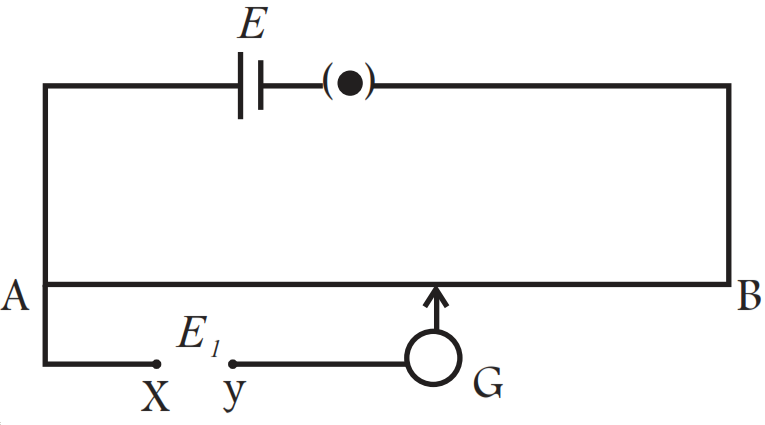
While doing an experiment with potentiometer (Fig.) it was found that the deflection is one sided and (i) the deflection decreased while moving from one end A of the wire to the end B; (ii) the deflection increased. while the jockey was moved towards the end B.
  1. Which terminal +or -ve of the cell $E_1,$ is connected at X in case (i) and how is $E_1$ related to E?
  2. Which terminal of the cell $E_1$ is connected at X in case (ii)?
When a proton is released from rest in a room, it starts with an initial acceleration $a_0$ towards west. When it is projected towards north with a speed $v_0$, it moves with an initial acceleration $3a_0$ towards west. Find the electric field and the maximum possible magnetic field in the room.
The wavelength of sodium light in air is 589nm.
  1. Find its frequency in air.
  2. Find its wavelength in water (refractive index = 1.33).
  3. Find its frequency in water.
  4. Find its speed in water.
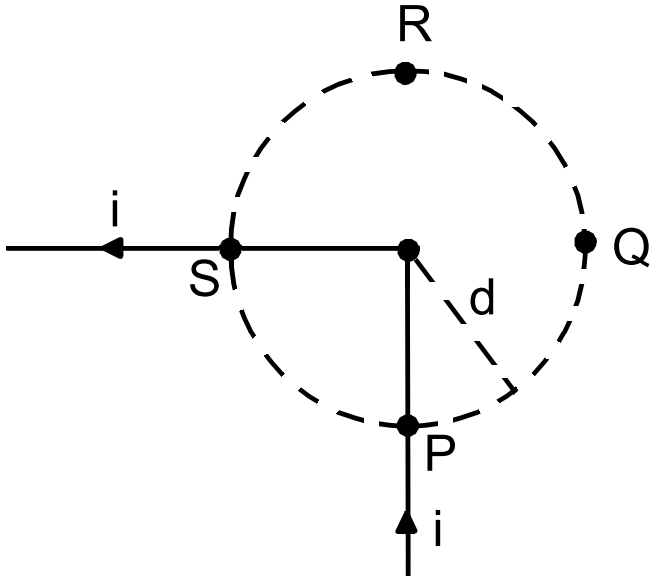
Figure shows a long wire bent at the middle to form a right angle. Show that the magnitudes of the magnetic fields at the points P, Q, R and S are equal and find this magnitude.
Consider a non-conducting plate of radius r and mass m that has a charge q distributed uniformly over it. The plate is rotated about its axis with an angular speed $\omega.$ Show that the magnetic moment $\mu$ and the angular momentum of the plate are related as $\mu=\frac{\text{q}}{2\text{m}}\text{l}.$
Radiations of frequency $10^{15}Hz$ are incident on two photosensitive surfaces A and B. Following observations are recorded:
Surface A: No photoemission takes place.
Surface B: Photoemission takes place but photoelectrons have zero energy.
Explain the above observations on the basis of Einstein’s photoelectric equation. How will the observation with surface B change when wavelength of incident light is decreased?