Question
State and prove the theorem of 'parallel axes'.

Answer

Statement: The moment of inertia $\left(l_0\right)$ of an object about any axis is the sum of its moment of inertia ( $l_c$ ) about an axis parallel to the given axis, and passing through the centre of mass and the product of the mass of the object and the square of the distance between the two axes. Mathematically, $I _0= I _{ C }+ Mh ^2$
Proof:
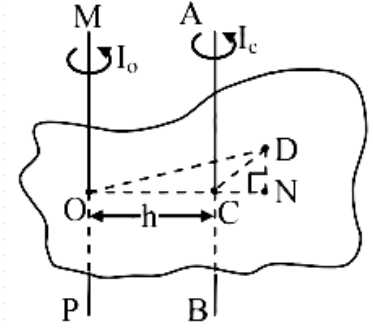
1.Consider an object of mass M. Axis MOP is an axis passing through point $O$.
2.Axis $A C B$ is passing through the centre of mass $C$ of the object, parallel to the axis MOP, and at a distance $h$ from it ( $\therefore h = CO$ ). 

Image
The theorem of parallel axes
3.Consider a mass element 'dm' located at point D. Perpendicular on OC (produced) from point D is DN.
4. The moment of inertia of the object about the axis $A C B$ is $I _{ C }=\int(D C)^2 dm$, and about the axis MOP, it is $I _0=\int$ (DO) ${ }^2 dm$.
$\text { 5. } I_0=\int(DO)^2 dm$
$=\int\left((DN)^2+(NO)^2\right) dm$
$=\int\left((DN)^2+(NC)^2+2 \cdot NC \cdot CO+(CO)^2\right) dm$
$=\int\left((DC)^2+2 NC \cdot h+h^2\right) dm . . . . . . . . . . . . .(\text { using Pythagoras theorem in } \Delta DNC)$
$=\int(DC)^2 dm+2 h \int NC \cdot dm+h^2 \int dm$
Now, $\int(D C)^2 dm = I _{ C }$ and $\int dm = M$
6.NC is the distance of a point from the centre of mass. Any mass distribution is symmetric about the centre of mass. Thus, from the definition of the centre of mass, $\int NC . dm =0$
$\therefore I_0=I_{C}+M \cdot h^2$
This is the mathematical form of the theorem of parallel axes.

Need a full question paper?

Generate a complete, print-ready paper with questions like this in minutes — across 16+ boards, with answer keys.
Start Generating Free

Similar questions

What is electromagnetic induction? Prove theoretically \(e=-\frac{ d \phi}{ d t}\).
What are eddy currents? State applications of eddy currents.
In a metre bridge experiment, with a resistance $R_1$ in the left gap and a resistance $X$ in the right gap, the null point is obtained at $40 \ cm$ from the left end of the wire. With a resistance $R_2$ in the left gap and the same resistance $X$ in the right gap, the null point is obtained at 50 $cm$ from the left end of the wire. Where will be the null point if $R_1$ and $R_2$ are connected first in series and then in parallel in the left gap, the right gap still containing $X$ ?
A water molecule is made up of two hydrogen atoms and one oxygen atom, with a total of 10 electrons and 10 protons. The molecule is modelled as a dipole with an effective separation $d=3.9 \times 10^{-12} m$ between its positive and negative particles. What is the electric potential energy stored in the dipole? What does the sign of your answer mean?
A potentiometer wire $4 m$ long has a resistance of $4 \Omega$. What resistance must be connected in series with the wire and a cell of emf $2 V$ having internal resistance of $2 \Omega$ to get a potential drop of $10^{-3} V / cm$ along the wire?
Explain how a Zener diode maintains constant voltage across a load.
State and verify the laws of vibrating strings using a sonometer.
Derive an expression for the electric potential energy of an electric dipole in a uniform electric field.
OR
Derive an expression for the total work done in rotating an electric dipole through an angle θ in a uniform electric field.
A galvanometer has a resistance of $16 \Omega$ and gives a full scale deflection when a current of $20\ mA$ is passed through it. The only shunt resistance available is $0.04 \Omega$ which is not sufficient to convert the galvanometer to an ammeter to measure up to $10 A$. What resistance should be connected in series with the coil of the galvanometer so that the range of the ammeter is $10 A ?$
Derive the ideal gas equation, $\mathrm{PV}=\mathrm{nRT}$.
OR
Derive the equation of state for an ideal gas.