Question
State any five functions of blood.

Answer

(i) It transports oxygen from the lungs to body tissues.
(ii) It transports carbon dioxide from the tissues to the lungs partly in combination with haemoglobin and partly as solution in blood plasma.
(iii) It transports digested food to different organs of the body which is utilized by cells.
(iv) It helps in keeping the temperature of the body uniform by distributing heat.
(v) It forms a clot wherever there is a cut in a blood vessel. The clot not only prevents further loss of blood but also prevents the entry of disease germs.

Need a full question paper?

Generate a complete, print-ready paper with questions like this in minutes — across 16+ boards, with answer keys.

Start Generating Free

Similar questions

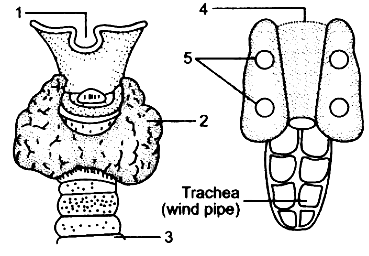
Given alongside are the diagrammatic sketches of some endocrine glands. Observe the figures and answer the following questions:
(i) Label the parts numbered 1 to 5.
(ii) Name the hormones secreted by (2) and (5).
(iii) Which chemicals in our body are greatly affected by hormones?
(iv) What is the chemical nature of hormones?
(v) Name the elements related to the functioning of hormones secreted by the structure (2) and (5).
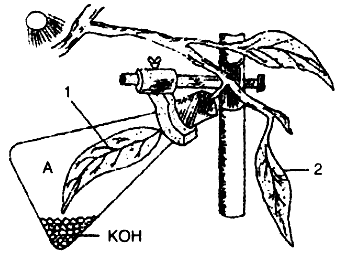
The figure given below represents an experiment to demonstrate a particular aspect of photosynthesis. The alphabet ‘A’ represents a certain condition inside the flask.

(i) What is the aim of the experiment?
(ii) Identify the special condition inside the flask.
(iii) Name an alternative chemical that can be used instead of $KOH.$
(iv) In what manner do the leaves 1 and 2 differ at the end of the starch test?
Why do plants absorb more water than what is required by them? Give three uses of this phenomenon.
Draw a well-labelled diagram to show the anaphase stage of mitosis in plant cells having four chromosomes.
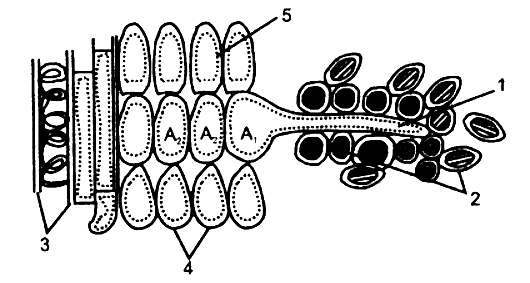
The figure given below is a diagrammatic representation of a part of the cross-section of the root in the root hair zone. Study the same and then answer the questions that follow :

(i) Name the parts indicated by guidelines ‘1’ to ‘5’
(ii) Is the root hair cell unicellular or multi-cellular?
(iii) Draw a labeled diagram of the root hair cell as it would appear if some fertilizer is added to the soil close to it.
(iv) Name the process responsible for the entry of water molecules from the soil into A1 and then A2.
(v) What pressure is responsible for the movement of water in the direction indicated by arrows?
(vi) How is this pressure set up?
Explain the Term: Hypermetropia
The below diagram represents the human brain as seen in an external view. Study the same and then answer the questions that follow:
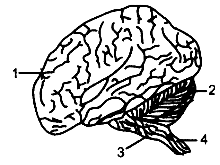
(i) Name the parts labeled 1, 2, 3, and 4.
(ii) Mention the difference in the arrangement of the nerve cells in the parts marked ‘1’ and ‘4’.
(iii) What is the main function of the parts marked ‘3’ and ‘4’?
(iv) Name the sheet of nerve fibers that connect the two halves of the part labeled ‘1’.
Compare the hormonal response with the nervous response with respect to their speed, transmission and the general nature of changes brought about.
Draw neat and labelled diagrams of a myelinated neuron
Write in sequence the regions in which a mature sperm travels from the seminiferous tubules up to the urethral opening?