Question
State Bohr’s quantization condition of angular momentum. Calculate the shortest wavelength of the Bracket series and state to which part of the electromagnetic spectrum does it belong.

Answer

According to Bohr's quantisation, the electrons revolve around the nucleus only in those orbits for which the angular momentum is the integral multiple of
$\frac{\text{h}}{2\pi}$
$\text{L}=\frac{\text{nh}}{2\pi}$
For Bracket series $\text{n}_2=\infty,$
$\frac{1}{\lambda}=\text{R}_\text{H}\text{Z}^2\Big\{\frac{1}{4^2}-\frac{1}{\infty}\Big\}$
$\frac{1}{\lambda}=\frac{\text{R}_\text{H}}{16}$
$\lambda=\frac{16}{\text{R}_\text{H}}=14.58\times10^{-7}\text{m}$
This wavelength belongs to the inftra-red region.

Need a full question paper?

Generate a complete, print-ready paper with questions like this in minutes — across 16+ boards, with answer keys.
Start Generating Free

Similar questions

When a person leaves his home for sightseeing by his car, the meter reads 12352km. When he returns home after two hours the reading is 12416km.
  1. What is the average speed of the car during this period?
  2. What is the average velocity?
What is a transformer? Write down its working principle and construction.
Two electric dipoles whose dipole moments are $P$ and 64 P are placed on a line at a distance of 25 cm in opposite directions. If the electric field at any point between them is zero, then what will be the distance of this point from the electric potential $P$ ?
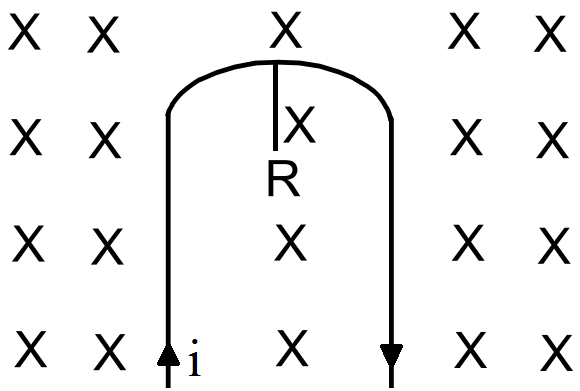
A rigid wire consists of a semi-circular portion of radius R and two straight sections The wire is partially immersed in a perpendicular magnetic field B, as shown in the figure. Find the magnetic force on the wire if it carries a current i.

A screen is placed 90 cm from an object. The image of the object on the screen is formed by a convex lens at two different locations separated by 20 cm. Determine the focal length of the lens.
Find the dimensions of:

  1. The specific heat capacity c.
  2. The coefficient of linear expansion a.
  3. The gas constant R.
Some of the equations involving these quantities are

$\text{Q = mc(T}_2-\text{T}_1),\text{l}_{\text{t}}=\text{l}_0[1+\alpha(\text{T}_2-\text{T}_1)]$ and $\text{PV = nRT}.$

If two bodies are in thermal equilibrium in one frame, will they be in thermal equilibrium in all frames?
A hydrogen atom in a state having a binding energy of 0.85eV makes transition to a state with excitation energy 10.2eV (a) Identify the quantum numbers n of the upper and the lower energy states involved in the transition. (b) Find the wavelength of the emitted radiation.
Light from Balmer series of hydrogen is able to eject photoelectrons from a metal. What can be the maximum work function of the metal?
Is neutral temperature always the arithmetic mean of inversion temperature and the temperature of the cold junction? Does the unit of temperature have an effect in deciding this question?