$r_c=\frac{1}{4\pi\varepsilon_0}.\frac{2Ze^2}{K}$
‘K’ is doubled, $\therefore\text{ }r_c$ becomes $\frac{r}{2}$
50 questions · self-marked practice — reveal the answer and mark yourself.
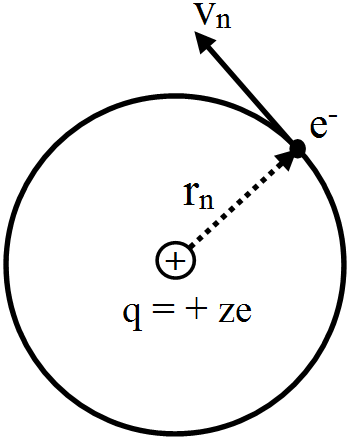
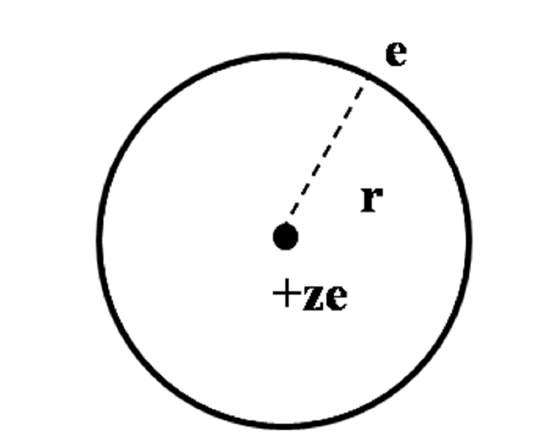
Total energy = P.E +K.E. $ = - \frac{1}{4\pi\in_{o}}\frac{\text{ze}^{2}}{\text{r}} + \frac{1}{2}\text{mv}^{2}$ $ = - \frac{1}{2}.\frac{1}{4\pi\in_{o}}\frac{\text{ze}^{2}}{\text{r}} = = - \frac{1}{8\pi\in_{o}}\frac{\text{ze}^{2}}{\text{r}}$ Negative Sign implies that. Electron – nucleus form a bound system. Alternate Answer
Electron – nucleus form an attractive system.[Give Rydberg constant, R = 107 m-1]
−13.6 eV; −3.4 eV; −1.5 eV
$\therefore$ The 12.5 eV electron beam can excite the electron up to n = 3 level only.
The corresponding wavelengths are: 102 nm, 122 nm and 653 n
$\big(\lambda=\frac{hc}{E}\big)$
| 4 → 1 | $\bigg\}$ | Lyman series |
| 3 → 1 | ||
| 2 → 1 | ||
| 4 → 2 | $\bigg\}$ | Balmer series |
| 3 → 2 | ||
| 4 → 3 | Paschen series |
$r= \text{r}_{o}\text{n}^2=0.53n^2\mathring{\text{A}}$
$=0.53\times4\mathring{\text{A}}$
$=212 \mathring{\text{ A}}$
For an electron revolving in nth orbit, according to de Broglie relation $2\pi{r}_n= n \lambda, \text{For} {1}^{st} \text{excited state n}=2$$2\times3.14\times2.12\times10^{-10}=2\lambda$ $\lambda=3.14\times2.12\times10^{-10}n$ $=6.67\overset{\circ}{\text{A}}$
Alternate Answer
$\lambda=\frac{\text{h}}{\text{p}}=\frac{\text{h}}{\text{m}_ev}$
Velocity of electron in first excited state, $v=1.1\times10^{-6}{\text{m/s}}$ $\lambda=\frac{6.63\times10^{-34}}{9\times10^{-31}\times1.1\times10^{6}}$ $=6.67\times{10}^{-10}\text{m}$ $=6.67\overset{\circ}{\text{A}}$Alternate Answer
Let $\lambda_n$ be the wavelength of the electron in the nth orbit. We then have $2\pi r_n=n\lambda_n$$\therefore \lambda_2=\pi{r}_{2}$
$\text{Also}$${r}_{2}=4{\text{r}}_{0}$
(r0 = radius of the ground state orbit)
$\therefore \lambda_2=4\pi{r}_{0}$
Alternate Answer
Let $\lambda_n$ be the wavelength of the electron in the nth orbit. We then have $\lambda_n=\frac{h}{mv_n}$ But $v_n=\frac{v_0}{n}$ $\lambda_2=\frac{2h}{mv_0}$ Where $v_0$ is the velocity of electron in ground state.Alternate Answer
Velocity of electron, in the ground state, of hydrogen atom $=2.18\times10^{-6}m/s$ Hence momentum of revolving electron $\text{p}=mv$ $=9.1\times10^{-31}\times2.18\times10^{-6}kg\text{ }m/s$ $\lambda=\frac{h}{p}=\frac{6.63\times10^{-34}}{9.1\times10^{-31}\times2.18\times10^{-6}}\text{m}$ $=3.32\mathring{\text{A}}$
He+ = 10.2 × z2 = 10.2 × 4 = 40.8V
= 13.6V × z2 = 13.6 × 9 = 122.4V
or $\frac{13.6\times8}{9}=\frac{4.14\times10^{-15}\times3\times10^8}{\lambda}$
$\lambda=\frac{4.14\ \times\ 3\ \times\ 10^{-7}}{13.6\ \times\ 8}=1.027\times10^{-7}=103\text{nm}$
then, $\text{E}=13.6\times\Big(\frac{1}{4}-\frac{1}{16}\Big)=2.55\text{ev}$ and $2.55=\frac{1242}{\lambda}$ or $\lambda=487\text{nm}$
So, current
$=\text{i}=\frac{2\pi\text{a}_0}{\text{v}}\text{e}.$$\Rightarrow\frac{\text{n}(\text{n}-1)}{2}=6$
$\Rightarrow\text{n}=4$
$\therefore$ The gas is in 4th excited state.
$\frac{\text{n}(\text{n}-1)}{2}=6$
$\Rightarrow\text{n}=4$
So, n = 4 to n = 2
$\lambda=\frac{16}{1.097\times3\times10^7}=4.8617\times10^{-7}=487\text{nm}$