State Brewster’s law.
The value of Brewster angle for a transparent medium is different for light of different colours. Give reason.
CBSE DELHI - SET 1 2016
Download our app for free and get started
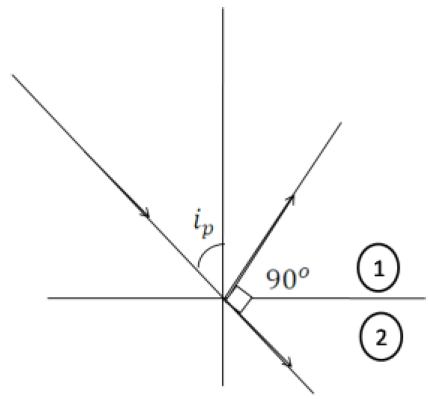
When unpolarized light is incident on the surface separating two media, the reflected light gets (completely) polarised only when the reflected light and refracted light become perpendicular to each other.
The refractive index of denser medium, with respect to rarer medium, is given by $\mu = \tan\text{i}_{p}$
Since Refractive index (μ) of a transparent medium is different for different colours, hence Brewster angle is different for different colours.
Download our app
and get started for free
Experience the future of education. Simply download our apps or reach out to us for more information. Let's shape the future of learning together!No signup needed.*
If we put a cardboard (say 20cm × 20cm) between a light source and our eyes, we can't see the light. But when we put the same cardboard between a sound source and our ear, we hear the sound almost clearly. Explain.
A parallel beam of light of wavelength 500 nm falls on a narrow slit and the resulting diffraction pattern is observed on a screen 1 m away. It is observed that the first minimum is at a distance of 2.5 mm from the centre of the screen. Find the width of the slit.
A source emitting light of wavelengths 480nm and 600nm is used in. a double slit interference experiment. The separation between the slits is 0.25mm and the interference is observed on a screen placed at 150cm from the slits. Find the linear separation between the first maximum (next to the central maximum) corresponding to the two wavelengths.
Answer the following question:
As you have learnt in the text, the principle of linear superposition of wave displacement is basic to understanding intensity distributions in diffraction and interference patterns. What is the justification of this principle?
White light is used in a Young's double slit experiment. Find the minimum order of the violet fringe $(\lambda=400\text{nm}),$ which overlaps with a red fringe $(\lambda=700\text{nm}).$
When are two objects just resolved? Explain. How can the resolving power of a compound microscope be increased? Use relevant formula to support your answer.
Distinguish between polarised and unpolarized light. Does the intensity of polarised light emitted by a Polaroid depend on its orientation? Explain briefly.
The vibrations in a beam of polarised light make an angle of 60° with the axis of the polaroid sheet. What percentage of light is transmitted through the sheet?