Question
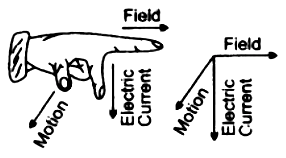
State Fleming's left hand rule.

Answer


According to this rule, stretch the thumb, forefinger and middle finger of your left hand such that they are mutually perpendicular. If the first finger points in the direction of magnetic field and the second finger in the direction of the current, then the thumb will point in the direction of motion of the conductor or the force acting on the conductor.

Need a full question paper?

Generate a complete, print-ready paper with questions like this in minutes — across 16+ boards, with answer keys.

Start Generating Free

Similar questions

A faulty balance of unequal arms and pans of unequal weights is used to find the true weight of a metal. By double weighing the weights are found to be 1210 g and 1000 g. Calculate the true weight of the metal.
Explain, why is the p.d. between the terminals of a storage battery less when it is supplying current than when it is on open circuit. A battery of e.m.f. 10 volts and internal resistance 2.5 ohms has two resistances of 50 ohms each connected to it. Calculate the power dissipated in each resistance
(a) When they are in series,
(b) When they are in parallel.
In each case calculate the power dissipated in the battery.
The following diagram shows a fixed coil of several turns connected to a
center zero galvanometer G and a magnet NS which can move.
(a) Describe the observation in the galvanometer if (i) The magnet is moved
rapidly in the direction of arrow, (ii ) The magnet is kept still after it has
moved into the coil, (iii ) The magnet~ then rapidly pulled out the coil.
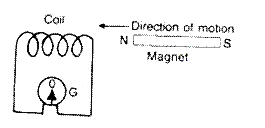


(b) How would the observation alter if a more powerful magnet is used?
(i) (a) Define calorie.
(b) What do you understand by the term latent heat of fusion?
(ii) A piece of metal of mass 50 g is at $100^{\circ} C$. It is placed on a block of ice. Calculate the amount of ice which melts, if the specific heat capacity of metal is $0.8 Jg ^{-1} C ^{-1}$ and specific latent heat of fusion of ice is $340 Jg ^{-1}$.
(iii) A vessel of negligible thermal capacity contains 60 g of water at $40^{\circ} C$. In this water is placed 10 g of ice at $-10^{\circ} C$. If all the ise melts calculate the final temperature of water.
Specifle heat capacity of ice $=2100 Jkg ^{-19} C ^{-1}$
Specific heat capacity of water $=4200 Jkg ^{-19} C ^{-1}$
Specific latent heat of fission of ice $=336 \times 10^3 J / kg$
A block and tackle system has the velocity ratio 3. Draw a labelled diagram of the system indicating the points of application and the directions of load L and effort E. A man can exert a pull of 200 kgf.
If the effort end moves a distance 60 cm, what distance does the load move?
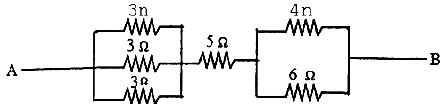
Find the equivalent resistance between points $A$ and $B$
$200 g$ of ice at $0^{\circ} C$ converts into water at $0^{\circ} C$ in 1 minute when heat is supplied to it at a constant rate. In how much time, $200 g$ of water at $0^{\circ} C$ will change to $20^{\circ} C$ ? Take specific latent heat of ice $=336 Jg ^{-1}$.
Find the result of mixing $10 g$ of ice at $-10^{\circ} C$ with $10 g$ of water at $10^{\circ} C$. Specific heat capacity
of ice $=2.1 Jkg ^{-1} K ^{-1}$, Specific latent heat of ice $=336 Jg ^{-1}$ and specific heat capacity of water
$
=4.2 Jkg ^{-1} K ^{-1}
$
What are the names of the three types of rays given off by a radioactive substance? Define the properties you know they possess. Why are the largest atoms radioactive?
(i) Define machine and write functions of a machine.
(ii) Describe mechanical advantage and its types.
(iii) (a) Derive relation between the efficiency, mechanical advantage, and the velocity ratio of a practical machine.
(b) Derive relation between ideal mechanical advantage and velocity ratio for a perfect machine