Questions

5 Marks Questions

🎯

Test yourself on this topic

3 questions · timed · auto-graded

Question 15 Marks
What is electric dipole? Find and expression for electric potential at any point due to an electric dipole.
Answer
Electric dipole : It is a system of two equal and opposite charges separated by a very small distance. The line connecting the two charges is known as the axis of the dipole.
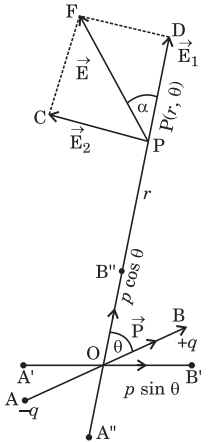
In Fig. two point charges - q and + q of equal magni-tude and of opposite sign constitute an electric dipole AB in which line AB is its axis.
Image
For example, HCl molecule is an example of electric dipole as it is composed of H+ and Cl- separated by a small distance.
Electric Intensity due to an electric dipole at any point : Consider a short electric dipole AB having dipole.
Let P be the point at a distance r from the centre O of the dipole AB. Let the line OP makes an angle θ with the direction of dipole moment $\vec{p}$ .
Resolve $\vec{p}$ into two components :
(i) $p$ cos θ along OP and (ii) $p$ sin θ ⊥ OP.
Point P is on the axial line w.r.t. $p$ cos θ. So electric field intensity at P due to short dipole is given by $E _1=\frac{2 p \cos \theta}{4 \pi \varepsilon_0 r^3}$ along PD direction .
P is on the equitorial line w.r.t. $p$ sin θ. So electric field intensity at P due to short dipole is given by $E _2=\frac{p \sin \theta}{4 \pi \varepsilon_0 r^3}$ along PC direction .
Since $E _1$ and $E _2$ are 1 to each other, so the resultant electric field intensity at P is given by.

Image

$E =\sqrt{ E _1^2+ E _2^2}$
$=\sqrt{\left(\frac{2 p \cos \theta}{4 \pi \varepsilon_0 r^3}\right)^2+\left(\frac{p \sin \theta}{4 \pi \varepsilon_0 r^3}\right)^2}$
$=\frac{p}{4 \pi \varepsilon_0 r^3} \sqrt{4 \cos ^2 \theta+\sin ^2 \theta}$
$=\frac{p}{4 \pi \varepsilon_0 r} \sqrt{3 \cos ^2 \theta+\left(\cos ^2 \theta+\sin ^2 \theta\right)}$
$\Rightarrow \quad E=\frac{P}{4 \pi \varepsilon_0 r^3} \sqrt{\left(3 \cos ^2 \theta+1\right)}$
Direction of E is given by
$\tan \alpha=\frac{F D}{P D}=\frac{E_2}{E_1}$
$=\frac{p \sin \theta}{4 \pi \varepsilon_0 r^3} \times \frac{4 \pi \varepsilon_0 r^3}{2 p \cos \theta}=\frac{1}{2} \tan \theta$
$\Rightarrow \quad \alpha=\tan ^{-1}\left(\frac{1}{2} \tan \theta\right)$ .

View full question & answer
Question 25 Marks
Define capacitance of a capacitor. Derive expression for stored energy between plates of parallel plate capacitor. Show that energy-density between plates of parallel capacitor can be expressed as $\frac{1}{2}\in_{0}E^{2}$ , when E = Electric Field between plates.

Answer
Capacitance: It is the capacity of a conductor for acquiring electric charge. It is defined as follows :
"The electrical capacitance of a conductor is defined as the ratio of the charge given to the conductor and potential raised due to it." It is denoted by C.
If $q$ be the quant ity of charge given to any conductor and V be the potential raised by the charge, then :
$\text { Capacitance } =\frac{\text { ElectricCharge }}{\text { RiseinPotential }} $
$\Rightarrow \quad C =\frac{q}{V}$ ...(1)
It depends upon the size and shape of the conductor and upon the nature of surrounding medium and presence of other conductors.
If $V =1$, then from equation (1), we get
$C=q .$
Thus, the capacitance of a conductor is numerically equal to the charge to be given to a conductor to raise its potential by unity.
S.I. Unit of capacitance. The SI unit of capacitance is farad. It is so named in the honour of Michael Faraday and is depicted by F.
Energy of a charged capacitor : The energy of a charged capacitor is measured by the total work done in charging the capacitor to a given potential.Let $q$ be the charge given to the capacitor so that its potential becomes V , then :
$V=\frac{q}{C}$
where C is the capacitance of the capacitor, $1 / C$ is a constant here.
$\therefore \quad V \propto q .$
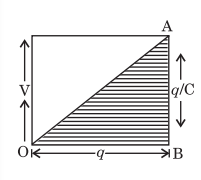
Graph between potential and charge is shown in the following figure. It is a straight line OA. Area OAB represents the energy stored in the capacitor in charging it. Thus stored potential energy \
$U =$ Area of $\Delta OAB$
$=\frac{1}{2} OB \times BA $
$=\frac{1}{2} \times q \times \frac{q}{C} $
$\Rightarrow U =\frac{ 1 }{2}\left(\frac{ q ^2}{ C }\right) $ ...(1)
$\text { But } q =CV $
$\therefore U =\frac{1}{2} \frac{(CV)^2}{C} \Rightarrow U =\frac{ 1 }{2} C V ^2 $ ...(2)
$\Rightarrow U =\frac{1}{2} CV(V) ; \text { but } CV=q $
$\therefore U =\frac{ 1 }{2} q V$ ...(3)
This energy of the charged capacitor remains in the medium between plates.
Energy density : The energy of a charged parallel plate capacitor is stored in the medium existing between its plates. "Energy density of a parallel plate capacitor is defined as the amount of energy stored per unit volume of the space (i.e. medium) between the plates of the capacitor." It is denoted by $u$.
Image
i.e. $\quad u=\frac{\text { Total Energy Stored ' } U}{\text { Volume of space between the plates }}$
But $\quad U =\frac{1}{2} CV ^2$ and Volume $= A \times d$
where
$C =$ capacitance of the capacitor,
$V =$ potential difference between the plates of the capacitor,
$A=$ area of each of the plates of the capacitor and
$d=$ distance between the plates of the capacitor.
$\therefore \quad u=\frac{\frac{1}{2} CV^2}{A \times d} \Rightarrow u=\frac{CV^2}{2 A d}$
But capacitance of the air capacitor
$C =\frac{\varepsilon_0 A}{d} $
$\Rightarrow \quad u =\frac{\left(\varepsilon_0 A / d\right) \times V^2}{2 A d} \Rightarrow u =\frac{1}{2} \varepsilon_0\left(\frac{ V }{ d }\right)^2$ ... (1)
But $\frac{V}{d}=$ Electric field intensity between the plates of the capacitor = E
$\therefore \quad u =\frac{1}{2} \varepsilon_0 E ^2$ ... (2)
If the space between the plates be filled with some medium of dielectric constant $K$, then the energy density would be
$u=\frac{1}{2} K \varepsilon_0 E^2$ ...(3)
The S. I. unit of $u$ is $\text { joule/metre}^3$.

View full question & answer
Question 35 Marks
State Gauss's Theorem and prove it.
Answer
Gauss's Law : It states that 'The total electric flux $\Phi_{E}$ through any closed surface is $(\frac{1}{\in_{0}})$ times the total charge $q$ enclosed inside the closed surface, where ɛ0 is the permittivity of free space."
That is $\Phi_{E}=\oint_{S}\vec{E}.\vec{dS}=\frac{q}{\in_{0}}$
This is integral form of Gauss's law.
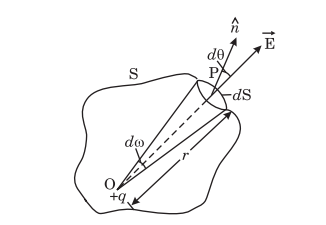
Proof : Consider a closed surface S, surrounding a point charge $+q$ and also consider a small area $d S$ on the closed surface S . (adjacent fig.) Let $d \omega$ be the solid angle subtended by area $d S$ at $O$. Then, electric flux over the area $d S$ is
$d \Phi_{E}=\overrightarrow{E} \cdot \hat{n} d S$
where $\hat{n}$ is the unit vector normal to $d S$.
The electric flux or the total electric normal induction through the whole of closed surface $S$ is
$\Phi_{E}=\oint_{S} \overrightarrow{E} \cdot \hat{n} d S$ ...(1)
The electric intensity at a point on $d S$ due to charge $q$ is given by :
$\overrightarrow{E}=\frac{q \hat{r}}{4 \pi \varepsilon_0 r^2}$ ...(2)
where $\hat{r}$ is a unit vector in the direction of $\vec{E}$.
Image
Substituting relation (2) in (1),
$\Phi_{E}=\oint_{S}\left(\frac{q \hat{r} \cdot \hat{n}}{4 \pi \varepsilon_0 r^2}\right) d S $
$\Rightarrow \Phi_{E}=\oint_{S}\left(\frac{q d S \cos \theta}{4 \pi \varepsilon_0 r^2}\right) $ ...(3)
$\text { But } d \omega=\frac{d S \cos \theta}{r^2}$
∴ Relation (3) takes the following form:
$\Phi_{E}=\frac{q}{4 \pi \varepsilon_0} \oint d \omega .$ ...(4)
The solid angle subtended by any closed surface at any point inside the surface $=4 \pi$ staradian i.e., $\oint d \omega= 4 \pi$
Substituting it in relation (4),
$\Phi_{E}=\frac{q}{4 \pi \varepsilon_0}(4 \pi) $
$\Rightarrow \Phi_{ E }=\frac{q}{\varepsilon_0}$ ...(5)

View full question & answer
5 Marks Questions - Physics STD 12 Science Questions - Vidyadip