Question
  1. State the two Kirchhoff's laws. Explain briefly how these rules are justified.
  2. The current is drawn from a cell of emf E and internal resistance r connected to the network of resistors each of resistance r as shown in the figure. Obtain the expression for (i) the current draw from the cell and (ii) the power consumed in the network.
Answer

  1. Junction Rule: At any Junction, the sum of currents, entering the junction, is equal to the sum of currents leaving the junction.
Loop Rule: The Algebraic sum, of changes in potential, around any closed loop involving resistors and cells, in the loop is zero.
$\sum(\triangle V)=0$
Justification: The first law is in accord with the law of conservation of charge.
The Second law is in accord with the law of conservation of energy.
  1. Equivalent resistance of the loop
$\text{R}=\frac{r}{3}$
Hence current drawn from the cell
$\text{I}=\frac{E}{\frac{r}{3}+r}=\frac{3E}{4r}$
Power consumed $\text{P}=I^2(\frac{r}{3})$
$=\frac{9E^2}{16r^2}\times\frac{4r}{3}=\frac{3E^2}{4r}$

Need a full question paper?

Generate a complete, print-ready paper with questions like this in minutes — across 16+ boards, with answer keys.

Start Generating Free

Similar questions

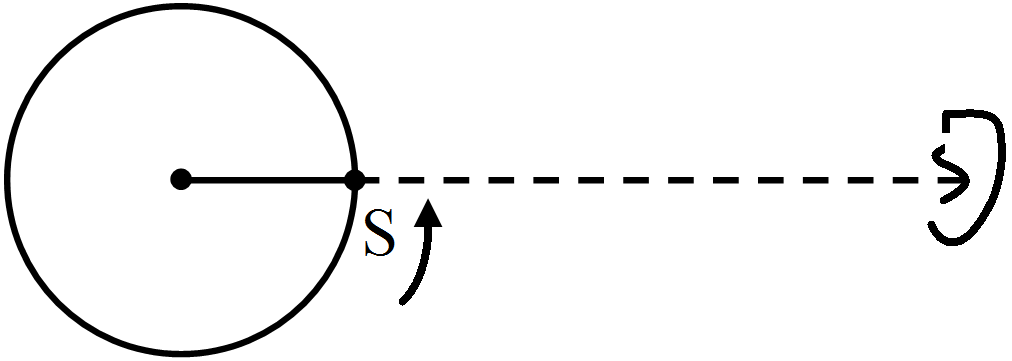
A small source of sound S of frequency 500Hz is attached to the end of a light string and is whirled in a vertical circle of radius 1.6m. The string just remains tight wher the source is at the highest point.
  1. An observer is located in the same vertical plane at a large distance and at the same height as the centre of the circle figure. The speed of sound in air = 330m/s and g = 10m/s 2. Find the maximum frequency heard by the observer.
  2. An observer is situated at a large distance vertically above the centre of the circle. Find the frequencies heard by the observer corresponding to the sound emitted by the source when it is at the same height as the centre.
An atom is in its excited state. Does the probability of its coming to ground state depend on whether the radiation is already present or not? If yes, does it also depend on the wavelength of the radiation present?
Add vectors $\overrightarrow{\text{A}},\overrightarrow{\text{B}}$ and $\overrightarrow{\text{C}}$ each having magnitude of 100 unit and inclined to the X-axis at angles 45°, 135° and 315° respectively.
Describe the procedure for obtaining V-I characteristic curve in forward bias of P-N junction diode. Make a circuit diagram of the experimental arrangement.
An electron of kinetic energy 100eV circulates in a path of radius 10cm in a magnetic field. Find the magnetic field and the number of revolutions per second made by the electron.
A town has a population of $1$ million. The average electric power needed per person is $300W$. A reactor is to be designed to supply power to this town. The efficiency with which thermal power is converted into electric power is aimed at $25\%$.
  1. Assuming $200\ \text{MeV}$ to thermal energy to come from each fission event on an average, find the number of events that should take place every day.
  2. Assuming the fission to take place largely through ${235}U,$ at what rate will the amount of ${235}U$ decrease? Express your answer in $\ kg$ per day.
  3. Assuming that uranium enriched to $3\%$ in $^{235}U$ will be used, how much uranium is needed per month $(30$ days$)$?
Write in detail the important results related to conductive electrostatics.
  1. Draw a ray diagram showing the image formation by a compound microscope. Hence obtain expression for total magnification when the image is formed at infinity.
  2. Distinguish between myopia and hypermetropia. Show diagrammatically how these defects can be corrected.
$i$. Draw a ray diagram showing the image formation by a compound microscope. Hence obtain the expression for total magnification when the image is formed at least distance of distinct vision.
$ii$. A compound microscope consists of an objective lens of focal length $2.0 \ cm$ and an eyepiece of focal length $6.0 \ cm$. If they are separated by a distance of $24 \ cm,$ find the total magnification when the image is formed at infinity.
Answer the following questions:
  1. Define electric flux. Write its $SI $ unit.
  2. Using Gauss’s law, prove that the electric field at a point due to a uniformly charged infinite plane sheet is independent of the distance from it.
  3. How is the field directed if:
  • The sheet is positively charged.
  • Negatively charged?