Question
State Gauss᾿s theorem in electrostatics. Using this theorem, derive an expression for the electric field due to an infinitely long straight wire of linear charge density $\lambda$.
Answer

(I) Gauss’s theorem: The flux of electric field through any closed surface is $\frac{1}{\varepsilon_0}$ times the total charge enclosed by the closed surface.
$\phi=\frac{q}{\varepsilon_0}$ ..(1)
By definition, the total electric flux through the closed surface is given by
$\phi=\oint \vec{E} \cdot \overrightarrow{d s}$
$\therefore$ From (1) and (2), Gauss's theorem may be expressed as follows
$\phi=\oint \vec{E} \cdot \overrightarrow{d s}=\frac{q}{\varepsilon_0}$
The surface integral of electric field over a closed surface is equal to $\frac{1}{\varepsilon_0}$ times the total charge enclosed by the surface.
Application of Gauss’s theorem
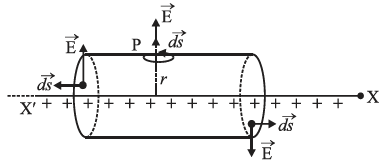
To find electric field due to a line charge let us consider an infinitely long line charge placed along XX’ axis with linear charge density λ. Our aim is to find electric field intensity at a point P distant r from the line charge. We draw a cylindrical surface of radius r and length l coaxial with the line charge. The net flux through the cylindrical gaussian surface i.e.

Image

$
\begin{aligned}
\phi= & \phi \vec{E} \cdot \overrightarrow{d s}=\int_{L C F} \vec{E} \cdot \overrightarrow{d s}+\int_{C s} \vec{E} \cdot \overrightarrow{d s}+\int_{R C F} \vec{E} \cdot \overrightarrow{d s} \\
& \quad=\int_{L C F} E d s \cos 90^{\circ}+\int_{C s} E d s \cos 0^{\circ}+\int_{R C F} E d s \cos 90^{\circ} \\
& \phi=\int_{C s} E d s \cos 0^{\circ}=E \cdot 2 \pi r l
\end{aligned}
$
The charge enclosed by the gaussian surface is q = N
Using Gauss’s theorem from equations (1) and (2)
$E(2 \pi r l)=\frac{\lambda l}{\varepsilon_0} \Rightarrow E=\frac{\lambda}{2 \pi \varepsilon_0 r}$

Need a full question paper?

Generate a complete, print-ready paper with questions like this in minutes — across 16+ boards, with answer keys.
Start Generating Free

Similar questions

Draw a circuit diagram of a C.E. transistor amplifier. Briefly, explain its working and write the expression for (i) current gain, (ii) voltage gain of the amplifier.
A storage battery of emf $8.0 V$ and internal resistance $0.5\ \Omega$ is being charged by a $120 V\  dc$ supply using a series resistor of $15.5\ \Omega.$ What is the terminal voltage of the battery during charging? What is the purpose of having a series resistor in the charging circuit?
A semiconducting material has a band gap of 1eV. Acceptor impurities are doped into it which create acceptor levels 1meV above the valence band. Assume that the transition from one energy level to the other is almost forbidden if kT is less than $\frac{1}{50}$ of the energy gap. Also, if kT is more than twice the gap, the upper levels have maximum population. The temperature of the semiconductor is increased from 0K. The concentration of the holes increases with temperature and after a certain temperature it becomes approximately constant. As the temperature is further increased, the hole concentration again starts increasing at a certain temperature. Find the order of the temperature range in which the hole concentration remains approximately constant.
Calculate the magnetic dipole moment corresponding to the motion of the electron in the ground state of a hydrogen atom.
Figure shows a light bulb (B) and iron cored inductor connected to a dc battery through a switch (S).
  1. What will one observe when switch (S) is closed?
  2. How will the glow of the bulb change when the battery is replaced by an ac source of rms voltage equal to the voltage of dc battery? Justify your answer in each case.
  1. State Biot – Savart law and express this law in the vector form.
  2. Two identical circular coils, P and Q each of radius R, carrying currents 1 A and $\sqrt{3}$ A respectively, are placed concentrically and perpendicular to each other lying in the XY and YZ planes. Find the magnitude and direction of the net magnetic field at the centre of the coils.
Explain Ohm's law. State factors on which the resistance of any conductor depends. Define specific resistance and state its relation with the conductivity.
Suppose, one wishes to construct a 1.0 farad capacitor using circular discs. If the separation between the discs be kept at 1.0mm, what would be the radius of the discs?
Consider the situation of the previous problem. Find the average electric field energy stored in the capacitor and the average magnetic field energy stored in the coil.
What is the parallel and crossed arrangement of polaroid?