Questions

3 Marks Question

Take a timed test

8 questions · self-marked practice — reveal the answer and mark yourself.

Question 23 Marks
Find the expression for the capacitance of a parallel plate capacitor of plate area $A$ and plate separation $d$ when $(I)$ a dielectric slab of thickness $t$ and $(II)$ a metallic slab of thickness $t,$ where $(t < d)$ are introduced one by one between the plates of the capacitor. In which case would the capacitance be more and why?
Answer
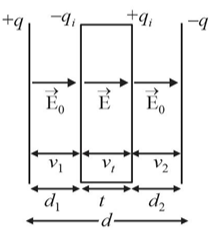
$(I)$ The capacitance of a parallel plate capacitor with dielectric slab $(t < d)$

Image
$+q,-q=$ the charges on the capacitor plates
$+q_1-q_1=$ Induced charges on the faces of the dielectric slab
$E_0 \rightarrow $ electric field intensity in air between the plates
$E \rightarrow$ the reduced value of electric field intensity inside the dielectric slab.
When a dielectric slab of thickness $t < d$ is introduced between the two plates of the capacitor the electric field reduces to $E$ due to the polarisation of the dielectric.
The potential difference between the two plates is given by
$V=V_1+V_t+V_2$
$V=E_0 d_1+E t+E_0 d_2 ..(1)$
Here $E$ is the reduced value of electric field intensity
$\vec{E}=\vec{E}_0+\vec{E}_j$. Here $\vec{E}_J$ is the electric field due to the induced charges $\left[+q_i\right.$ and $\left.-q_j\right]$
$E=\sqrt{E_0^2+E_i^2+2 E_0 E_i \cos 180^{\circ}}$
$=\sqrt{\left(E_0-E_i\right)^2}$
$E=E_0-E_{ i }$
Also the dielectric constant $K$ is given by
$K=\frac{E_0}{E} ..(2)$
$E_0=\frac{\sigma}{\varepsilon_0}=\frac{q}{A \varepsilon_0} ..(3)$
From equations $(1), (2)$ and $(3)$
$V=E_0\left[d_1+d_2\right]+\frac{E_0}{K} t$
$V=\frac{q}{A \varepsilon_0}\left[d-t+\frac{t}{K}\right] ..(4)$
The capacitance of the capacitor on the introduction of the dielectric slab is
$C=\frac{q}{V} ..(5)$
From $(4)$ and $(5)$
$C=\frac{\varepsilon_0 A}{d-t+\frac{t}{K}}$
If $t=d$, then $C=K \frac{\varepsilon_0 A}{d} $
$\Rightarrow C = KC _0 \quad$
​​​​​​​Here $C_0=\frac{\varepsilon_0 A}{d}$
Since $K>1$ therefore $C>C_0$
$(II)$ For a metallic slab $K$ is infinitely large,
therefore $C=\frac{\varepsilon_0 A}{d-t}$
View full question & answer
Question 33 Marks
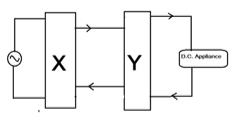
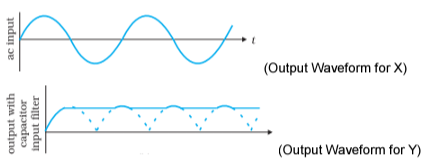
(I) Identify the circuit elements X and Y as shown in the given block diagram and draw the output waveforms of X and Y.

Image

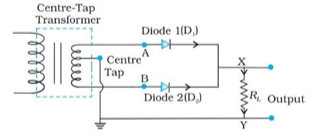
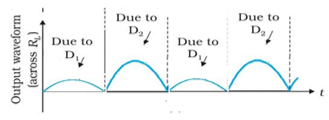
(II) If the centre tapping is shifted towards Diode D1 as shown in the diagram, draw the output waveform of the given circuit.

Image
Answer
(I) X = Full wave rectifier , Y = Filter

Image
(II)

Image
View full question & answer
Question 43 Marks
$(II) (a)$ Define electric flux and write its $SI$ unit.
$(b)$ Use Gauss᾿s law to obtain the expression for the electric field due to a uniformly charged infinite plane sheet of charge.
Answer
$(a)$ Definition of electric flux and its $SI$ unit
$(b)$ Electric field due to an infinite plane sheet of charge.
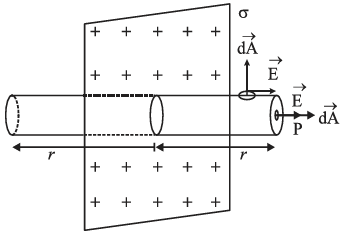
Let us consider an infinite thin plane sheet of positive charge having a uniform surface charge density $\sigma$.
Let $P$ be the point where electric field $E$ is to be found.
Let us imagine a cylindrical gaussian surface of length $2r$ and containing $P$ as shown.
The net flux through the cylindrical gaussian surface.

Image
$ \phi =\oint \vec{E} \cdot \overrightarrow{d A}$
$ =\int_{ RCF } \vec{E} \cdot \overrightarrow{d A}+\int_{L C F} \vec{E} \cdot \overrightarrow{d A}+\int_{C S} \vec{E} \cdot \overrightarrow{d A}$
$=\int_{RCF} E d A \cos 0^{\circ}+\int_{LCF} E d A \cos 0^{\circ}+\int_{CS} E d A \cos 90^{\circ}$
$=EA+EA+0$
$\phi=2 EA ...(1)$
Here $A$ is the area of cross$-$section of each circular face i.e. $\text{LCF}$ and $\text{RCF.}$ The total charge enclosed by the gaussian cylinder
$=\sigma A ...(2)$
Using Gauss's theorem, from $(1)$ and $(2),$
$2 EA =\frac{\sigma A}{\varepsilon_0}$
$E =\frac{\sigma}{2 \varepsilon_0}$
View full question & answer
Question 53 Marks
State Gauss᾿s theorem in electrostatics. Using this theorem, derive an expression for the electric field due to an infinitely long straight wire of linear charge density $\lambda$.
Answer
(I) Gauss’s theorem: The flux of electric field through any closed surface is $\frac{1}{\varepsilon_0}$ times the total charge enclosed by the closed surface.
$\phi=\frac{q}{\varepsilon_0}$ ..(1)
By definition, the total electric flux through the closed surface is given by
$\phi=\oint \vec{E} \cdot \overrightarrow{d s}$
$\therefore$ From (1) and (2), Gauss's theorem may be expressed as follows
$\phi=\oint \vec{E} \cdot \overrightarrow{d s}=\frac{q}{\varepsilon_0}$
The surface integral of electric field over a closed surface is equal to $\frac{1}{\varepsilon_0}$ times the total charge enclosed by the surface.
Application of Gauss’s theorem
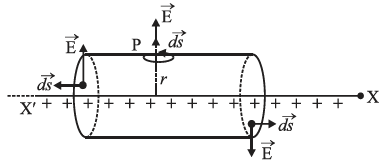
To find electric field due to a line charge let us consider an infinitely long line charge placed along XX’ axis with linear charge density λ. Our aim is to find electric field intensity at a point P distant r from the line charge. We draw a cylindrical surface of radius r and length l coaxial with the line charge. The net flux through the cylindrical gaussian surface i.e.

Image

$
\begin{aligned}
\phi= & \phi \vec{E} \cdot \overrightarrow{d s}=\int_{L C F} \vec{E} \cdot \overrightarrow{d s}+\int_{C s} \vec{E} \cdot \overrightarrow{d s}+\int_{R C F} \vec{E} \cdot \overrightarrow{d s} \\
& \quad=\int_{L C F} E d s \cos 90^{\circ}+\int_{C s} E d s \cos 0^{\circ}+\int_{R C F} E d s \cos 90^{\circ} \\
& \phi=\int_{C s} E d s \cos 0^{\circ}=E \cdot 2 \pi r l
\end{aligned}
$
The charge enclosed by the gaussian surface is q = N
Using Gauss’s theorem from equations (1) and (2)
$E(2 \pi r l)=\frac{\lambda l}{\varepsilon_0} \Rightarrow E=\frac{\lambda}{2 \pi \varepsilon_0 r}$

View full question & answer
Question 63 Marks
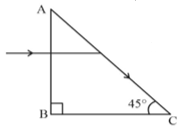
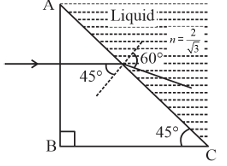
A light ray entering a right $-$ angled prism undergoes refraction at the face $AC$ as shown in Figure
$(I)$ What is the refractive index of the material of the prism in Figure?

Image
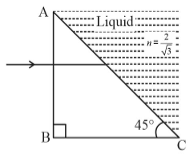
$(II) (a)$ If the side $AC$ of the above prism is now surrounded by a liquid of refractive index $\frac{2}{\sqrt{3}}$ as shown in Figure, determine if the light ray continues to graze along the interface $AC$ or undergoes total internal reflection or undergoes refraction into the liquid.

Image
$(b)$ Draw the ray diagram to represent the path followed by the incident ray with the corresponding angle values.
$($Given $,\sin ^{-1}\left(\frac{\sqrt{2}}{\sqrt{3}}\right)=54.6^{\circ} )$
Answer
$(I)$ Since the light ray enters perpendicular to the face $AB,$ the angle of incidence on face $AC$ will be $45^\circ$ .
So $, \sin \theta_C =\frac{1}{n}$
$\sin 45^{\circ} =\frac{1}{n}=\frac{1}{\sqrt{2}} $ So $, n=\sqrt{2}$
$(II)$ In figure , the face $AC$ of the prism is surrounded by a liquid so $n=\frac{n g}{n_l}=\frac{\sqrt{2}}{\left(\frac{2}{\sqrt{3}}\right)}=\frac{\sqrt{3}}{\sqrt{2}}$
$\sin \theta_C=\frac{1}{n}=\frac{\sqrt{2}}{\sqrt{3}} \theta_C=\sin ^{-1}\left(\frac{\sqrt{2}}{\sqrt{3}}\right)=54.6^{\circ}$
Since the angle of incidence on the surface $AC$ is $45^\circ ,$ which is less than the critical angle for the pair of media $($glass and the liquid$),$ the ray neither undergoes grazing along surface $AC,$ nor does it suffer total internal reflection
Since the angle of incidence on the surface $AC$ is $45^\circ,$ which is less than the critical angle for the pair of media $($glass and the liquid$),$ the ray neither undergoes grazing along surface $AC,$ nor does it suffer total internal reflection
For refracting interface $AC , n_1 \sin i=n_2 \sin r$
$n_1 \cdot \sin 45^{\circ}=\left(\frac{2}{\sqrt{3}}\right) \sin r$
$\sin r=\frac{\sqrt{3}}{2} $
$\therefore r=60^{\circ} .$
Image
View full question & answer
Question 73 Marks
A boy is holding a smooth, hollow and non-conducting pipe vertically with charged spherical ball of mass 10 g carrying a charge of +10 mC inside it which is free to move along the axis of the pipe. The boy is moving the pipe from East to West direction in the presence of magnetic field of 2T. With what minimum velocity, should the boy move the pipe such that the ball does not move along the axis. Also determine the direction of the magnetic field.
Answer
Given
$B=2 T, q=10 mC$, mass of the ball $=10^{-2} kg, g=9.8 m / s ^2$ Magnetic force $(q v B \sin \theta)=$ gravitational force $( mg )$ $
v=\frac{m g}{q B \sin \theta}
$
For min. velocity $\sin \theta=1$

$\begin{aligned} v & =\frac{m g}{q B \sin \theta}=v=\frac{m g}{q B} \\ & =\frac{10^{-2} \times 9.8}{10^{-2} \times 2} m / s \\ & =4.9 m / s \\ & v=4.9 m / s ^2\end{aligned}$
As force is in upward direction so from Fleming’s Left-hand rule, magnetic field will be along North to South.
View full question & answer
Question 83 Marks
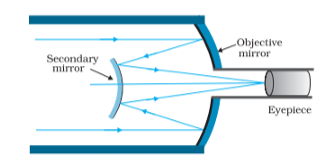
(I) Draw a ray diagram for the formation of image by a Cassegrain telescope.
(II) Why these types of telescopes are preferred over refracting type telescopes.
Answer
(I)

Image

(ii)
  • It has mirror objective, which is free from chromatic and spherical aberrations.
  • It can gather more light as objectives can be made larger, hence images can be brighter. Any other two equivalent examples can be accepted.
View full question & answer