Question
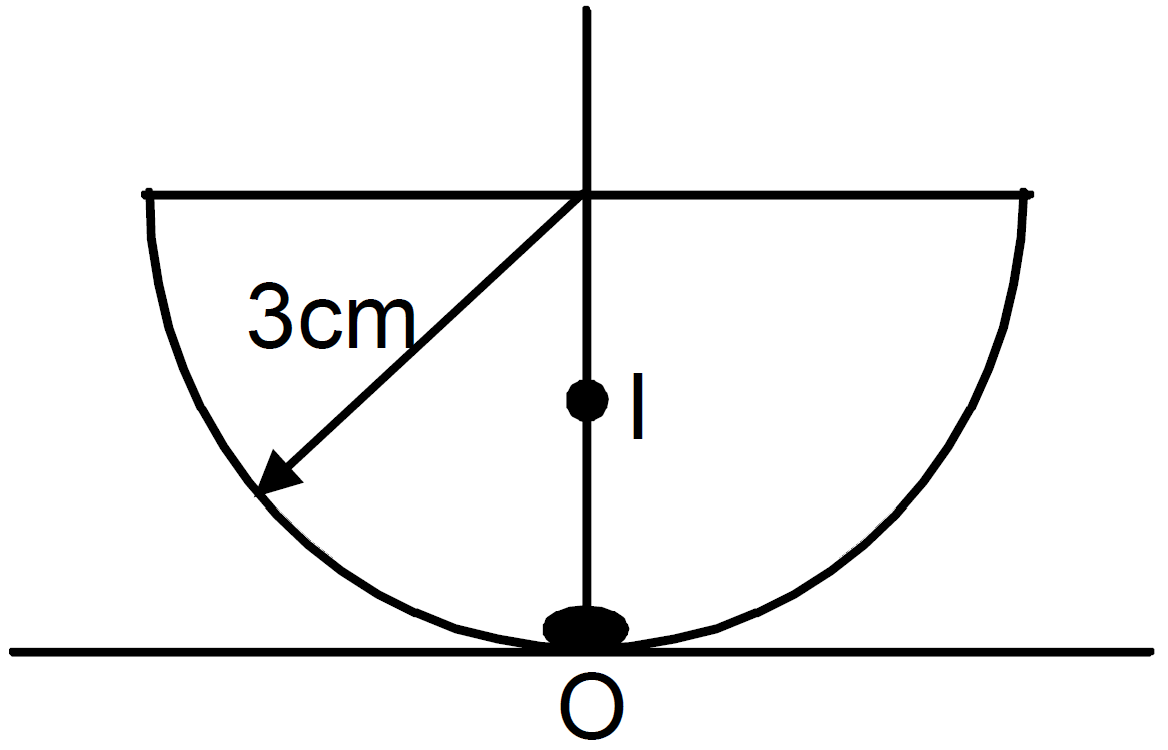
Solve the previous problem if the paperweight is inverted at its place so that the spherical surface touches the paper.
Answer

Thickness of glass $=3\text{cm}, \ \mu_{\text{g}}=1.5$

Image shif $=3\Big(1-\frac{1}{1.5}\Big)$

[Treating it as a simple refraction problem because the upper surface is flat and the spherical surface is in contact with the object]

$=3\times\frac{0.5}{1.5}=1\text{cm}.$

The image will appear 1 cm above the point P.

Need a full question paper?

Generate a complete, print-ready paper with questions like this in minutes — across 16+ boards, with answer keys.

Start Generating Free

Similar questions

Establish a relation between resistance and resistivity of any substance. Explain in detail, the dependence of resistivity on the temperature.
Explain the experiment which represents the total internal reflection.
A water particle of mass 10.0mg and having a charge of 1.50 × 10-6C stays suspended in a room. What is the magnitude of electric field in the room? What is its direction?
How many time constants will elapse before the current in a charging RC circuit drops to half of its initial value? Answer the same question for a discharging RC circuit.
A circular coil of radius 8.0cm and 20 turns is rotated about its vertical diameter with an angular speed of 50rad s–1 in a uniform horizontal magnetic field of magnitude 3.0 × 10⁻²T. Obtain the maximum and average emf induced in the coil. If the coil forms a closed loop of resistance 10Ω, calculate the maximum value of current in the coil. Calculate the average power loss due to Joule heating. Where does this power come from?
The pendulum of a certain clock has time period 2.04s. How fast or slow does the clock run during 24 hours?
A circular loop of radius R carries a current I. Another circular loop of radius r ( << R) carries a current i and is placed at the centre of the larger loop. The planes of the two circles are at right angle to each other. Find the torque acting on the smaller loop.
Can two equipotential surfaces cut each other?
Consider a variation of the previous problem (figure). Suppose the circular loop lies in a vertical plane. The rod has a mass m. The rod and the loop have negligible resistances but the wire connecting O and C has a resistance R. The rod is made to rotate with a uniform angular velocity $\omega$ in the clockwise direction by applying a force at the midpoint of OA in a direction perpendicular to it. Find the magnitude of this force when the rod makes an angle $\theta$ with the vertical.
Find the temperature at which the average thermal kinetic energy is equal to the energy needed to take a hydrogen atom from its ground state to n = 3 state. Hydrogen can now emit red light of wavelength 653.1nm. Because of Maxwellian distribution of speeds, a hydrogen sample emits red light at temperatures much lower than that obtained from this problem. Assume that hydrogen molecules dissociate into atoms.