Question
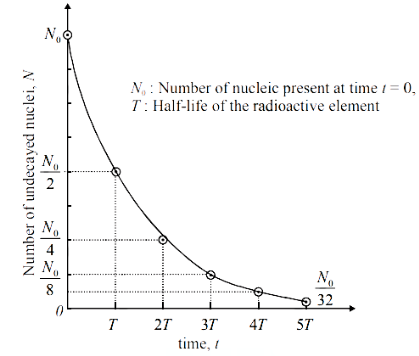
State law of radioactive decay. Hence derive the relation $N = N _{ o } e ^{-\lambda t}$. Represent it graphically.

Answer

Radioactive decay law :
The number of nuclei undergoing the decay per unit time is proportional to the number of unchanged nuclei present at that instant.
Proof:
  • Let ‘N’ be the number of nuclei present at any instant ‘t’.
  • Let 'dN’ be the number of nucleic that disintegrated in short interval of time ‘dt’.
  • According to law
$\frac{- dN }{ dt } \propto N$
$\therefore \frac{ dN }{ dt }=-\lambda N ...........(1)$
Where λ - decayconst
$\therefore \frac{ dN }{ N }=-\lambda dt$
$\therefore$ integrating both sides
$\int \frac{ dN }{ N }=\int-\lambda dt$
${(e l l) N =\lambda t+C \ell^{\prime \prime} N ^{\prime \prime}=\lambda t + C ^{\prime}}..........(2)$
Where $C \rightarrow$ integration consta
Image
$\therefore at  t = 0 , N =N_0$
$\therefore \ell nN _0=C$
∴ Frome equation (2) and (3)
$\ln N=-\lambda t+\ell n N_0$
$\lambda t=\operatorname{In} N-\operatorname{In} N_0$
$-\lambda T =\ln \left(\frac{N}{N_0}\right)$
$\frac{N}{N_0}=e^{-(\lambda t)}$
$\therefore N=N_0 e^{-(\lambda t)}$

Need a full question paper?

Generate a complete, print-ready paper with questions like this in minutes — across 16+ boards, with answer keys.
Start Generating Free

Similar questions

Determine the change in wavelength of light during its passage from air to glass. If the refractive index of glass with respect to air is 1.5 and the frequency of light is \(3.5 \times 10^{14} Hz\), find the wave number of light in glass. [Velocity of light in air, \(c=3 \times 10^8 m / s\) ]
The radius of gyration of a body about an axis at $6 \mathrm{~cm}$ from its centre of mass is $10 \mathrm{~cm}$. Find its radius of gyration about a parallel axis through its centre of mass.
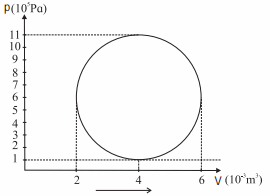
A hypothetical thermodynamic cycle is shown in the figure. Calculate the work done in $25$ cycles.

Image
 
Give an example of some familiar process in which heat is added to an object, without changing its temperature.
Derive an expression for terminal velocity of a spherical object falling under gravity through a viscous medium
The frequency of revolution of a particle performing circular motion changes from $60 \mathrm{rpm}$ to $180 \mathrm{rpm}$ in 20 seconds. Calculate the angular acceleration of the particle.
Is electrostatic potential necessarily zero at a point where electric field strength is zero? Justify.
A circular coil of wire is made up of $200$ turns, each of radius $10 \ cm$. If a current of $0.5A$ passes through it, what will be the Magnetic field at the centre of the coil?
A current of $10 A$ in the primary of a transformer is reduced to zero at the uniform rate in 0.1 second. If the mutual inductance be $3 H$, what is the emf induced in the secondary and change in the magnetic flux per turn in the secondary if it has 50 turns?
Find the total current 'I' flowing through the following circuit.