The radius of gyration of a body about an axis at $6 \mathrm{~cm}$ from its centre of mass is $10 \mathrm{~cm}$. Find its radius of gyration about a parallel axis through its centre of mass.
Q 96.6
Download our app for free and get started
Let $O$ be a point at $6 \mathrm{~cm}$ from the centre of mass of the body.
Let $\mathrm{I}=\mathrm{Ml}$ about an axis through $\mathrm{O}$,
$\mathrm{k}=$ radius of gyration about the axis through $\mathrm{O}$,
$\mathrm{I}_{\mathrm{CM}}=\mathrm{Ml}$ about a parallel axis through the centre of mass of the body,
$\mathrm{k}_{\mathrm{CM}}=$ radius of gyration about a parallel axis through the centre of mass,
$M=$ mass of the body,
$\mathrm{h}=$ distance between the two axes.
Data : $\mathrm{h}=6 \mathrm{~cm}, \mathrm{k}=10 \mathrm{~cm}$
By the theorem of parallel axis,
$
\mathrm{I}=\mathrm{I}_{\mathrm{CM}}+\mathrm{Mh}^2
$
Also, $\mathrm{I}=\mathrm{Mk}^2$ and $\mathrm{I}_{\mathrm{CM}}=M k_{\mathrm{CM}}^2$
$
\begin{aligned}
& \therefore M k^2=M k_{\mathrm{CM}}^2+M h^2 \\
& \therefore k^2=k_{\mathrm{CM}}^2+h^2 \\
& \therefore 100=k_{\mathrm{CM}}^2+36 \quad \therefore k_{\mathrm{CM}}=8 \mathrm{~cm}
\end{aligned}
$
The radius of gyration about a parallel axis through its centre of mass is $8 \mathrm{~cm}$.
Let $\mathrm{I}=\mathrm{Ml}$ about an axis through $\mathrm{O}$,
$\mathrm{k}=$ radius of gyration about the axis through $\mathrm{O}$,
$\mathrm{I}_{\mathrm{CM}}=\mathrm{Ml}$ about a parallel axis through the centre of mass of the body,
$\mathrm{k}_{\mathrm{CM}}=$ radius of gyration about a parallel axis through the centre of mass,
$M=$ mass of the body,
$\mathrm{h}=$ distance between the two axes.
Data : $\mathrm{h}=6 \mathrm{~cm}, \mathrm{k}=10 \mathrm{~cm}$
By the theorem of parallel axis,
$
\mathrm{I}=\mathrm{I}_{\mathrm{CM}}+\mathrm{Mh}^2
$
Also, $\mathrm{I}=\mathrm{Mk}^2$ and $\mathrm{I}_{\mathrm{CM}}=M k_{\mathrm{CM}}^2$
$
\begin{aligned}
& \therefore M k^2=M k_{\mathrm{CM}}^2+M h^2 \\
& \therefore k^2=k_{\mathrm{CM}}^2+h^2 \\
& \therefore 100=k_{\mathrm{CM}}^2+36 \quad \therefore k_{\mathrm{CM}}=8 \mathrm{~cm}
\end{aligned}
$
The radius of gyration about a parallel axis through its centre of mass is $8 \mathrm{~cm}$.

Download our appand get started for free
Experience the future of education. Simply download our apps or reach out to us for more information. Let's shape the future of learning together!No signup needed.*
Similar Questions
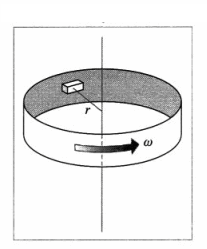
- 1View SolutionA thin cylindrical shell of inner radius 1.5 m rotates horizontally, about a vertical axis, at an angular speed ω. A wooden block rests against the inner surface and rotates with it. If the coefficient of static friction between block and surface is 0.3, how fast must the shell be rotating if the block is not to slip and fall ?
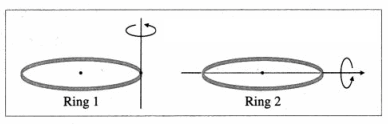
- 2View SolutionTwo identical rings are to be rotated about different axes of rotation as shown by applying torques so as to produce the same angular acceleration in both. How is it possible ?
- 3A ballet dancer spins about a vertical axis at $2.5 \pi \mathrm{rad} / \mathrm{s}$ with his arms outstretched. With the arms folded, the MI about the same axis of rotation changes by $25 \%$. Calculate the new speed of rotation in rpm.View Solution
- 4A stone of mass $100 \mathrm{~g}$ attached to a string of length $50 \mathrm{~cm}$ is whirled in a vertical circle by giving it a velocity of $7 \mathrm{~m} / \mathrm{s}$ at the lowest point. Find the velocity at the highest point.View Solution
- 5A stone of mass $2 \mathrm{~kg}$ is whirled in a horizontal circle attached at the end of a $1.5 \mathrm{~m}$ long string. If the string makes an angle of $30^{\circ}$ with the vertical, compute its period.View Solution
- 6The frequency of revolution of a particle performing circular motion changes from $60 \mathrm{rpm}$ to $180 \mathrm{rpm}$ in 20 seconds. Calculate the angular acceleration of the particle.View Solution
- 7View SolutionAssuming the expression for the MI of a uniform solid sphere about its diameter, obtain the expression for its moment of inertia about a tangent.
- 8View SolutionWrite the kinematical equations for circular motion in analogy with linear motion.
- 9A boy standing at the centre of a turntable with his arms outstretched is set into rotation with angular speed $\omega \mathrm{rev} / \mathrm{min}$. When the boy folds his arms back, his moment of inertia reduces to $\frac{2}{5}$ th its initial value. Find the ratio of his final kinetic energy of rotation to his initial kinetic energy.View Solution
- 10A torque of $100 \mathrm{~N} . \mathrm{m}$ is applied to a body capable of rotating about a given axis. If the body starts from rest and acquires kinetic energy of $10000 \mathrm{~J}$ in 10 seconds, findView Solution
(i) its moment of inertia about the given axis
(ii) its angular momentum at the end of 10 seconds.