Question
State Ohm’s law? How can it be verified experimentally? Does it hold good under all conditions? Comment.
Answer


According to Ohm's law the electric current flowing through a conductor is directly proportional to the potential difference applied across its ends provided the physical conditions such as temperature etc remains unchanged.
Let V be the potential difference applied across the ends of conductor through which current Iflows, then according to Ohm's law.
$\text{V}\propto\text{I}\Rightarrow\ \text{V}=\text{IR}$
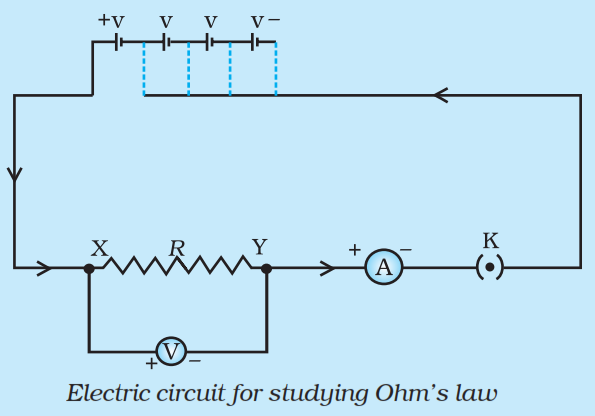
Ohm’s law can be verified experimentally by the activity given below:
  1. Firstly, Set up a circuit as shown in figure given below, consisting of a nichrome wire XY of length, say 0.5m, an ammeter, a voltmeter and four cells of 1.5V each. (Nichrome is an alloy of nickel,chromium, manganese, and iron metals.)
  1. First use only one cell as the source in the circuit. Note the reading in the ammeter I, for the current and reading of the voltmeter V for the potential difference across the nichrome wire XY in the circuit. Tabulate them in the Table given.
  2. Next connect two cells in the circuit and note the respective readings of the ammeter and voltmeter for the values of current through the nichrome wire and potential difference across the nichrome wire.
  3. Repeat the above steps using three cells and then four cells in the circuit separately.
  4. Calculate the ratio of V to I for each pair of potential difference V and current I.
S.No. Number of cells used in the circuit Current through the nichrome wire, I (ampere) Potential difference across the nichrome wire, V (Volt) $\frac{\text{V}}{\text{I}}$ $\Big(\frac{\text{Volt}}{\text{Ampere}}\Big)$
1. 1      
2. 2      
3. 3      
4. 4      
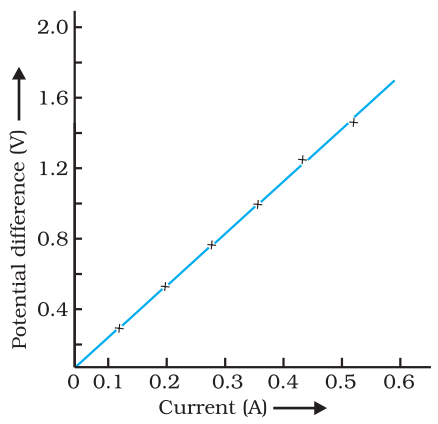
  1. Plot a graph between V and I. The graph will be a straight line as shown below.
  1. This verifies the Ohm’s law.
Ohm's does not hold under all conditions as it is basically not a fundamental law which means it has exceptions. Following are the conditions when Ohm’s law does not hold:
  • It is not obeyed when physical conditions of conductors like temperature keep on changing.
  • It is not obeyed by a lamp filament, junction diode, thermistor etc.
  • It is not obeyed in case of superconductors whose resistance is equal to zero.

Need a full question paper?

Generate a complete, print-ready paper with questions like this in minutes — across 16+ boards, with answer keys.

Start Generating Free

Similar questions

An object 5cm high is held 25cm away from a converging lens of focal length 10cm. Find the position, size and nature of the image formed. Also draw the ray diagram.
When a broken piece of the stem of a plant X is planted in the soil, a new plant grows from it in a week's time. The leaves of plant X also have many small entities Y in their margins which can fall to the ground alone or alongwith leaves and grow into new plants.
  1. Name a plant which X could be.
  2. What are the entities Y present on the leaves of X known as?
  3. Name a plant other than X which can be reproduced from its leaves.
  4. Name a common plant grown in many homes which can be propagated from its broken stems like plant X.
  5. Name a kind of dormant organs present in dry stems of old grass plants lying in the fields which get activated and produce green grass plants after the rains.
  1. Draw a diagram of human alimentary canal and label - gall bladder, pancreas, liver and small intestine on it.
  2. Give two reasons to explain why absorption of digested food occurs mainly in the small intestine.
Draw a labelled diagram of the human digestive system. With the help of this diagram, describe the process of digestion of food in man (humans).
What is a decomposition reaction? Give an example of a decomposition reaction. Describe an activity to illustrate such a reaction by heating.
  1. What is scattering of light? Explain how the colour of the scattered light depends on the size of the scattering particles.
  2. Explain the reddish appearance of the Sun at sunrise or sunset. Why does it not appear red at noon?
What is biomass? Explain the principle and working of a biogas plant using a labelled schematic diagram.
The organs A of a person have been damaged completely due to which too much of a poisonous waste material B has started accumulating in his blood, making it dirty. In order to save this person's life, the blood from an artery in the person's arm is made to flow into long tubes made of substance E which are kept in coiled form in a tank containing solution F. This solution contains three materials G, H and I in similar proportions to those in normal blood. As the person's blood passes through long tubes of substance E, most of the wastes present in it go into solution. The clean blood is then put back into a vein in the arm of the person for circulation.
  1. What are organs A?
  2. Name the waste substance B.
  3. What are (i) E and (ii) F? Name G, H and I.
  4. What is the process described above known as?
Why are the Arabari forests of Bengal known to be a good example of conserved forest?
Describe the process of urine formation in kidneys.