Question
State Ohm’s law? How can it be verified experimentally? Does it hold good under all conditions? Comment.
Answer

According to Ohm's law the electric current flowing through a conductor is directly proportional to the potential difference applied across its ends provided the physical conditions such as temperature etc remains unchanged. Let V be the potential difference applied across the ends of conductor through which current Iflows, then according to Ohm's law.$\text{V}\propto\text{I}\Rightarrow\ \text{V}=\text{IR}$
Ohm’s law can be verified experimentally by the activity given below:
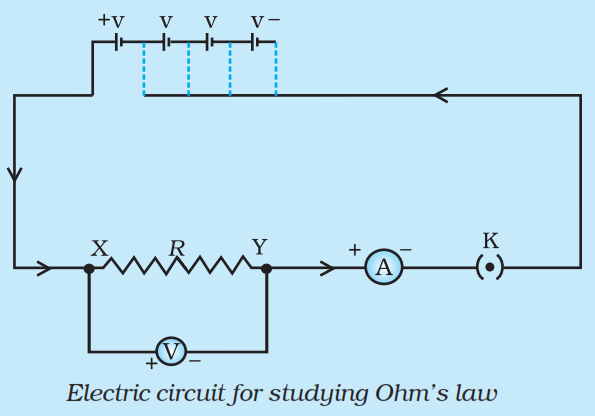
  1. Firstly, Set up a circuit as shown in figure given below, consisting of a nichrome wire XY of length, say 0.5m, an ammeter, a voltmeter and four cells of 1.5V each. (Nichrome is an alloy of nickel,chromium, manganese, and iron metals.)
  1. First use only one cell as the source in the circuit. Note the reading in the ammeter I, for the current and reading of the voltmeter V for the potential difference across the nichrome wire XY in the circuit. Tabulate them in the Table given.
  2. Next connect two cells in the circuit and note the respective readings of the ammeter and voltmeter for the values of current through the nichrome wire and potential difference across the nichrome wire.
  3. Repeat the above steps using three cells and then four cells in the circuit separately.
  4. Calculate the ratio of V to I for each pair of potential difference V and current I.
S.No. Number of cells used in the circuit Current through the nichrome wire, I (ampere) Potential difference across the nichrome wire, V (Volt) $\frac{\text{V}}{\text{I}}$ $\Big(\frac{\text{Volt}}{\text{Ampere}}\Big)$
1. 1      
2. 2      
3. 3      
4. 4      
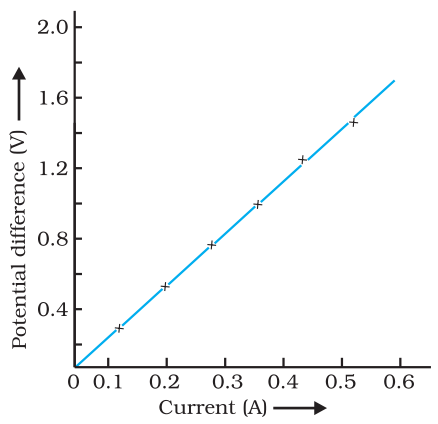
  1. Plot a graph between V and I. The graph will be a straight line as shown below.
  1. This verifies the Ohm’s law.
Ohm's does not hold under all conditions as it is basically not a fundamental law which means it has exceptions. Following are the conditions when Ohm’s law does not hold:
  • It is not obeyed when physical conditions of conductors like temperature keep on changing.
  • It is not obeyed by a lamp filament, junction diode, thermistor etc.
  • It is not obeyed in case of superconductors whose resistance is equal to zero.

Need a full question paper?

Generate a complete, print-ready paper with questions like this in minutes — across 16+ boards, with answer keys.

Start Generating Free

Similar questions

Write two points of difference between asexual and sexual types of reproduction. Describe why variations are observed in the offspring formed by sexual reproduction.
Give the reaction for the hydrogenation of unsaturated carbon compounds. Define the term catalyst and name the catalyst used in this reaction. Which oil should be chosen for cooking and why?
State the law of refraction of light that defines the refractive index of a medium with respect to the other. Express it mathematically. How is refractive index of any medium 'A' with respect to a medium 'B' related to the speed of propagation of light in two media A and B? State the name of this constant when one medium is vacuum or air.
The refractive indices of glass and water with respect to vacuum are $\frac{3}{2}$ and $\frac{4}{3}$ respectively. If the speed of light in glass is $2\times 10^{8} \text{ m/s}$ find the speed of light in,
  1. Vacuum.
  2. Water.
What are the advantages of the periodic table?
  1. One-half of a convex lens is covered with a black paper. Will such a lens produce an image of the complete object? Support your answer with a ray diagram.
  2. An object 5 cm high is held 25 cm away from a converging lens of focal length 10 cm.
  1. Draw the ray diagram.
  2. Calculate the position and size of the image formed.
  3. What is the nature of the image?
In the surgical method of birth control available for human females, the structures P in the reproductive system are cut and ligated (tied up) properly at both ends. This prevents the reproductive cell Q released by an organ R from entering the structures P so that Q is not available to fuse with another reproductive cell S coming from the male reproductive system. In this way, pregnancy is prevented.
  1. What are structures P?
  2. What is cell Q?
  3. Name the organ R.
  4. What is the reproductive cell S?
  5. What is the name of this surgical method of birth control available to females?
P and Q are two types of plants having weak stems which cannot stand upright on their own. The plants P and Q have organs R and S respectively which can grow towards any support which they happen to touch and wind around that support. It is observed that organ R originates from the leaves of the plant whereas organ S originates directly from the stem of the plant.
  1. What is (i) R, and (ii) S?
  2. What is the name of growth movement exhibited by the organs R and S?
  3. Name the stimulus involved in this case.
  4. State whether the behaviour of organs R and S is a tropic movement or a nastic movement.
  5. Name one plant like P and another plant like Q.
An object is placed at a distance of 60cm from a concave lens of focal length 30cm.
  1. Use lens formula to find the distance of the image from the lens.
  2. List four characteristics of the image (nature, position, size, erect/ inverted) formed by the lens in this case.
  3. Draw ray diagram to justify your answer of part (ii).
Draw a labelled diagram of the human digestive system. With the help of this diagram, describe the process of digestion of food in man (humans).
Gas A, which is the major cause of global warming, combines with hydrogen oxide B in nature in the presence of an environmental factor C and a green material D to form a six carbon organic compounds E and a gas F. The gas F is necessary for breathing.
  1. What is gas A?
  2. What is the common name of B?
  3. What do you think could be C?
  4. What is material D? Where is it found?
  5. Name the organic compound E.
  6. What is gas F? Name the natural process during which it is released.