Question
  1. State the condition under which a charged particle moving with velocity v goes undeflected in a magnetic field B.
  2. An electron, after being accelerated through a potential difference of 104 V, enters a uniform magnetic field of 0.04 T, perpendicular to its direction of motion. Calculate the radius of curvature of its trajectory.
Answer

  1. The force experienced $\vec{F}=q(\vec{v}\times\vec{B})$
The charge will go undeflected when $\vec{v}$ is parallel or
antiparallel to$\vec{B}\because\vec{F}=0$
  1. The radius of electron
$eV=\frac{1}{2}mv^2$
$\frac{mv^2}{r}=qvB$
$\therefore\text{ }r=\frac{1}{B}\sqrt{\frac{2mV}{e}}$
$=\Bigg[\sqrt{\frac{2\times9.1\times10^{-31}\times10^4}{1.6\times10^{-19}}}\times\frac{1}{0.04}\Bigg]m$
$=8.4\times10^{-3}m$

Need a full question paper?

Generate a complete, print-ready paper with questions like this in minutes — across 16+ boards, with answer keys.

Start Generating Free

Similar questions

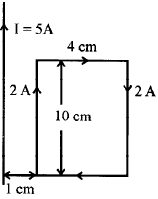
A rectangular loop of wire of size 4cm × 10cm carries a steady current of 2A. A straight long wire carrying 5A current is kept near the loop as shown. If the loop and  the wire are coplanar, find
  1. The torque acting on the loop and.
  2. The magnitude and direction of the force on the loop due to the current carrying wire.
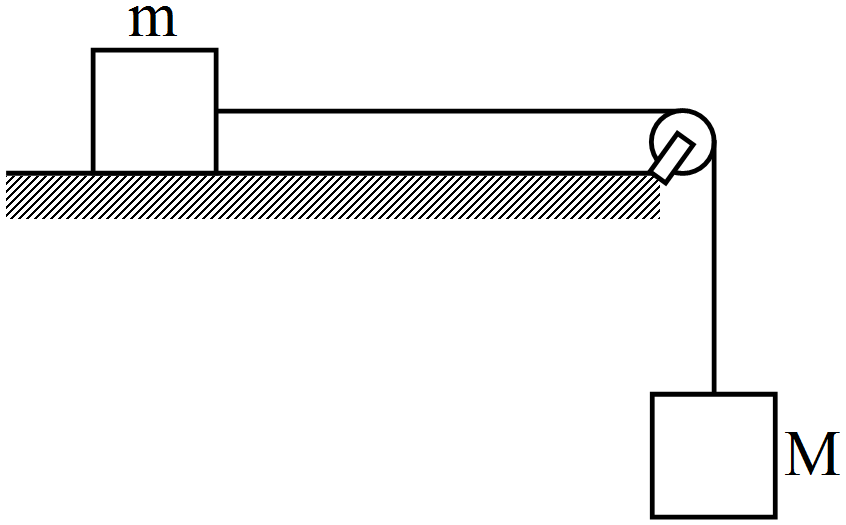
Figure shows two blocks of masses m and M connected by a string passing over a pulley. The horizontal table over which the mass m slides is smooth. The pulley has a radius r and moment of inertia I about its axis and it can freely rotate about this axis. Find the acceleration of the mass M assuming that the string does not slip on the pulley.
A small piece of wood is floating on the surface of a 2.5m deep lake. Where does the shadow form on the bottom when the sun is just setting? Refractive index of water $=\frac{4}{3}.$
In an experiment on photoelectric effect, the slope of the cut$-$off voltage versus frequency of incident light is found to be $4.12 \times 10^{–15} Vs.$ Calculate the value of Planck’s constant.
What is the shortest wavelength present in the Paschen series of spectral lines?
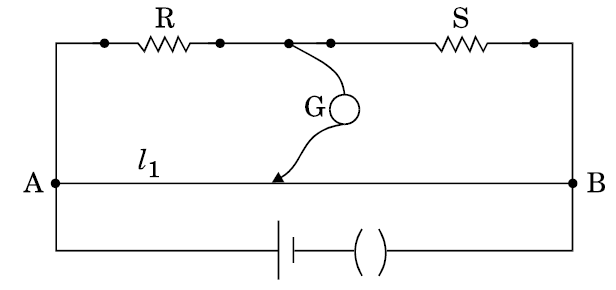
  1. Write the principle of working of a metre bridge.
  2. In a metre bridge, the balance point is found at a distance $l_1$ with resistances R and S as shown in the figure.

An unknown resistance X is now connected in parallel to the resistance S and the balance point is found at a distance $l_2$. Obtain a formula for X in terms of $l_1$, $l_2$ and S.
A solenoid has a core of a material with relative permeability 400 . The windings of the solenoid are insulated from the core and carry a current of 2A. If the number of turns is 1000 per metre, calculate (a) $H$, (b) $M$, (c) $B$ and (d) the magnetising current $I_m$.
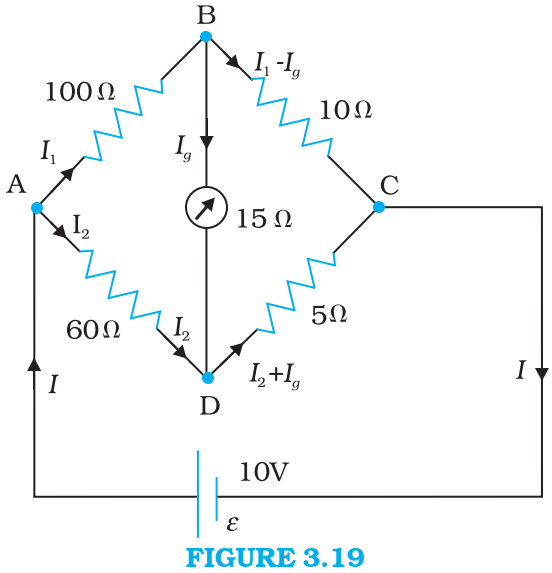
The four arms of a Wheatstone bridge $($Fig. $3.19)$ have the following resistances:
$AB =100 \Omega, BC =10 \Omega, CD =5 \Omega \text {, and } DA =60 \Omega \text {. }$
Image
A galvanometer of $15 \Omega$ resistance is connected across $BD$. Calculate the current through the galvanometer when a potential difference of $10 V$ is maintained across $AC$.
Area of a parallel plate capacitor is A and distance between them is $d$. It is charged with a constant current of I. An element of area $\frac{A}{2}$ is kept in the middle of the plates, parallel to the plates. What is the current flowing through this area?
An electric bulb of volume $250\ cc$ was sealed during manufacturing at a pressure of $10^{-3}\ mm$ of mercury at $27^\circ C.$ Compute the number of air molecules contained in the bulb. Avogadro constant $= 6 \times 10^{23}\ mol^{-1},$ density of mercury $= 13600\ kg/ m^{-3}$ and $g = 10\ ms^{-2}.$