The four arms of a Wheatstone bridge $($Fig. $3.19)$ have the following resistances:
$AB =100 \Omega, BC =10 \Omega, CD =5 \Omega \text {, and } DA =60 \Omega \text {. }$
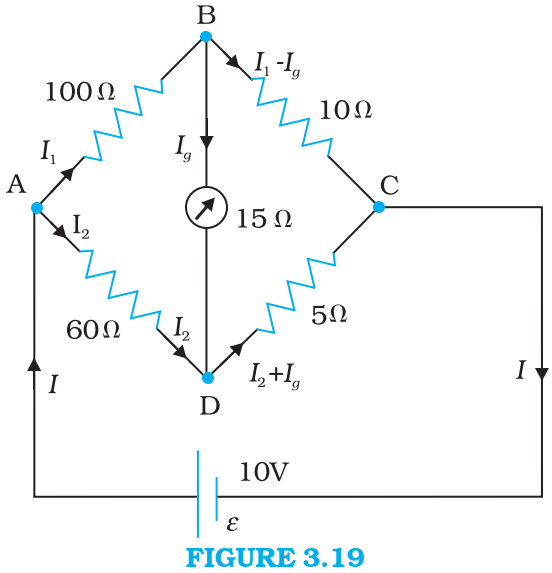
A galvanometer of $15 \Omega$ resistance is connected across $BD$. Calculate the current through the galvanometer when a potential difference of $10 V$ is maintained across $AC$.
$AB =100 \Omega, BC =10 \Omega, CD =5 \Omega \text {, and } DA =60 \Omega \text {. }$
A galvanometer of $15 \Omega$ resistance is connected across $BD$. Calculate the current through the galvanometer when a potential difference of $10 V$ is maintained across $AC$.
Example-(3.7)
Download our app for free and get started
Considering the mesh $\text {BADB,}$ we have
$100 I_1+15 I_g-60 I_2=0$
or $ 20 I_1+3 I_g-12 I_2=0\ {[3.65(a)]}$
Considering the mesh $\text {BCDB}$, we have
$10\left(I_1-I_g\right)-15 I_g-5\left(I_2+I_g\right)=0$
$10 I_1-30 I_g-5 I_2=0$
$2 I_1-6 I_g-I_2=0 \ {[3.65(b)]}$
Considering the mesh $\text {ADCEA},$
$60 I_2+5\left(I_2+I_g\right)=10$
$65 I_2+5 I_g=10$
$13 I_2+I_g=2 \ {[3.65(c)]}$
Multiplying Eq. $(3.65b)$ by $10$
$20 I_1-60 I_g-10 I_2=0 \ {[3.65(d)]}$
From Eqs. $(3.65d)$ and $(3.65a)$ we have
$63 I_g-2 I_2=0$
$I_2=31.5 I_g \ {[3.65(e)]}$
Substituting the value of $I_2$ into Eq. $[3.65(c)],$ we get
$13\left(31.5 I_g\right)+I_g=2$
$410.5 I_g=2$
$I_g=4.87 mA .$
$100 I_1+15 I_g-60 I_2=0$
or $ 20 I_1+3 I_g-12 I_2=0\ {[3.65(a)]}$
Considering the mesh $\text {BCDB}$, we have
$10\left(I_1-I_g\right)-15 I_g-5\left(I_2+I_g\right)=0$
$10 I_1-30 I_g-5 I_2=0$
$2 I_1-6 I_g-I_2=0 \ {[3.65(b)]}$
Considering the mesh $\text {ADCEA},$
$60 I_2+5\left(I_2+I_g\right)=10$
$65 I_2+5 I_g=10$
$13 I_2+I_g=2 \ {[3.65(c)]}$
Multiplying Eq. $(3.65b)$ by $10$
$20 I_1-60 I_g-10 I_2=0 \ {[3.65(d)]}$
From Eqs. $(3.65d)$ and $(3.65a)$ we have
$63 I_g-2 I_2=0$
$I_2=31.5 I_g \ {[3.65(e)]}$
Substituting the value of $I_2$ into Eq. $[3.65(c)],$ we get
$13\left(31.5 I_g\right)+I_g=2$
$410.5 I_g=2$
$I_g=4.87 mA .$

Download our appand get started for free
Experience the future of education. Simply download our apps or reach out to us for more information. Let's shape the future of learning together!No signup needed.*
Similar Questions
- 1The potential difference between the terminals of a battery of emf 6.0V and internal resistance $1\Omega$ drops to 5.8V when connected across an external resistor. Find the resistance of the external resistor.View Solution
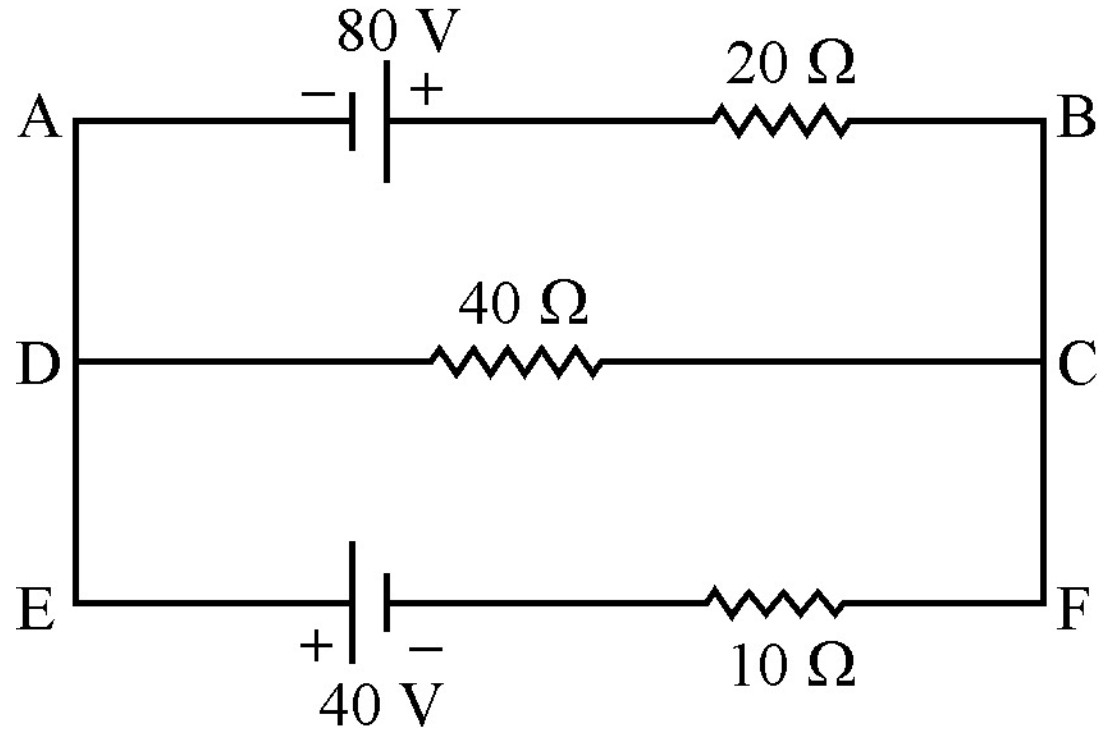
- 2Using Kirchhoff’s rules, calculate the current through the $40\Omega$ and $20\Omega$ resistors in the following circuit:View Solution
- 3The potential difference across a resistor $‘r\ ’$ carrying current $‘I\ ’$ is $Ir.$View Solution
- Now if the potential difference across $‘r\ ’$ is measured using a voltmeter of resistance $‘RV\ ’,$ show that the reading of voltmeter is less than the true value
- Find the percentage error in measuring the potential difference by a voltmeter.
- At what value of $RV,$ does the voltmeter measures the true potential difference?
- 4View Solution
- In a metre bridge [Fig. 3.27], the balance point is found to be at 39.5 cm from the end A, when the resistor Y is of $12.5\ \Omega.$ Determine the resistance of X. Why are the connections between resistors in a Wheatstone or meter bridge made of thick copper strips?
- Determine the balance point of the bridge above if X and Y are interchanged.
- What happens if the galvanometer and cell are interchanged at the balance point of the bridge? Would the galvanometer show any current?
- 5View SolutionAn electric bulb, when connected across a power supply of 220V, consumes a power of 60W. If the supply drops to 180V, what will be the power consumed? If the supply is suddenly increased to 240V, what will be the power consumed?
- 6What are the advantages of the null$-$point method in a Wheatstone bridge? What additional measurements would be required to calculate $R_{unknown}$ by any other method?View Solution
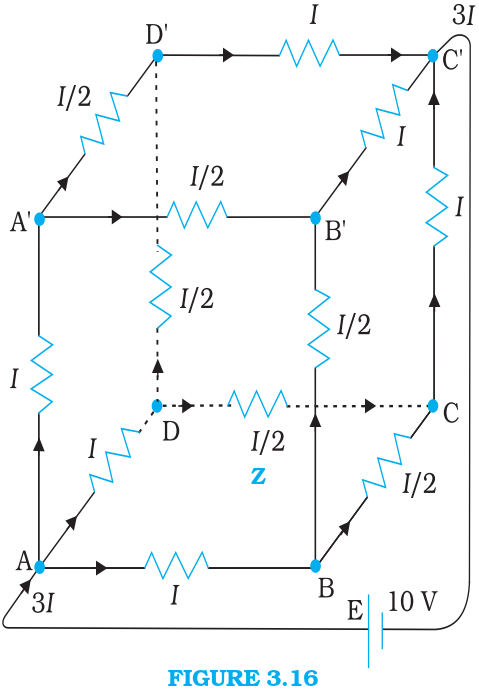
- 7A battery of $10 V$ and negligible internal resistance is connected across the diagonally opposite corners of a cubical network consisting of 12 resistors each of resistance $1 \Omega$ (Fig. 3.16). Determine the equivalent resistance of the network and the current along each edge of the cube.View Solution
- 8View SolutionFor the potentiometer circuit shown in the given figure, points X and Y reprensent the two terminals of an unknown emf E'. A student observed that when the jockey in moved from the end A to the end B of the potentiometer wire, the deflection in the galvanometer remains in the same direction.

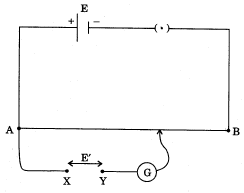 What may be the two possible faults in the circuit that could result in this obsevation?
If the galvanometer deflection at the end B is (i) more, (ii) less, than that at the end A, which of the two faults, listed above, would be there in the circuit?
Give reasons in support of your answer in each case. - 9Three resistors $1\ \Omega,\ 2\ \Omega$ and $3\ \Omega$ are combined in series. What is the total resistance of the combination?View Solution
If the combination is connected to a battery of emf $12 V$ and negligible internal resistance, obtain the potential drop across each resistor. - 10A wire $AB$ is carrying a steady current of $12 A$ and is lying on the table. Another wire $CD$ carrying $5A$ is held directly above $AB$ at a height of $1 mm.$ Find the mass per unit length of the wire $CD$ so that it remains suspended at its position when left free. Give the direction of the current flowing in $CD$ with respect to that in $AB.$ $[$Take the value of $g = 10 ms^{–2}]$View Solution